In the food, FMCG, and dairy businesses, packaging has traditionally been viewed as a functional necessity—protecting the product, preserving shelf life, enabling efficient logistics, and communicating brand identity on the shelf. Over the years, manufacturers have invested heavily in packaging machinery, materials, automation, and quality systems to ensure speed, consistency, compliance, and scale. Yet, despite this sophistication inside the factory, a fundamental gap remains unresolved that requires consumer friendly tech solutions as suggested below.
Modern packaging lines are highly optimized. High-speed form-fill-seal machines, fillers, cappers, checkweighers, vision systems, and palletizers operate with remarkable precision. Quality systems monitor seal integrity, weights, rejects, and deviations. From the factory’s perspective, packaging is one of the most controlled and data-rich parts of the operation.

Once a product leaves the packaging line and reaches the consumer, the feedback loop breaks. The pack becomes silent. The real experience—how the pack is opened, handled, stored, and perceived—remains largely invisible until something goes wrong. This is the gap and let’s look a how consumer feedback is understood today.
Most food, FMCG, and dairy organizations learn about consumer dissatisfaction through indirect signals: customer complaints, distributor feedback, retailer returns, call-center escalations, or social media posts. By the time this information reaches packaging, quality, or operations teams, it has passed through multiple layers.
Context is diluted. Timelines blur. Root-cause analysis becomes difficult.
More importantly, feedback is skewed. Satisfied consumers rarely report positive experiences. Dissatisfied consumers surface only after frustration crosses a threshold. As a result, packaging improvements—whether related to seal quality, material choice, opening convenience, or logistics damage—are often reactive rather than preventive.
The limits of market segmentation
Marketing teams have long relied on segmentation to understand consumers. Buyers are grouped by age, income, geography, or buying behavior, and packaging designs are optimized accordingly.
While segmentation remains useful, it treats consumers as averages. In reality, every purchase is an individual decision!
A consumer buying a packaged food or dairy product is influenced by context: urgency, trust, familiarity, prior experience, ease of opening, confidence in sealing, storage convenience, and perceived freshness. Two consumers within the same segment may respond very differently to the same packaging. This leads to an important question for modern brands: Can every customer be treated as a segment of one?
What packaging teams really need to know
From a packaging and quality perspective, the most valuable questions are rarely captured systematically:
- Why did the consumer choose this product at this moment?
- Is this a first-time purchase or a repeat purchase?
- Was the pack easy to open, pour, or reseal?
- Did the packaging inspire confidence in freshness and safety?
- Was there leakage, spillage, or damage?
- How was freshness perceived after opening?
- Would the consumer buy the product again?
- What one improvement would enhance the experience?
These insights are far more valuable than periodic surveys or generic satisfaction scores. However, traditional methods—emails, apps, or long forms—create friction. Most consumers are unwilling to type feedback for everyday products. At the same time, many consumers are willing to spend 20–30 seconds speaking, provided the experience is simple and intuitive.
Where AI enters packaging
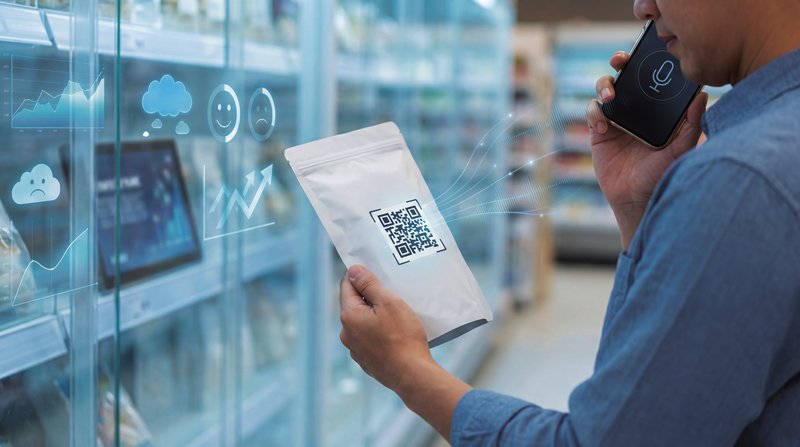
Advances in artificial intelligence, voice interfaces, and mobile technology now make it possible to add a listening layer to packaging—without changing pack formats or disrupting packaging lines. A simple QR code printed on a pouch, bottle, carton, or label becomes the trigger. When scanned, it connects the consumer directly to a brand-owned interaction layer.
The intelligence does not reside on the pack itself. The pack becomes an interface—linking the physical product to a digital listening system.
Text-only questionnaires: the practical first layer
To make listening packaging viable at scale—especially for high-volume, low-margin products—the default interaction must be simple and economical. When a consumer scans the QR code, they are first presented with a text-only questionnaire. This approach:
- Loads instantly on any smartphone
- Requires no app downloads
- Has near-zero marginal cost
- Captures structured, actionable data
Typical questions may include:
- Reason for scanning (feedback, complaint, information)
- Product or SKU
- Short text description
- Optional contact consent
For the majority of consumers, this is sufficient. Text allows brands to listen at scale while maintaining full cost control and providing clean, analyzable data.
Where voice adds value—and why it must be gated
Voice is introduced as a secondary, optional layer, not the default. Voice interaction is enabled only where it adds genuine value, such as:
- Quality or safety complaints
- Packaging failures (leakage, seal issues, breakage)
- Situations requiring explanation or emotional context
In these cases, the voice experience is:
- Intent-specific
- Time-bound
- Designed to conclude in seconds, not minutes
This ensures that voice delivers clarity and empathy without exposing brands to uncontrolled interaction costs.
Designing for ease of participation
Whether text or voice, user experience is critical. The interaction must respect the consumer’s time.
- No complex navigation
- No long instructions
- No unnecessary data entry
Voice mirrors natural human communication. Consumers simply scan and speak. Text provides a fast alternative for those who prefer typing or are in noisy environments.From feedback to packaging intelligence AI can convert text and voice inputs into structured insight:
- Transcription and classification
- Detection of recurring issues (leakage, opening difficulty)
- Sentiment trends by geography, SKU, or batch
Because feedback is captured at the point of consumption, insights can be generated quickly—allowing faster corrective action in packaging design, materials, sealing parameters, and distribution practices.
Traceability meets conversation
The same QR code can integrate with track-and-trace systems. When required, feedback can be linked to a specific batch, line, or production date. When not required, insights can remain anonymous. The flexibility lies in system design, not in technology limitations.
From passive packs to active dialogue, as automation and AI mature inside factories, the next frontier lies outside them—at the moment the consumer opens the pack. Listening packaging closes the loop between packaging operations, quality systems, and real consumer experience. Packaging evolves from a silent container into an active interface—one that listens, learns, and informs better decisions.
Three QR codes are provided below: one linking to our website, one opening a voice-based demonstration using a free desktop voice interface purely for illustrative purposes, and the third which opens a text-only feedback interface representing the most scalable real-world deployment model.
What if every package could listen?


K Ravi The is a packaging and automation consultant with over four decades of experience in food, FMCG, and dairy manufacturing, spanning packaging machinery, shop-floor operations, and quality systems. He currently focuses on applying AI and digital platforms, including RAAS Intellibox, to convert packaging data and consumer feedback into actionable operational insight. Visit Raas IntelliSolutions. Scan the code below