What if the material shaping the future of sustainability isn’t steel, plastic, or concrete — but paper? Corrugated packaging, once seen merely as a humble shipping box, is now redefining industries, design, and innovation, proving that strength and sustainability can go hand in hand.
From protecting fresh produce in rural mandis to delivering smartphones ordered online, corrugated packaging has become the invisible backbone of the global supply chain. Its unique structure — fluted paper sandwiched between linerboards — provides exceptional strength while remaining lightweight and energy-efficient. This strength-to-weight advantage allows it to carry heavy loads while being cost-effective and environmentally responsible.

But the story of corrugated packaging no longer ends with logistics.
When the world watched the Tokyo Olympics, few realised that athletes were sleeping on beds made from corrugated cardboard frames. Designed to be lightweight, sturdy, and fully recyclable, these beds demonstrated how engineered paper could replace conventional materials in large-scale institutional settings. Around the world, corrugated boards are now used in disaster relief shelters, temporary hospitals, modular furniture, portable toilets, exhibition stalls, and even cardboard coffins — proving that wonders can indeed be created out of cardboard.
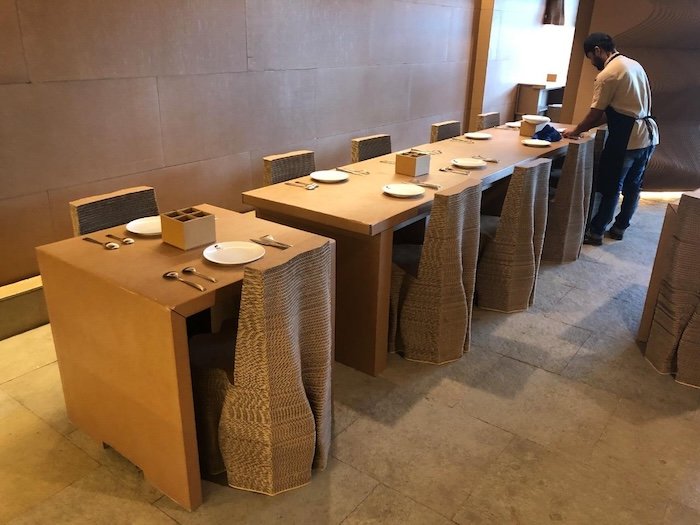
Can you imagine a restaurant built almost entirely from corrugated material? Mumbai once had a themed café called ‘Cardboard’ in Bandra Kurla Complex, where corrugated cardboard was used as a core design and architectural material. From tables and chairs to light fixtures, wall panels, signage, and menu cards, cardboard wasn’t just décor — it was everywhere. The eco-friendly café became the talk of the nation before it closed during the Covid pandemic.
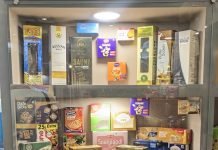
These innovative applications were showcased at the curtain raiser programme of the forthcoming ICCA Global Summit 2027 held at Hitex, Hyderabad. Telangana special chief secretary Sanjay Kumar, who attended as chief cuest, expressed amazement at the versatility of corrugated packaging material.
Referring to the Olympic beds, he said he was astonished to learn that corrugated hospital-style beds could support multiple adults. The artefacts displayed at the event included a statue of Mahatma Gandhi, a giant Charminar replica, a large welcome mannequin, massive hospital bed prototypes capable of holding five people, and even the event podium — all crafted entirely from corrugated boards.
Designers and architects are increasingly exploring corrugated board as a serious creative medium. Entire cafés, retail interiors, trade show booths, sculptures, installations, and even life-sized statues are being conceptualised using engineered paper structures. Its acoustic properties, insulation capabilities, ease of customisation, and biodegradability make it an attractive alternative in an era searching for greener building materials.
One such innovator is Haresh Mehta of Jayna Packaging, Mumbai, often described as a “wonder man of cardboard.” The 74-year-old designer has devoted his life to pushing the boundaries of corrugated creativity. With over 65 designs and patents to his credit and several more in progress, he creates everything “from cradle to coffin” using cardboard and panels. He manufactures furniture, exports globally, produces wood-free canvas, and has even built a boat measuring 88 by 25 by 9 feet using corrugated material. He has designed portable toilets and single-person homes made entirely from cardboard structures.
A cancer survivor, Mehta says he never missed a single day at work during his illness. “My work is worship,” he often remarks. His dream is to establish a museum showcasing innovative cardboard creations and to build giant installations of iconic figures such as Mahatma Gandhi, Mother Teresa, and Shivaji Maharaj. He has also expressed a desire to create large-scale replicas of Hyderabad landmarks such as Charminar and the Buddha statue, provided local support is available.
Eleni Despotou, chief executive officer of the International Corrugated Case Association (ICCA), who travelled to Hyderabad for the event, emphasised that corrugated packaging is among the most recyclable materials globally. She noted that sustainability discussions inevitably bring corrugated packaging to the forefront due to its high recyclability and renewable nature.
Two Hyderabad-based leaders hold top positions in ICCA’s global leadership. ML Agarwal, chairman of Central India Packaging, is chairman of the ICCA board of directors — the first Indian to hold this position in the association’s 64-year history. Ankit Agarwal, managing director of Central India Packaging, serves as India director on the ICCA Board and is also president-elect of FCBM.
Beyond innovation, corrugated packaging is also an economic powerhouse. It supports thousands of MSMEs, generates employment across manufacturing, logistics, and recycling, and drives advancements in automation, digital printing, and smart packaging design. With the rapid expansion of e-commerce, pharmaceuticals, FMCG, electronics, and food delivery sectors, demand for sustainable, high-performance packaging continues to rise. Corrugated boards are evolving alongside this growth, incorporating moisture resistance, enhanced strength, branding capabilities, and smart tracking features.
As Hyderabad prepares to host the ICCA Global Summit 2027 in January next year, the city is poised to witness even more extraordinary applications of cardboard. In an age where sustainability is no longer optional, corrugated packaging offers endless possibilities for innovation, resilience, and growth. It reminds us that sometimes the most transformative solutions are hiding in plain sight — folded neatly into the shape of a box.