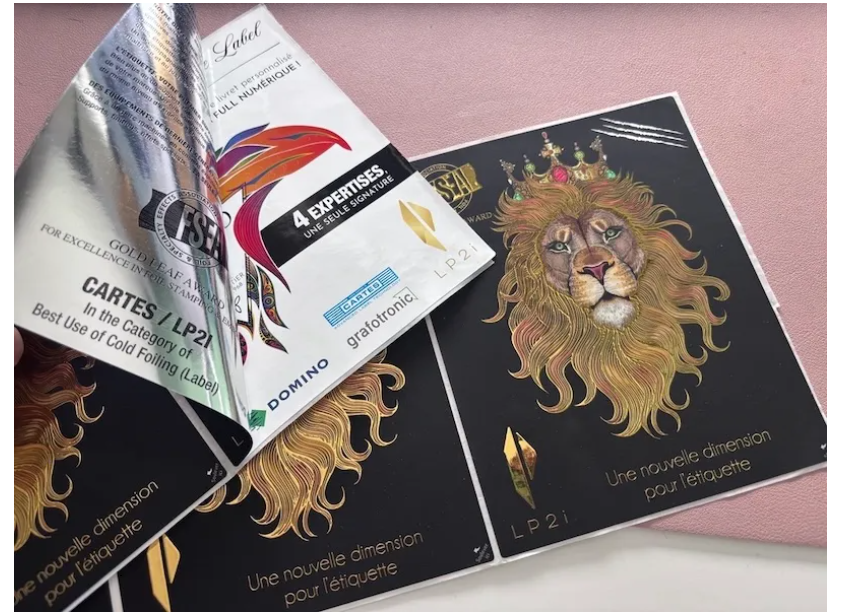
The French label converter LP2i Étiquettes installed a hybrid printing solution from Domino to enable it to digitally print multi-layer extended content and peel-and-reveal multi-layer labels as an alternative to single-sided labels.
Patrice Néri, managing partner of LP2i Étiquettes, says his customers have increasingly more constraints regarding the information they need to include on their labels, adding, “Unfortunately, the label is limited in space due to its format, and we often work with small formats, yet they have more and more information to include on their labels.”
He says that new environmental regulations are aimed at reducing instruction leaflets and packaging, noting, “So, they find themselves having to provide as much information as possible and also comply with certain legislation.”
The solution he came up with was to print directly on top of the adhesive layer, as he explains, “So printing on glue will allow us to make a booklet, three pages or even five pages.” This means that every part of the label, from the first page through to additional panels and stubs, can be fully customized.
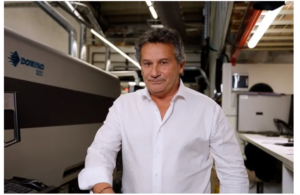
LP2i Étiquettes was set up by Patrice Néri in 1989 and has concentrated on adhesive labels since 2010. In 2013, the company transitioned to digital production. He notes, “Label manufacturing is a perpetual challenge, and you always have to innovate, move forward, invest in new technologies that you don’t have.”
The new print line is made up of a Domino K600i monochrome inkjet printer followed by a Domino N730i Integration Module, which is the N730i print unit configured to run within a flexo line rather than its own winder/ rewinder.
The Domino units fit within a Grafotronic web-handling and finishing line, which includes the winders and rewinders and supports the assembly of the printed layers in a secondary process. It’s complemented by an inspection system from Lake Image Systems, which is also part of the Domino group.
The K600i digitally prints monochrome variable data onto the adhesive side of the label during the delamination stage, similar to how it would be done in a flexo process, but with the added benefit of digital variability. Once printing on the adhesive has been completed, the material is relaminated. Then the N730i print engine prints the front of the label as normal, with the option to apply variable data there as well. Together, the two systems enable variable data to be applied in places that a single engine alone can’t achieve.
Néri says, “What has impressed us most is how easily we can now produce multi-page prints for our clients. That’s fantastic because before, we did it digitally, using lamination, layering several sheets on top of each other, which involved technical constraints that we no longer have. It increases our productivity and profitability because we save on materials and time.”
Patrice’s son Axel Néri, who works as an Operator at LP2i Étiquettes, says that the K600i was new to him, but he’s happy with the time that it saves: “We’ve saved a huge amount of time on booklets and everything else. I can also do spot printing on the back, which is very easy, and all while reprinting with the N730i, which is right behind it. And that has been revolutionary.”
The heart of the system is the N730i module, of which Patrice Néri says: “The N730i is a latest-generation model with 1200 x 1200 resolution and, most importantly, a colour gamut that closely matches traditional standards.”
LP2i Étiquettes has also taken advantage of the high-speed productivity mode that Domino announced last year for the N730i unit, and which boosts the speed from the standard 70 meters per minute to 90 mpm. This is a software that involves dropping the resolution slightly from 1200 x 1200 dpi to 1200 x 900 dpi. It makes use of all seven colors, which include CMYK plus orange, violet, and white, though as Michael Matthews, Domino’s global product manager, points out, “There would be a slight reduction in opacity on white, due to the slightly lighter ink film we are putting down. However, the lighter ink film actually has a net positive for most with sharper detail on small text, for example.”
Vivien Sol, Quality Manager, LP2i Étiquettes, says, “The Domino press gives us greater control over the printing process, especially in terms of repeatability, print quality, and 100% line control.”
He goes on to say that the inspection system also plays its part in this, “We manage detected non-conformities in two stages. First, we have direct control thanks to the camera and the software, which provides us with real-time alerts for any label that shows an anomaly. This allows us to prevent any problems that might arise at the client’s site. Secondly, all anomalies and footage captured by the camera are stored on servers, enabling us to review and retrieve data afterward. Today, our clients have high-quality standards. They demand measurable, quantifiable values that conform to their specifications.”
Neri concludes that he would recommend a Domino press if he had to do it again, adding, “And perhaps I myself will soon be getting a second one.”