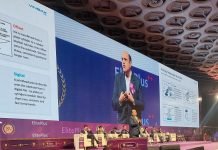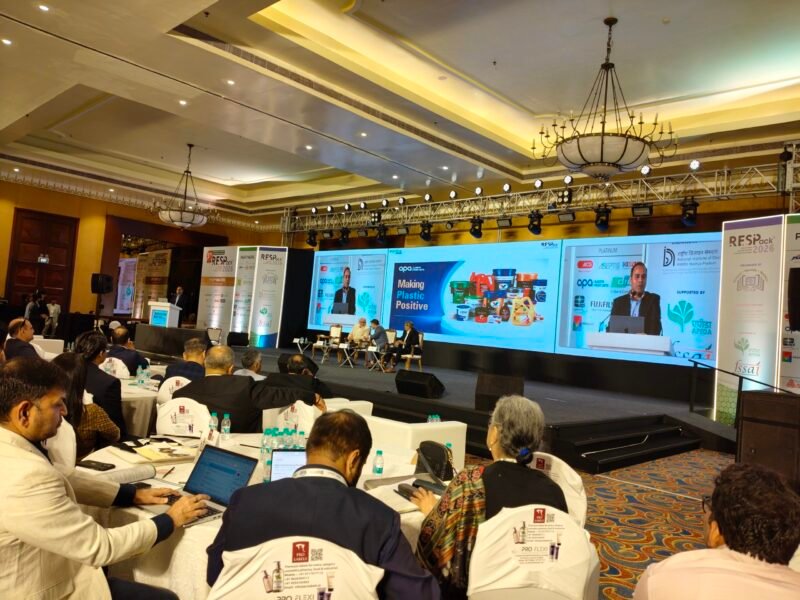
In-mold labelling (IML) offers one of the most practical pathways to improving the sustainability of plastic packaging without compromising functionality, aesthetics or recyclability, Vikas Khanna of Ajanta Print Arts said at a presentation at Respack 2026 in Mumbai.
Addressing delegates at the packaging industry event, Khanna argued that plastics should not be viewed solely through the lens of environmental criticism. Instead, the industry should focus on redesigning packaging systems to make them easier to recycle and more resource-efficient.
“Plastic is a great material. It reduces transportation waste. It preserves hygiene. It’s hard to imagine a world without plastic,” Khanna said. “But, can we redesign plastic packaging to work more responsibly for the future? Not eliminate plastic, not defend plastic, but engineer the packaging.”
Khanna explained how many recycling challenges stem not from plastic itself but from the combination of multiple materials within a single package. Labels made from paper, PVC, PET and other substrates often complicate the recycling process by requiring separation and additional handling.
He presented IML as a solution that integrates the label directly into the container during the moulding process. A pre-printed label is placed inside the mold before molten polymer is injected, allowing the label and container to fuse into a single structure.
“The label and the container are the same polymer family. They do not get glued together later. They get fused during the molding process,” he said.
According to Khanna, the approach eliminates secondary labelling operations and creates mono-material packaging that can move through recycling streams more efficiently.
“IML removes all of that. The label and the container are of the same polymer. One material, nothing to separate, nothing to strip out. That’s mono-material packaging. And that’s what the planet needs,” he said.
Beyond sustainability, Khanna highlighted the branding and performance benefits of the technology. IML enables full-container decoration, premium finishes, tactile textures, metallic effects, gloss and matte combinations, and transparent ‘no-label’ appearances while maintaining durability throughout the product lifecycle.
“One thing is to design and make a great label. But getting it to survive the life of the product is a different challenge,” he said, noting conventional labels can suffer from peeling, wrinkling, fading and moisture damage during transportation and retail display.
While acknowledging that IML requires investments in robotics, molds, training and tooling, Khanna said the economics become attractive once secondary labeling operations are removed.
“The ROI or initial investments can be achieved in 12 to 24 months. So no secondary labeling line, no adhesive, no liner waste, no additional floor space, less power, less labor and less inventory management,” he said.
Khanna stressed that IML is not the answer for every packaging application but believes it represents the most effective sustainability solution currently available for polypropylene rigid packaging.
“If I stood here today and told you that in-mold labeling is the best solution for a sustainable choice for every packaging, that would be false,” he said. “But as a label supplier in today’s time, we see IML as the best solution for polypropylene rigid packaging.”
Ajanta Print Arts currently works with more than 100 IML molders across India, produces over 4mn labels daily and serves around 1,000 brands across multiple industry sectors.