The jam-packed first day of the ElitePlus Injection, Blow Moulding & PET International Summit and Exhibition on 30 June 2026 in Mumbai yielded a potent dose of inspiration, information, and knowledge about a well-organized industry sector. Apart from Indian and global suppliers of polymers and additives, machinery, plastics, and packaging converters and recyclers, leading consumer brand owners spoke about abundant domestic growth opportunities and increasing global penetration.
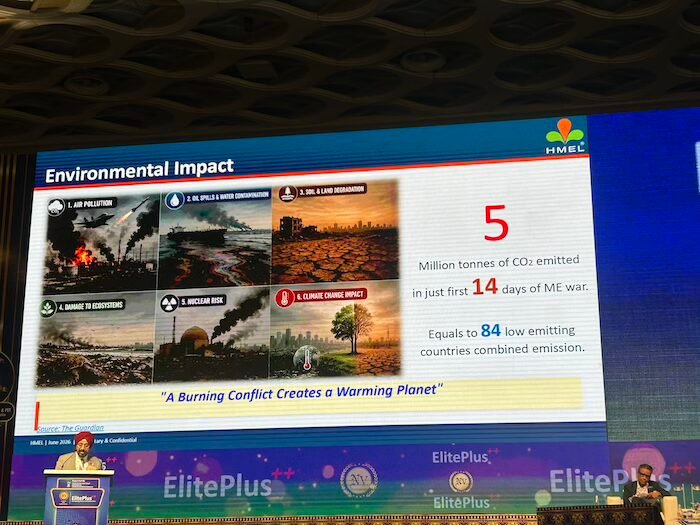
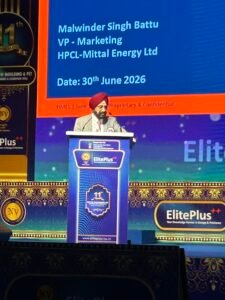
The assembly of 1,300 to 1,400 participants and delegates and 60 partners from 30-plus countries, listened to messaging that dared to discuss the impact of the ongoing wars on the Indian plastic industry and their negative effects on real global sustainability. As MS Battu of HPCL-Mittal Energy pointed out, the first 14 days of destruction in the US-Israeli war on Iran, emitted 5 million tons of CO2, equal to the combined CO2 emissions of 84 low-emission countries. “A burning conflict creates a warming planet. . . Apart from the thousands dead and wounded, the effects on fuel, fertilizer, and food prices, geopolitical conflicts ripple through the lives of billions,” he said.
Pointing to another contemporary sustainability paradox, Battu said that data centers for Artificial Intelligence consumed 4.5 trillion liters of water in 2025, equivalent to the annual needs of 600 million people in sub-Saharan Africa. They generated 189 million tons of CO2, with the carbon intensity of their electricity being 48% higher than average electricity use in the United States. He nevertheless pointed to India’s steady and responsible improvement in the global sustainability index to 99th position and demonstrated the positive role of polyolefins in preventing food loss and waste.
The complex mix of ancient belief systems, storytelling, technology, examples, and even sales presentations turns the ElitePlus conference into a knowledge experience. Vagesh Dixit of global packaging technology supplier Alpla, with eight plants in India, unflinchingly linked traditional wisdom with the current requirement of pulling up our socks. “Has the lava of Kalyug eroded our sanity when schoolteachers are at the bottom of our salary pyramid?” he asked. “Process and manufacturing excellence require spiritual discipline, and empowerment is the solution, not merely delegation.” He ended by saying that the opportunity for the Indian plastics manufacturing industry is, “To become not merely the workshop of the world but its conscience!”
Opportunities, resilience, and recovery
The oil, polymer, and additive marketing companies and several forecasters spoke about the domestic and global opportunities for the industry. The Indian plastic industry is likely to grow by 1.2 or 1.3 times the GDP growth, they said. Adding that the global plastic trade amounts to US$1 trillion, whereas India’s plastic exports are at 1.1% or US$13 billion. Vikram Bhadhauria of Alok Masterbatches and the Plexcouncil chairman, spoke eloquently about the long-running joint effort of the industry in working with the government that has yielded positive results in several Free Trade Agreements awaiting implementation and more on the cards. However, as with the other industry leaders who spoke, he cautioned that quality and compliance with the new EU rules on packaging sustainability, which will come into effect this August, are essential.
Divy Malick of McKinsey & Co spoke of the US-Israel war on Iran undermining the relatively benign period of oil resources that preceded 28 February 2026. Speaking of the war’s effect, particularly on India, he said that while inputs for fertilizer were the most deeply affected since they had the lowest reserves, PP suffered a rise in prices between 50 to 75%, while PET and MEG were more resilient with better reserve inventories and a lower rise in prices. While Malick expects that it may take two to four months after the war ends for the flow of oil feedstocks to recover, he forecasts slower demand growth partly because of the moderation in Chinese capacity expansion. Global trends such as the rationalization of inefficient industry assets, rising market protectionism, and the increased regionalization of the raw material supply chain are also likely. Finally, he acknowledged that the recent trend of global companies to prioritize profits over sustainability investments and efforts will intensify going forward. Nevertheless, the petrochemical industry is looking at resilience, efficiency, and technologically led transformation.
Domestic growth and exports require trust and value
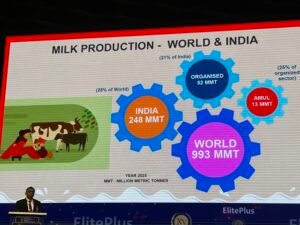
Among the brand owners’ presentations, Amul, Bisleri, and Reliance Consumer Products spoke about responsibility and growth. Jayen Mehta of Amul and the GCMF said that his company is really an information technology company in the business of cooperative agriculture and marketing. Apart from being the world’s leading cooperative organization, it generated revenues exceeding Rs 1,00,000 crore (US$ 11 billion) in the past year, far exceeding the turnover of Hindustan Unilever and Nestle in the country. Saying that the company’s currency is trust, he expects not only the global expansion of the brand with Amul’s full-cream milk already available in 38 of the 50 states in the US, but also that the cooperative model that the company has pioneered to be extended to other countries. He added that there is an opportunity to add one company the size of Amul each year in the country.
Dr Angelo George of Bisleri International spoke about various consumer trends and challenges for the plastic packaging industry, such as the fact that 80% of the recycling capacity is limited to only 7 states in the country. Forecasting that sustainability will expand beyond plastics, he asked, “How do we make consumers participate in circularity.
Vaibhav Tandon of Reliance Consumer Products stated that while consumer expectations are changing, value remains the first consideration of the Indian consumer. There is a perceptible change in preference from functional to sustainable, and another trend is a kind of personalization of various aspects of packaging, including different-sized formats.
The Elite conference is packed with ideas and learning. Look for more gatherings of information, observations, and insights in this space. The networking is also dynamic at the event where one meets knowledgeable practitioners and brand owners at the leading edge of difficult changes.