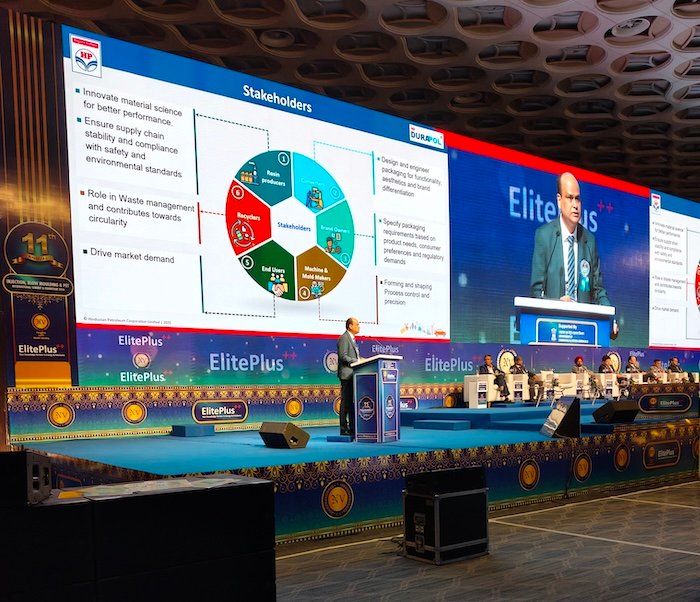
Advanced polymers, sustainable materials and greater collaboration across the packaging value chain will drive the next phase of growth in the rigid packaging industry, according to Saugata Chaudhuri, head of petrochemicals at Hindustan Petroleum Corporation Ltd (HPCL).
Speaking at the 11th Injection, Blow Moulding & PET International Summit & Exhibition 2026 in Mumbai, Chaudhuri said plastics have evolved into an essential component of modern packaging because of their lightweight design, durability and cost efficiency.
Rigid plastic packaging now serves a broad range of industries, including food and beverages, dairy, healthcare and ready-to-eat meals, each requiring specialized performance characteristics such as oxygen barriers, carbon dioxide retention, heat resistance and sterilization compatibility.
He noted that innovation in rigid packaging is being driven by three key pillars—sustainability and circularity, enhanced functionality and changing consumer preferences. Increased use of post-consumer recycled (PCR) materials, lightweighting, design for recyclability, improved barrier properties and smart packaging technologies are reshaping product development while helping manufacturers meet evolving sustainability goals.
According to Chaudhuri, the rigid packaging ecosystem relies on close collaboration among polymer producers, converters, brand owners, machinery manufacturers, mold makers, consumers and recyclers, each playing a critical role in improving product performance and advancing circularity.
He highlighted several emerging materials that could transform the sector, including polyethylene furanoate (PEF), polymer nanocomposites, cyclic olefin copolymers (COC) and fluorinated polymers.
PEF, a fully bio-based polymer produced from renewable feedstocks, offers oxygen barrier properties six times higher than conventional polyethylene terephthalate (PET) and three times greater carbon dioxide barrier performance, making it suitable for hot-fill packaging applications.
Polymer nanocomposites can significantly improve the mechanical strength, thermal stability and gas barrier performance of conventional plastics with only small additions of nanofillers, opening opportunities in demanding food and industrial packaging applications.
Chaudhuri described cyclic olefin copolymers as one of the most promising next-generation materials for rigid packaging because of their high transparency, chemical resistance, dimensional stability and superior moisture barrier properties. He said the material could find applications in medical packaging, food packaging and extrusion blow-molded containers.
He spoke about fluorinated polymers for high-density polyethylene (HDPE) and polypropylene containers, noting that surface fluorination improves chemical resistance, reduces permeation and enhances coating performance. However, he acknowledged concerns surrounding polyfluoroalkyl substances (PFAS), saying environmental and regulatory issues associated with these materials would need to be addressed.
Looking ahead, Chaudhuri said global demand for rigid plastic packaging is expected to continue growing, supported by innovation in sustainable materials and increasing demand across Asia. He estimated that plastic consumption in rigid packaging would rise from about 68mn tonnes currently to around 80mn tonnes by 2030.
Despite the positive outlook, he said the industry must overcome challenges including plastic pollution, inadequate recycling infrastructure, inconsistent waste collection systems and the need to balance sustainability with material performance.
Chaudhuri said greater investment in recycling infrastructure, harmonized standards and commercially viable sustainable materials would be essential to unlocking the full potential of rigid plastic packaging while supporting the industry’s transition towards a circular economy.