The innovations in sustainable flexible packaging session at FoodTekPack in Gandhinagar had three parts. The first part presented the various challenges in developing new laminate structures with barrier properties considered safe for food products and also recyclable. The second and third parts discussed flexography, standardization, and extended color gamut flexo printing.
Based on Dr Ajay Neema’s presentation, Naresh Khanna spoke about the three broad categories of food products that need various levels of barriers to gas, moisture, light, aroma, and fat. In addition, a workable flexible pouch for food also requires sealing integrity and overall burst strength and toughness.
While increasing levels of complexity are needed for the most aggressive or sensitive food products, the forces at work and accelerating the change for new structures are regulation, performance, sustainability, and packaging complexity. Examples of a recyclable PE monomaterial structure were shown, which essentially have an outer PE print layer, an inner core PE layer for strength and barrier performance, and an inner PE seal layer. These structures also require bonding or tie layers in between.
To achieve the required barrier, limited but permissible for recycling materials such as EVOH, aluminum metallizing, or nylon are conventionally used. Had Dr Neema been present, he would have perhaps revealed some new ideas for a barrier additive he is working on at Alok Masterbatches.
The session proceeded with a presentation by Kirti Panchal of Echaar Equipments, who spoke about his company’s indigenous development over the past decade of flexo printing machines and CI flexo presses in several versions of speed and complexity. He emphasized the company’s engineering capabilities to extremely high tolerances, as a significant supplier to the energy and defense industries.
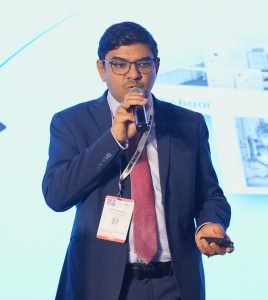
Panchal explained how flexography works and its advantages in terms of its ability to handle thinner substrates, with less material wastage, and faster changeover in comparison to other technologies. He spoke about new trends in CI flexo presses that increasingly incorporate automation to streamline operations by guiding operators through setup processes, enhance productivity, and reduce errors. New trends, he said, include hybrid presses incorporating digital printing stations, inline holography, and the use of (ECG) extended color gamut printing.
Explaining the functioning of a CI flexo press, he pointed to high-tech features that are now being incorporated into these, such as automated plate registration and a coating unit within the system. Of Echaar’s six Indian flexo customers, four are in Western India. Panchal made clear that while the press has found both leading Indian flexible packaging customers as well as export customers in Russia, Sri Lanka, and Africa, the company sees itself as a company still learning about flexo technology. It is continuously investing in research, development, and in-plant training to take it to a level where it is chosen by customers for its superior performance.
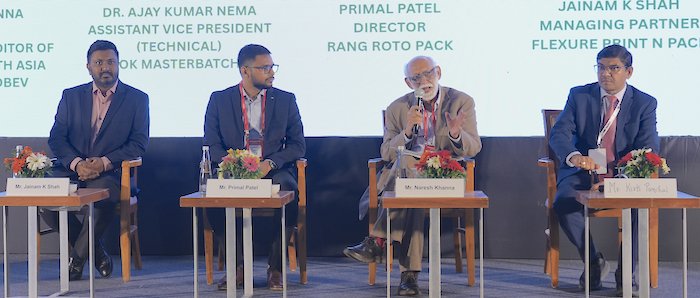
The presentation was followed by a panel discussion moderated by Naresh Khanna on the progress of standardization in flexo printing in India and its challenges. Primal Patel of Rang Roto in Ahmedabad, who uses a Pelican gravure press and a Multitec label press for flexible packaging, and Jainam Shah of Flexure, also in Ahmedabad, an Echaar CI flexo user, joined the panel with Kirti Panchal.
The discussion centered on the need for standardization and the difficulties it presents, including the investments in instrumentation, prepress technology changes, software, and other changes in management and pressroom behavior. Both Patel and Shah have been working on standardizing their flexo press operations with a view to possible migration to extended color gamut printing.
When the moderator asked Panchal if his presses in the field were ready for the high level of standardization and ESG printing, he was frank enough to admit that some automated pressure-setting improvements could be useful. While Patel and Shah have achieved outstanding quality on their gravure and flexo presses and are experimenting with extended color gamut printing, they explained that it is a serious exercise and fully changing over may require a commitment that may disrupt their current workload. According to them, the next step would require purchasing a second flexo press, dedicated to ECG printing.
Khanna said that while standardization is a prerequisite to attempting ECG printing, it requires a change of mindset among brand owners and converters. Brand owners and converters need to understand its benefits, including the possibility of running several SKUs on the same web side by side, which would greatly improve the economy of short-run flexible packaging.
He also explained that this will require serious investment in technology, time, materials, and effort. Selecting one set of standardized anilox rolls, standardized ink use right out of the box, full and repeated calibration of prepress, flexo plates, the press, and significant investment in pressroom ambient conditions and training are necessary. Collaboration in the entire ecosystem of brands, suppliers and converters is needed.
While the ultimate cost and climate savings indicate the necessity of standardization and ECG printing, he said, brand owner customers will also have to learn and adapt their designs and prepress work. Naming several leading flexible packaging printers in Europe, South Asia, and India that have mastered ECG printing, he said, “More are needed so that brand owners can have competitive choices for this advanced, quality-consistent, and cost-saving improvement in each region.”