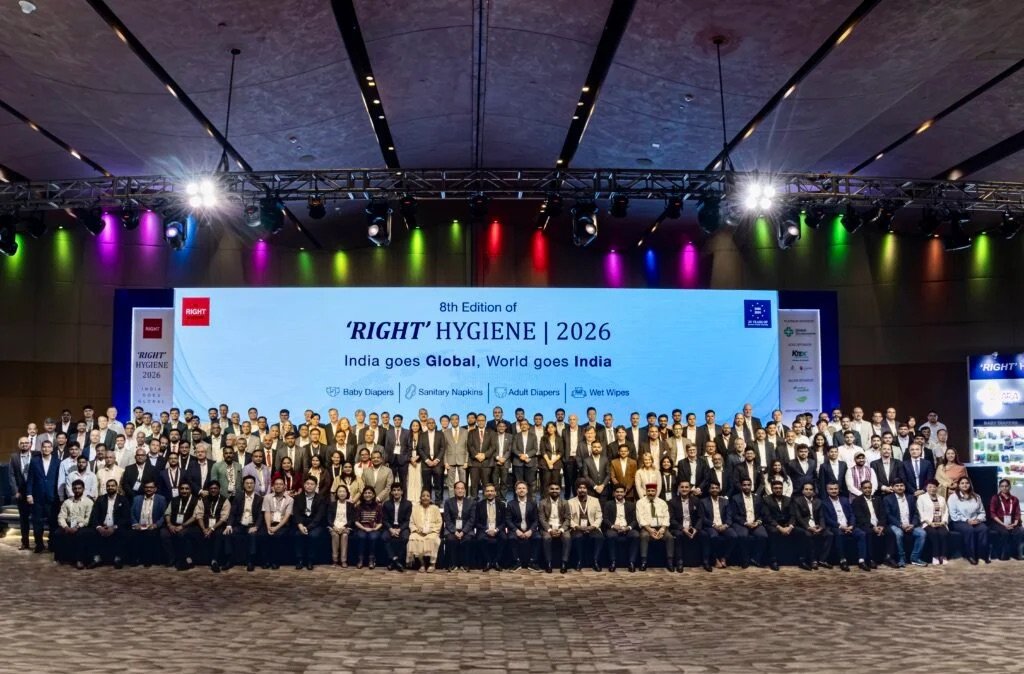
The eighth edition of Right Hygiene 2026, held on September 8-9 at Andaz by Hyatt, Aerocity, New Delhi, brought together manufacturers, technology suppliers, material producers, brands and other stakeholders from across the absorbent hygiene industry. The conference examined how India’s hygiene industry has evolved and where its next phase of growth could come from.
With the theme ‘India goes Global, World goes India,’ the program placed emphasis on India’s emergence as a manufacturing and export destination, while examining the technologies and consumer trends shaping the sector. Sessions covered manufacturing efficiency, global market developments, innovations in adhesives and absorbent materials, wet wipes, OEM partnerships and the changing requirements of hygiene consumers.
The second day offered a closer look at some of these developments. Conversations with suppliers and converters on the exhibition floor revealed an industry increasingly focused on material efficiency, product performance, multilayer structures, manufacturing integration and changing consumer requirements.
One example of the technology push came from H.B. Fuller, where Mohit Jaiswal explained the company’s hygiene adhesive portfolio and highlighted two products at the event.
The first, Full-Care 5887 Xtra, is a patent-pending wet-durability construction adhesive designed for disposable hygiene products where bonding hydrophilic substrates under wet conditions presents a challenge. According to the product material, the adhesive offers wet strength while providing an opportunity to reduce adhesive usage by up to 20% while maintaining peel performance at low coat weights. Its application between the acquisition distribution layer and topsheet is positioned around reducing resource usage while maintaining product performance.
The second, Full-Care 6550 SecureFix, is aimed at feminine hygiene applications such as daily-use pantiliners. The product is designed to maintain adhesion even when cotton and microfiber fabrics become wet, with the company highlighting a potential 20% reduction in adhesive add-on, lower application temperatures, and reduced residue on cotton or microfiber.
The focus on adhesives was consistent with the conference program, which included a session on ‘Building Resilient Hygiene Products Through Advanced Adhesive Technologies’ and discussed changing market requirements and market-driven innovation. H.B. Fuller’s 5887 Xtra was also among the nominations for the conference’s Innovation Award.
Further downstream, the exhibition floor showed how flexible packaging suppliers are adapting to the requirements of the hygiene industry.
SB-Constantia, which has been expanding its presence in India’s flexible packaging industry following its 2023 joint venture between SB Packaging and Constantia Flexibles, is looking at the next phase of growth through a combination of hygiene packaging, sustainable materials, cost innovation and technology. Its positioning reflects a wider shift in the Indian flexible packaging market, where hygiene applications increasingly demand a balance between performance, material efficiency, sustainability and economics.
That balance is particularly relevant as hygiene brands expand their portfolios and manufacturers look to serve increasingly differentiated products. For packaging suppliers, the challenge is no longer simply to provide a protective outer layer; packaging structures have to meet performance requirements while also addressing cost, production efficiency and sustainability considerations.
At Lorven Flex & Sack India, Muzaffar Naim discussed the company’s flexible and high-barrier packaging portfolio. Based in Hyderabad, the company has an annual production capacity of up to 35,000 tons. Its hygiene portfolio includes packaging for diapers, sanitary care, and wet wipes, supported by multilayer high-barrier flexible packaging capabilities.
The company profile highlights three-, five-, and seven-layer packaging materials, alongside W&H machinery for multilayer blown-film production. The stated film capability ranges from 20 to 200 microns, with web diameters of up to 2,600 mm.
Kris Flexipacks, represented in the interaction by Sundeep Kapoor, presented another perspective on the flexible packaging ecosystem. Its portfolio covers shrink sleeves, roll-fed labels, stretch sleeves, laminated films and pouches, shrink wrap, dairy packaging, hygiene packaging and industrial bags and rolls. The company’s profile identifies multilayer and barrier films for hygiene applications, including baby diapers, adult incontinence and feminine hygiene products.
Under its hygiene offerings, Kapoor highlighted the printed coextruded films and polyethylene bags and rolls, with formats such as wicketed bags, loop-handle bags, bottom-gusset bags and D-punch handle bags. The company also highlighted features including perforation, wicketing, scuff resistance and suitability for high-speed automated lines.
For Surya Polyflex, Ramandeep Singh described a relatively young operation that is building its presence in the hygiene packaging segment. The Haryana-based company began operations in 2024 and has installed four blown-film lines, along with bag-making, slitting and inspection equipment.
Singh said the company’s business is focused largely on hygiene applications, including materials for baby diapers, sanitary napkins and wet wipes. Surya Polyflex currently keeps most of its production activities in-house, while lamination is outsourced. The company plans to bring lamination into its own operations as customer demand for laminated structures increases.
The company is working with flexographic printing rather than gravure, with Singh citing the cost of gravure cylinders and the space requirements associated with gravure production as factors in that decision. He also pointed to the emergence of newer hygiene categories, including disposable period panties, as an indication of changing demand in the market.
That changing product landscape was also reflected in the conference programme. The “Taboo to Trillion” presentation by Sahil Khanna, director, Romsons Group, brought together baby, menstrual and adult care as interconnected parts of India’s growing hygiene ecosystem, highlighting rising demand, access and changing consumer expectations as opportunities for innovation.
Taken together, the conversations on the exhibition floor provide a useful complement to the conference discussions. Across adhesives, films and finished packaging, suppliers are responding to a hygiene industry that is becoming more sophisticated in its requirements.
What emerges from these conversations is a picture of an industry developing across multiple layers simultaneously. At one end are technologies such as advanced adhesives that can improve the performance and material efficiency of the hygiene article itself. Further downstream are multilayer films, high-barrier structures, specialized bags and increasingly sophisticated packaging formats. At the converter level, companies are adding capacity and considering greater vertical integration to respond to customer requirements.
The Right Hygiene conference highlighted India’s transition from a high-growth domestic market towards a potential global hygiene manufacturing hub, while stressing that international competitiveness will require more than simply adding capacity. Quality, technical expertise, scalable technologies and flexible solutions will become increasingly important as Indian manufacturers look outward.
The next phase of India’s hygiene packaging ecosystem, therefore, appears increasingly tied to doing more with materials, improving product performance, integrating manufacturing capabilities and responding more closely to evolving consumer needs. Those priorities, alongside India’s ambitions as a global manufacturing base, were among the recurring themes running through Right Hygiene 2026.