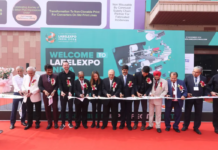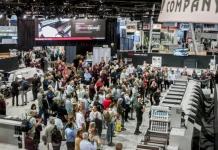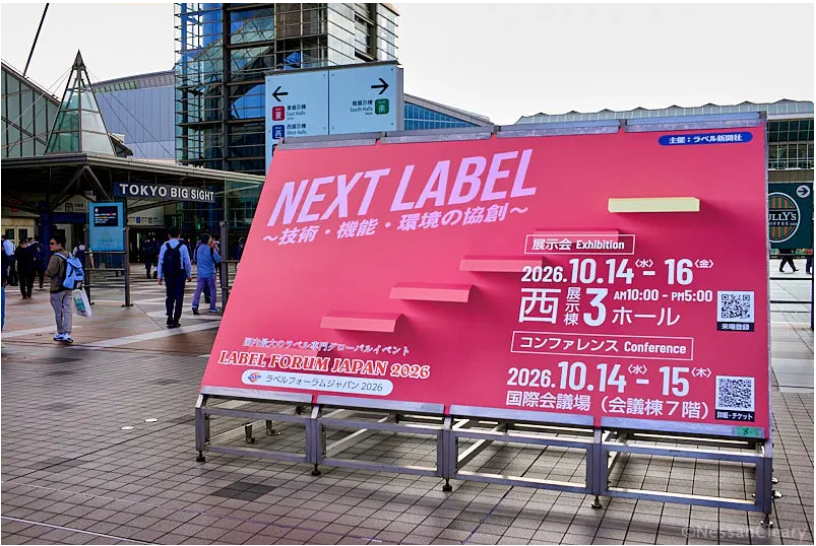
Last week’s Label Forum trade fair the Big Sight exhibition center in Tokyo has revealed little in the way of new technology but nonetheless has offered an interesting snapshot of the Japanese label printing industry.
The show, which is run by an industry newspaper, Label Shimbun, takes place every two years. This year’s event is broadly the same as two years ago, when I last covered this show. That is, it takes place in a single hall, backed up with a conference program. Label Forum is also conveniently located next to a food show, run by the Labelexpo/ Loupe organizers, Informa, and with the much larger Tokyo Pack show close by.
Not surprisingly, the team behind Label Shimbun are on good terms with the organizers behind the Labelexpo shows, now renamed Loupe. I caught a presentation from Andy Thomas, strategic director of Informa’s labels and packaging shows, who began by saying, “The label industry tracks very closely to the global economy, within 2-3 percent.” He added that the label industry returned to pre-covid levels in 2025. He pointed out that the use of pressure-sensitive labels is growing at a faster rate than glue-based labels. Beverage and food remain by far the biggest market sectors at 44% and 23%, respectively.
He also explained the rationale behind Labelexpo’s change of name to Loupe, essentially that some flexible film and folding carton packaging can now be produced on a narrow web press. The advantage is that all the converting and embellishment can be done inline with the printing as a single operation.
Thomas pointed out that the labelling industry refers to shrink sleeves as flexible packaging. The Japanese market is a big user of shrink sleeves. Most of these are produced by a relatively small number of companies on large rotogravure presses.
But according to data from Label Shimbun, 44.1% of Japanese label companies are small businesses with less than $1 million turnover. Mid-size companies with turnover between US$1m and US$5m account for a further 31.6 percent of the total number of label printers. Sora Yoshinaga, manager of Label Shimbun’s Sales and Research department, says there are roughly 2800 label printers in Japan, with most of the smaller companies running three or four semi-rotary letterpress machines.
Digital presses account for around 2% while flexo is only around 1.4% of label presses in Japan. He notes: “There are many conservative label converters in Japan and it’s not easy for them to change. So they are waiting to see if the market gets better.” He adds that the crisis in the Middle East has led to higher prices for label stocks, and that although some brand owners have raised their prices, naturally they don’t want to pay more for their labels.
Indeed, several suppliers echoed this, telling me that it’s difficult to sell highly automated equipment because the small label printers that dominate the Japanese market aren’t keen on investing, not helped by the historically weak Yen. Most exhibitors opted to just show samples, but there were a handful of machines also scattered around the show.

Thus Konica Minolta showed off the new AccurioLabel 231, which appears to be the same as the older 230 model that it replaces, even down to the same basic specifications. However, Konica Minolta has made a number of changes throughout the machine, including the control system, so that it’s not possible to upgrade an existing 230 to the new 231.
Yoshinori Koide from Konica Minolta’s professional print division says that there are three main improvements. This includes much more accurate color matching, though that requires an optional IQ module. This addresses feedback from customers that the colors would drift on anything other than very short runs. It’s worth noting that the average run length for these machines is around 150 linear meters.
The IQ module also supports color matching across longer images, up to 1.2 meters long. In addition to this, Konica Minolta has drastically improved the life expectancy of the machine, which should now be able to print around 2500 kilometers, up from around 1600 kilometers in total. Koide says that the machines may exceed this, but this is what the warranty covers in terms of maintaining print quality.
Konica Minolta has had a lot of success in selling these presses to the wine and spirit markets, as well as healthcare, where there are a lot of very short runs but customers still demand very high image quality. The dry toner print engine can handle a wide range of label stocks, and the machine is a good cost-effective option for very short runs.
This year also marked the first time that Bobst had exhibited at Label Forum. Laurent Castella, general manager for Bobst Japan, says, “This was really a letterpress market, but we see that’s changing and there is an opportunity for flexographic presses to take off.” He says this also extends to digital, noting, “Digital is already further in volume than flexo. But we do not sell it in Japan for the moment. We feel that we are not ready with the whole ecosystem.”
Gallus, which was also present at the show, is selling digital label presses in Japan. CEO Dario Urbanati says that Gallus worked hard to change its mindset away from single presses to a modular system that allows converters to configure the press line they want by slotting in different modules “like Lego bricks.”

It’s relatively easy to argue for a hybrid setup in Europe where most converters are familiar with flexo, but much harder in a mainly letterpress market like Japan. But he told me that Gallus is prepared to play the long game because eventually the Japanese label converters will need to invest to replace equipment as it ages. He added that the Japanese market does have very high quality expectations and that he was confident the Gallus presses can meet those needs. Nor was he worried that the weak Yen would make a European machine prohibitively expensive in Japan, saying, “If you look at the total cost of ownership, then the purchase price of the machine in only one factor over its lifetime.”
HP Indigo mainly showcased its collaborations with other companies. This includes Sato, which is one of the larger print production companies in Japan and also had its own booth at the show. Sato has used an Indigo to print shrink sleeves using recyclable PET. The design includes a QR code that links to an augmented reality website, with HP also supplying the AR hardware and software used to produce this.
HP has also worked with Casio for its linerless printing cartridges, which use Indigo printing for the boxes and labels. Toppan provided another example, with paper-based cartons for bottled water. Jeremy Goh, labels business manager for HP Indigo Asia Pacific, says that there’s a new sustainability push in the market, noting, “Converters are going towards sustainability materials. Many of the producers and consumers are used to paper-based materials and recycling systems, and we are seeing this in packaging now.”

I also came across a Japanese distributor, Selcam, which has put together an interesting solution that consists of a wide format UV printer integrated with an inline converting unit sold together as the AJ330E. Both are sourced from China but from different suppliers.
The printer has six channels for CMYK plus white and varnish. The print unit can produce up to 27mph in a four-pass 720 x 1200dpi mode. There’s a higher quality 720 x 1800 dpi mode that runs at 18mph. But in any case, the speed is limited by the converting unit. It’s also possible to add laminating, but Rena Takabayashi, from Selcam’s marketing department, says that it’s not possible to just use the converting machine with an existing wide format printer. Selcam only operates in Japan but is open to working with distributors from other regions.
Roland took a different approach to most other exhibitors by showing off the LSinc Peri One Direct-to-cylinder printer, having signed an exclusive worldwide distribution agreement with LSinc at the start of this year. Roland DG has also developed its own RC300 DtC printer, but Yohei Shinomura, a sales specialist for Roland DG, says that the label printing market requires more productivity, adding, “And we see that this machine fits that more than the RC300.” He continued: “So this is the first time that we have been able to show the true production scale.”
He says that some customers could use it to print directly to a bottle without using a label but expects most people to use it for decorating those bottles to add textured effects, noting: “It’s an additional tool that label printers can use. Rather than getting another label press, they can consider buying this to see what is possible.”
Two years ago Anytron showed off its desktop Any-002 printer but in the meantime the company has developed several much larger machines. This year it showed both the Any-Press and the Any-Jet 11. The Any-Press is based on an Oki dry toner printer and offers CMYK plus White. The Any-Jet II is one of several inkjet models, though they all use Memjet’s thermal Duraflex inkjet heads, which almost certainly means that the ink also comes from Memjet. The company also sells the Any-Jet 111, which has Duraflex heads but also has an inline laser cutter.

The Chinese manufacturer Weigang showed off a UV flexo press, with the ink coming from another Chinese vendor, BIC, and the mercury curing units from IUV (Innovation of UV technology), which also had a separate stand in the opposite corner of the show. It features motorized pressure settings and can be configured with all the usual converting options, including die cutting, foiling (hot and cold) and laminating as well as gravure and screen units. Weigang also sells its own digital press and can combine flexo and digital to offer a hybrid solution.
Spring Xu, International sales director for Weigang, explained that although the market is dominated by letterpress with some European flexo presses, there was also an opportunity for Chinese press vendors, noting: “We have advanced technology, but our price is also very reasonable.”
Weigang is represented in Japan by KK Irisu, which also distributes Durst, though Durst opted not to bring a machine and ended up tucked away in a corner behind the Weigang press. It’s also worth noting that Xeikon outsourced the manufacturing under contract of its Ecolyne press to Weigang.

OneVision, which has developed a range of automated workflow software, had a stand opposite Epson. The company produced files at the show to send to the Epson SurePress, as well as to Altech and ToyoTek for finishing. Toshikazu Yoshida-Eckl, a technical consultant with OneVision, explained, “We are independent from any manufacturer so we can take any file.” Instead, the system relies on APIs to integrate with other vendors’ equipment.
The company is developing a local AI server that will be able to automate many basic workflow tasks, including image enhancement, background removal and resolution upscaling, with Yoshida-Eckl saying: “It’s just additional functionality to our workflow.”
OneVision mainly sells its workflow in Japan to wide format printers, but Yoshida-Eckl predicts that the smaller label printers will also need to move into automated workflows. For now, OneVision mainly focuses on the larger label printers.
There were plenty more things to see at the show. Epson, for example, brought along its water-based inkjet SurePress L-5034, while Iwasaki showed off a letterpress machine, the Easy 200, and there were also a number of laser cutters. Nonetheless, my overall impression is that the Japanese label printing market is likely to see considerable changes over the next decade or so. Japan faces exactly the same pressures as any other modern industrialised nation so simple economics suggests that more widespread adoption of faster, more automated presses, including more digital technology, to increase productivity is long overdue.
So this explains why vendors such as Gallus and Bobst are circling. The obvious question is which way that investment will go – towards digital, or flexo, or a hybrid combination of the two? I suspect the answer lies in the other, unspoken question – will Japan follow other label markets towards more narrow web flexible packaging and folding carton? There were only a few packaging samples shown at Label Forum, though it does seem to me that adding more packaging to label production would suit the Japanese market very well because of the quality of the work produced there.
As always in Japan, I was struck by the sheer quality of the print work being produced. Some vendors have suggested that this is down to the need to reproduce in small sizes the complex kanji characters that make up the bulk of the Japanese alphabet. But it does seem to me that it’s more to do with a service-oriented mentality that permeates Japanese society – that if something is worth doing, then it’s worth doing properly – and which both brands and consumers in Japan have come to expect. This also explains why the bulk of the label printing companies are relatively small businesses serving a local market, and why letterpress is still their favored technology.