A pioneer and a leader in the Pakistani vertical form, fill & seal machines segment, Prepac Engineering Industries has been manufacturing machines for packing of viscous and semi-viscous products in co-extruded multi-layered PE-based film of different specifications. At interpack, the company demonstrated its Press n Pour model, which can be used to pack items such as edible oil, clarified butter, milk, fresh cream and mango pulp, to name a few. The pack size varies, with a minimum of 120 mm x 150 mm and a maximum size of 225 mm x 350 mm. It works with co-extruded 3- or 5-layer PE-based or laminated 90 to 120
micron films. The machine has the capability to produce 650 to 1000 packs per hour depending on the pack size. The Press n Pour model provides two options where the pouches can have a spout or a bottle shape.
“All our manufacturing happens in Pakistan while we have a sales office in Canada. Exports are a huge chunk of our business and it has a share of close to 60% while the remaining 40% of the business comes from Pakistani market,” said Zain Salam, business development manager, Prepac Engineering. Prepac Engineering was the first collaboration between Pakistan and France and was founded in 1979. Its manufacturing plant is located in Lahore, the capital of Punjab. The company has an in-house research and development department.
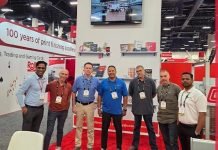
Being a company in which exports are a significant revenue generator, Prepac Engineering is using the interpack platform to meet new as well as old customers from across the globe. Prepac Engineering has customers in Europe, USA and Africa among others. “We have met some potential customers at the exhibition and we expect to have a great interpack,” Salam said.
Pakistani market is maturing
Although the Pakistani packaging market is still dominated by traditional and conventional forms of packaging, some players have started offering exciting and new packaging solutions. Salam said that packaging buyers in Pakistan are maturing but the process is slow because there is a reluctance to switch from solutions that have become popular and well accepted. But this is gradually changing. “In the ’80s, Pakistani market saw popularity of pillow pouches; then gradually standing pouches became popular. I expect in another 4-5 years solutions like bottle-shaped packs will gain popularity in Pakistan,” he stated.