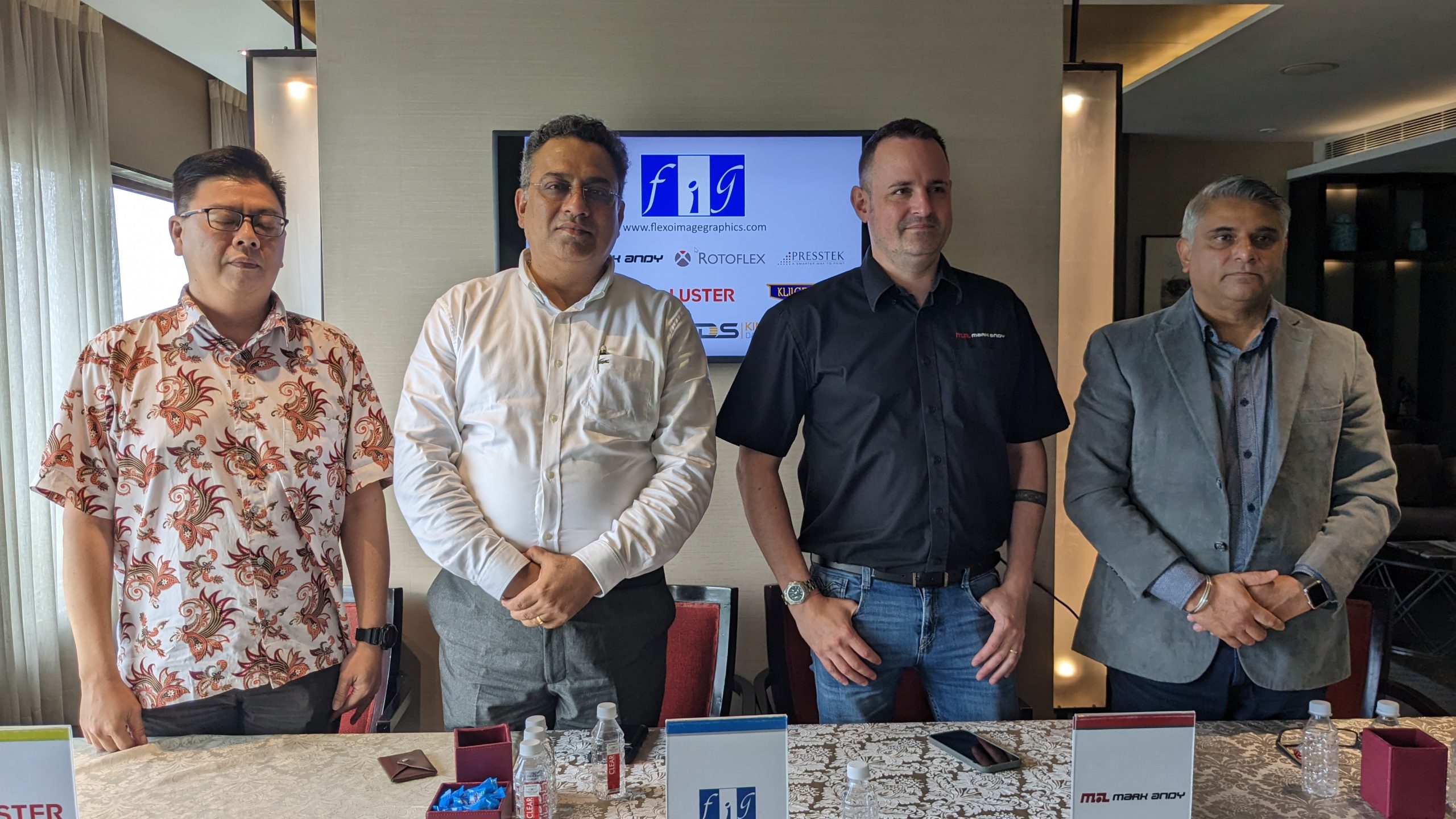
The present market scenario, the importance of advanced machinery and how Mark Andy, Rotoflex and Luster have contributed to the industry were the center of discussions at a press interaction conducted by Flexo Image Graphics (FIG), on 18 July at Crowne Plaza, New Delhi.
Phil Baldwin, sales manager, Mark Andy, Manohar Dhugga, vice-president, Rotoflex (which has been acquired by Mark Andy), Krisyanto Ekokurniawan, sales manager, Luster and Gaurav Roy, managing director, FIG were present at the event. FIG represents several overseas brands for printing and post-printing operations and consumables for India and its neighboring countries.
Gaurav Roy, managing director, FIG, highlighted the number of installations they have done around India and other South Asian countries. “In the last three years, we have done 25 installations of Luster. As far as Rotoflex and Mark Andy are concerned, those have been our main products for the last 23 years. We have installed 109 Rotoflex machines and 283 machines of Mark Andy.”
FIG has installed Mark Andy machines in Sri Lanka, catering to the tea industry. The market is growing and converters are buying presses with UV systems and numerous features to cater to various industries, Roy said. “People are looking into new possibilities and focusing on reducing the cost. It has become a very competitive market. We have been constantly developing ourselves, extending training processes for operators and developing training courses as well,” Roy said.
Differentiating factor
Asked about the differentiating factors and why FIG chooses Rotoflex and Luster for inspection over any other Indian-manufactured machine, Roy describes their efficiency and how one can fully rely on their advanced machinery to get 100% inspected labels without any error.
“Luster makes label inspection systems and Rotoflex integrates their system into the machine to inspect the printing. Luster detects irregularities in labels, running at a speed of 300 meters per minute. We take that information right from their position at the editing table and signal the operator to change or remove any irregular label,” Dhugga said while shedding light on the inspection machines of Rotoflex and Luster.
Dhugga says machines from Luster are highly essential as when a job is printed with errors, the manufacturers bear the loss. So if an inspection machine is integrated, the errors can be easily detected at the spot itself.
Current and future market
Covid had an impact on the market as the cost of raw materials, be it inks or chemicals, started going up. “Even though everyone was busy during Covid, post-pandemic when there was a hike in the input costs, profits started going down. So now they are looking at technology to improve the internal costs because the output is going to increase. One needs to adapt internally to serve the market,” Roy said.
Adding to Roy, Baldwin emphasized on measuring everything to improve and save money. “As the profit margins have minimized, companies need to work efficiently to sustain. To work efficiently, one needs to measure their inputs and wastage. They need to keep records and refer back to them for further enhancements.”
“Some of the big manufacturers are downsizing to maintain the profit margins. The companies even sell at a lower cost. By doing so, they don’t have enough money to reinvest in support. Mark Andy will never be the cheapest supplier, but we need to maintain enough margins that we can offer support,” Baldwin said. He suggested investing in efficient options rather than going for a lower cost for future sustainability. “Invest right,” he said.
As AI and automation are the calls of the future, Roy and the members of the panel agreed on the need to have advanced machinery. Investing in the right machinery will help increase productivity and maintain profit margins as well, they said.