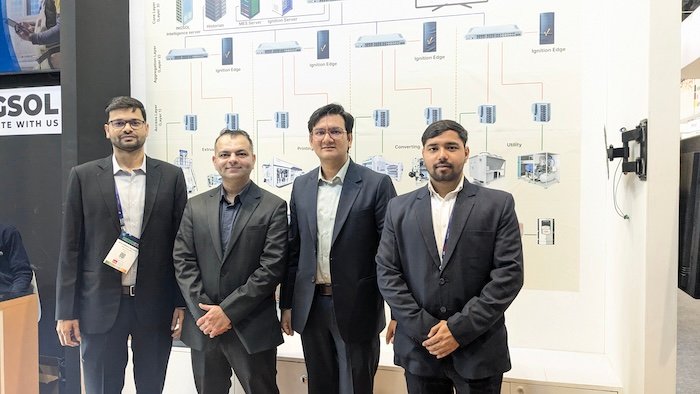
Positioning itself as more than just a service provider, Ingsol at PlastIndia presented a vision of becoming a globally reliable engineering and digital transformation partner for the flexible packaging industry.
In a conversation with Packaging South Asia at the show, Faraz Khan, partner with Ingsol, underscored a fundamental shift in how Indian engineering companies are perceived. According to him, with a strong foundation in engineering and services, India is increasingly exporting not just manpower but high-value expertise. For Ingsol, however, the goal is not limited to participation in global markets, but to establish itself as a trusted and performance-driven solutions provider.

Founded in 2021, Ingsol emerged from a clear industry gap identified by its founders during their tenure with leading European OEMs. Their experience across India, the Middle East, and Africa highlighted the need for faster, more flexible, and customer-centric service models, something Ingsol has built its foundation upon.
The company operates from a manufacturing base in Greater Noida with a growing international footprint. A significant share of its business comes from global markets such as the US.
A key differentiator lies in Ingsol’s ability to complement, and in some cases outperform, traditional OEM services. While the industry has long revolved around a few dominant European players, Khan said this narrative is evolving. Converters are no longer dependent on a single supplier; instead, they are adopting a multi-vendor approach that prioritises agility and responsiveness. Ingsol’s model reflects this shift, offering specialized teams, faster turnaround times, and solutions built on open-market technologies that ensure long-term ownership and scalability for customers.
The company’s expertise spans mechanical and electrical engineering, automation, retrofits, upgrades, and specialized services for blown film lines. However, what truly defines its future trajectory is its growing focus on digital transformation. As Khan explained, digitalization is often misunderstood as merely collecting machine data and pushing it to the cloud. Ingsol’s approach is far more structured and value-driven.
It begins with establishing a ‘single source of truth’ on the shop floor—eliminating ambiguity around machine performance and operations. From there, Ingsol builds data pipelines within the plant, followed by dashboards and reporting systems that provide visibility. The next layers involve optimization and the integration of manufacturing execution systems (MES), ultimately leading to intelligent, AI-driven insights.
He noted that Ingsol is not just conceptualizing these solutions but actively implementing them—bridging the gap between consultancy and execution. The company is developing an MES platform for the packaging industry, along with generative AI models trained specifically on packaging data.
As the industry moves toward smarter, more connected manufacturing ecosystems, Ingsol is aligning itself with this transformation. With its blend of OEM-level expertise, execution speed, and future-ready technologies, the company is positioning itself as a compelling alternative for converters seeking greater control, efficiency, and long-term value from their operations.