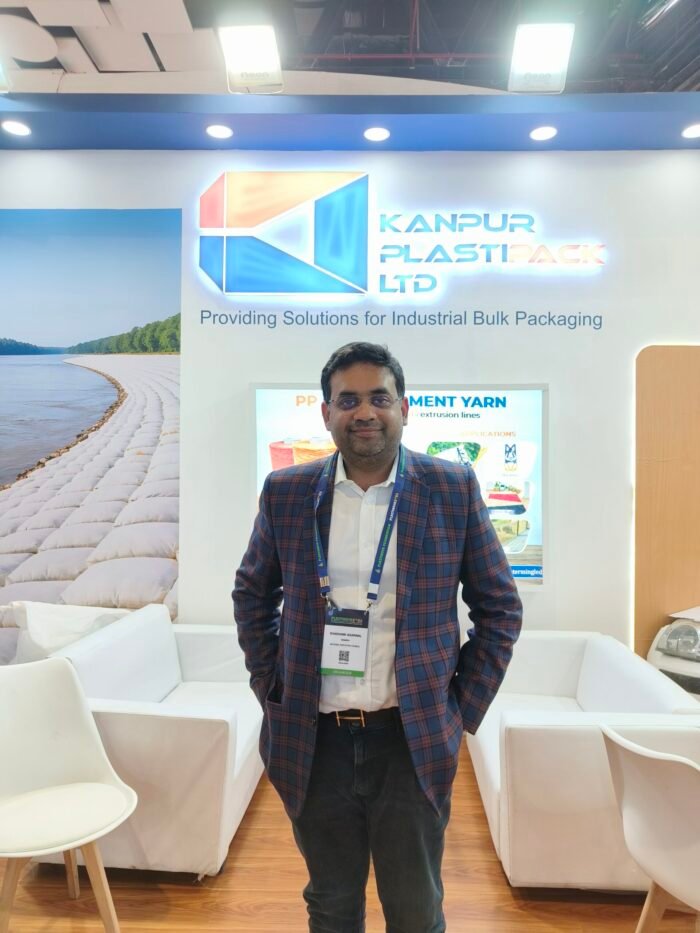
Kanpur Plastipack, a leading manufacturer and exporter of flexible intermediate bulk container (FIBC) bags, reported a highly positive experience at PlastIndia Delhi. Shashank Agarwal, managing director of Kanpur Plastipack, noted an increase in high-level decision-makers and praised the organizers for their efforts in making PlastIndia 2026 bigger than the previous editions.
The company has undergone a significant strategic shift by selling its entire CPP film business division to SRF, as reported by Packaging South Asia in March 2025.
This exit from the film industry, he said, enabled Kanpur Plastipack, a publicly listed company, to pivot toward needle-punching non-woven technical textiles, targeting diverse sectors such as geotextiles, the automotive industry, artificial leather, and the footwear industry.
In addition to these new ventures, the company is maintaining and growing its presence in the flexible intermediate bulk container (FIBC) market. It is in the process of implementing a 35% expansion in the FIBC segment.
This growth is part of a broader optimistic outlook on the Indian market, which Agarwal describes as extremely exciting due to the Indian growth story and favorable international trade shifts.
Key economic drivers Agarwal mentioned include the recent India-EU FTA, the trade agreement with the UK, and the easing of the US tariffs, all of which make global market expansion imperative.
A centerpiece of Kanpur Plastipack’s showcase was a joint venture with the Italian company Essegomma to manufacture high-performance polypropylene yarn in India, resulting in a new entity called SA-CAN. This venture focuses on producing specialized yarn for outdoor furniture that prioritizes environmental sustainability.
While traditional outdoor furniture often uses non-recyclable PVC-coated polyester, SA-CAN utilizes 100% recyclable and sustainable polypropylene. This commitment to sustainable materials, alongside the expansion into technical textiles and carpets, represents the core of the company’s future roadmap.
According to Agarwal, the project is expected to support India’s broader push towards Atmanirbhar Bharat in the technical textiles value chain.
“Technical yarn manufacturing continues to be an area that requires high precision, polymer engineering, and strong process control. The venture will help reduce import dependence and strengthen India’s positioning in global supply chains where PP-based high-performance yarns are widely used,” he said.