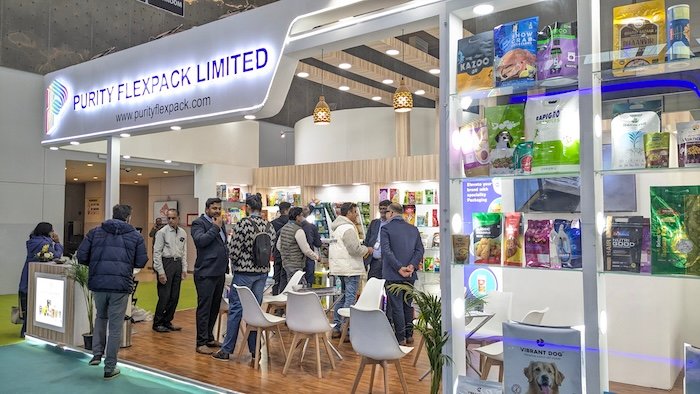
At the Indusfood Manufacturing exhibition in Delhi, Purity Flexpack presented its complete portfolio of flexible packaging laminates and pouches. In a conversation at the event, Chintan Patel, sales and marketing manager at Purity Flexpack, discussed the company’s journey, infrastructure strengths, and the market realities surrounding sustainability and technology adoption.

Purity Flexpack is a second-generation company based near Vadodara, Gujarat, specializing in flexible packaging laminates. The company serves a wide range of industries, including food, pharmaceuticals, confectionery, agrochemicals, ready-to-eat foods, and liquid packaging. “We are not limited to any one industry or niche,” Patel explained.

The company’s product portfolio includes roll-form laminates as well as pre-made and specialty pouches. These include jumbo and heavy-duty pouches, spout pouches, degassing pouches, retort pouches, and liquid packaging formats. While Purity Flexpack also produces conventional namkeen pouches, Patel emphasized that the company’s real strength lies in specialty packaging solutions that require higher technical expertise.
According to Patel, from a volume perspective, roll-form packaging currently dominates the company’s output. “Quantity-wise, roll form is much higher because execution is faster,” Patel noted. However, he added that pouching is a steadily growing focus area. “Year on year, our pouching capacity is increasing. Every two years, we add new pouching machines to expand capacity.” He said this strategy allows the company to serve both high-volume converters and customers looking for differentiated pouch formats.
Its manufacturing setup includes a 9-color rotogravure printing machine, solvent-based and solvent-less lamination, slitting, and advanced pouching lines. The blown film capability includes a 5-layer blown film line, enabling the production of complex multilayer structures for demanding applications.
The company recently started hot foil stamping directly on laminates—an application more commonly associated with carton packaging. In addition, it offers advanced security features such as UV inks, thermochromic effects, and holography. “We incorporate many security features using specialized inks and technologies,” Patel said.
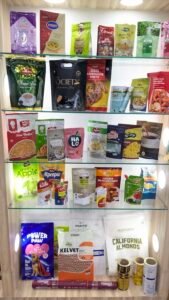
Photo- PSA
On the sustainability front, Purity Flexpack has developed eco-friendly packaging solutions and conducted customer trials. However, Patel was candid about the commercial challenges. “The results are technically fine, but compared to normal packaging, it costs three to four times more,” he explained. “There is no commercial viability yet, and customers are not very inclined.” Despite this, the company continues to experiment and develop new structures wherever possible.
Participating for the first time at Indusfood Manufacturing, Purity Flexpack used the exhibition as a platform for meaningful, one-on-one discussions rather than instant conversions. “Our solutions are customized, so it’s about understanding requirements first,” Patel said. With steady footfall and promising leads, Patel confirmed it to be a successful participation for the company.