One of the biggest surprises for me of this year’s Labelexpo show in Barcelona, Spain, came from Gallus. The company announced two new presses but arguably the most interesting story was Gallus itself and the fact that it’s not only still going but apparently thriving.
Heidelberg fully acquired the flexo press manufacturer Gallus in 2014, having previously picked up 30% of the company back in 1999. But back in 2021 Heidelberg attempted to sell Gallus to the Swiss company Benpac, which ultimately did not have the resources to complete the deal. At the time other flexo press vendors privately told me they weren’t surprised that Heidelberg would sell off Gallus as they no longer saw Gallus as a serious competitor. But now it seems that Gallus has a new lease of life, with new products to show and a busy stand that even its competitors remarked on.
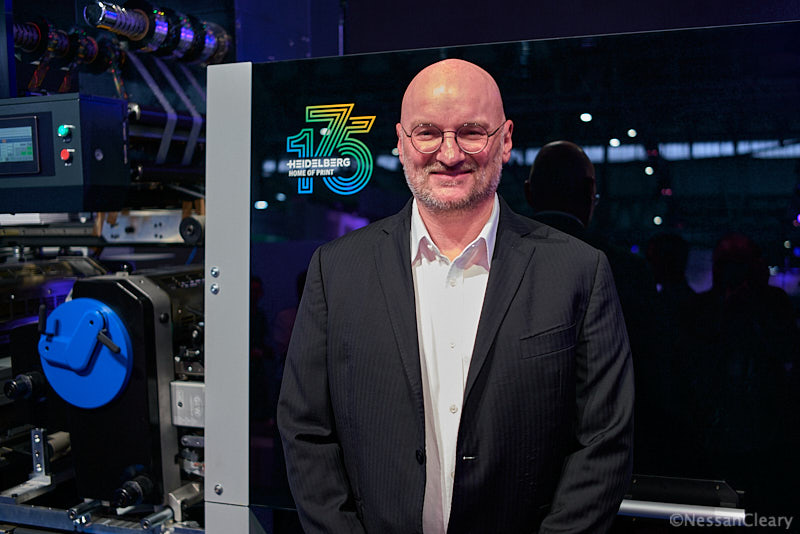
Much of this is down to having a tighter integration with Heidelberg. Dario Urbinati, CEO of Gallus, told me, “We are very happy that Heidelberg has taken more interest. Heidelberg supports us as a shareholder and we are an integral part of the Heidelberg Group. And 50% of the revenues of Heidelberg comes from packaging and the labelling contributes its part. And we are very happy that we have the support of our mother company in our market.”
Urbinati says that Gallus has its own R&D at its base in St Gallen in Switzerland but has also benefited from Heidelberg’s R&D centres, stating, “We have R&D sites so it depends on where we have the core competence to build the order. But we develop it as a Gallus product.” He adds that Heidelberg also lends Gallus a bigger footprint, “The benefit for Gallus is that we have a global sales and service network which gives us a much faster supply chain for parts and consumables.”
The Gallus Five
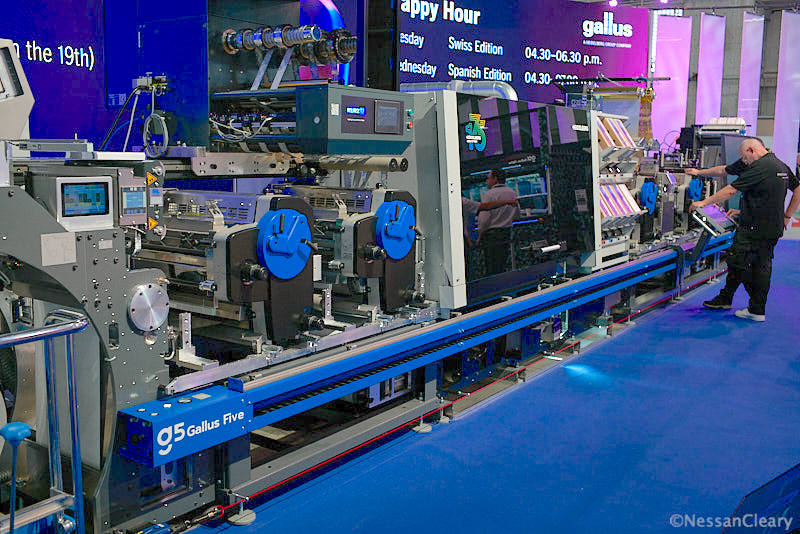
This contributed to Gallus announcing two new presses at the show, starting with a new flagship model, the Gallus Five. This can produce up to 100 meters per minute, including for white ink, which puts it on a par with the Durst Tau and Bobst Master presses as the fastest currently available inkjet label presses. But as Urbinati points out, those presses only achieve this speed with UV curable inks while the Gallus Five uses LED curing. That’s a considerable achievement as LEDs operate across a very narrow wavelength, so tuning multiple colors to cure at high speed is quite a challenge.
This inkset consists of six colors – CMYK plus orange and violet – as well as white. Urbinati says there’s no plan to add a green ink, “We could do it but we don’t see any need.” That’s because the ink can already reproduce 32 of the most specified Pantone colors, with most labels and packaging tending towards warmer colors.
Indeed, according to Urbinati, the core of the Gallus Five is the ink. “It’s highly pigment which reduces ink consumption and therefore cost. We don’t want to have a problem with ink so we test it and test it.” He adds, “The ink we have now is formulated to meet future regulations. We were looking at what regulation will come in five years. And what substances might not be recommended.”
It’s possible for existing customers of the Gallus One to upgrade their presses to run the new ink. Urbinati says, “You need to change the curing system to LED and we would recommend to have a faster die cutter. You can then get the faster speed from the Gallus One.” But he adds, “It comes down to the customer base. Do they need the faster speed?”
Reflecting back, Urbinati says that following the fiasco with the planned sale to Benpac, the company started again from basics four years ago with the Gallus One as a stand alone digital press. “This dramatically increased the performance and ultimately the success of our customers.” He adds, “With the Gallus Five we have the next evolution to bring our industry closer to smart connected print. We put the customer in control. They can choose from the best available technology in the market – digital, hybrid and conventional.”
The new Alpha
The second press anounced was the Gallus Alpha, which has been developed by another OEM that Urbinati didn’t want to name but which I understand to be Neos. This press runs at 65mpm and offers some automation such as head cleaning. There’s a choice of four or six colours plus white.
This has been designed as a cheaper alternative to the Gallus Five but Urbinati doesn’t like referring to it as an entry-level model, arguing, “With the Alpha we have produced a gateway digital press. Entry level sounds like a lower quality, which it is not. For us it’s a market that hasn’t been reached by digital.”
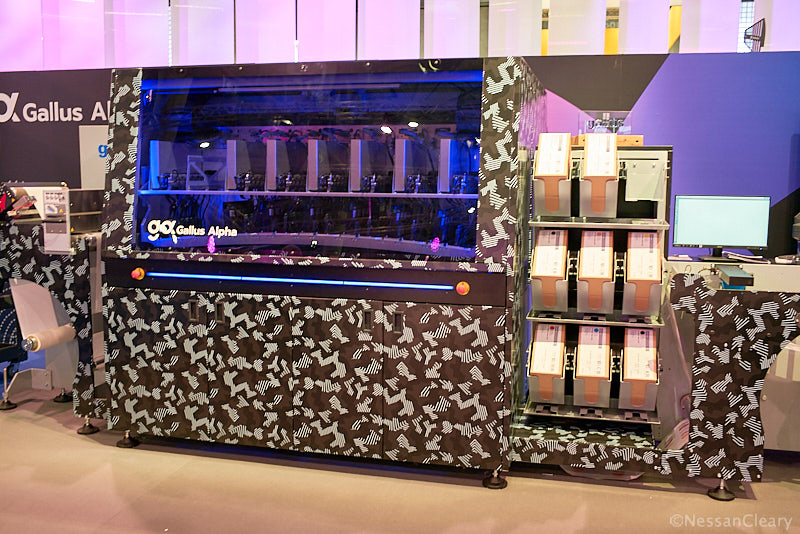
Photo Nessan Cleary
But of course Gallus has had to make some concessions in order to achieve the lower price point. Urbinati explains, “The Gallus One is modular and modularity always adds cost. So the System to Compose is like Lego blocks. We take the different building blocks and put them together for inline converting. But on a gateway press the modularity is the way we compromise. It’s a true roll-to-roll standalone machine for those that need to replace heritage digital presses, for those that need a gateway to Smart Connect.” He adds, “It has top notch technology as you would expect from Gallus. So it’s a gateway press without compromising on quality.”
Naturally Gallus makes use of Heidelberg’s Prinect software though Urbanati adds, “But we recognise that there is a software environment in the industry. So if someone wants to connect to our software then we can build APIs and interface to that software and to the software of our customer.” He continues, “Personally I think there are areas where the whole industry could improve. But we develop from outside in. So we asked our customers, ‘what are the pain points, what do you need, what do you want to develop’.”
This approach highlights that although Gallus remains a manufacturer of flexo presses, it has taken a more collaborative approach to its digital presses. He points out that vendors always need to collaborate with other partners even if that’s just for a curing system, adding, “We are a system integrator which is very flexible in bringing the best technology together. And we do have our own ink formulation in-house with Heidelberg.”
Although some vendors at the show talked about the growing use of hybrid presses in label production, Urbinati was more dismissive of this, saying, “Usually if someone focuses on a standalone press, then usually a die cutter is added because it makes sense to finish the product, so how do we class that – as a standalone or a hybrid? But we have machines that are in the traditional sense just roll-to-roll, and we have customers buying them. But a better question would be – to add a die cutter or a flexo station? It gives more flexibility. But at the end of the day we do not consider ourselves to be in a position to tell the customers what kind of set-up they should run in their factories. It’s our job to build the best building blocks. And we let the customer choose according to their own desire.”
He went on to say that he sees the scope for producing wider presses to take advantage of the growth in packaging, noting, “Certainly the market will go wider, not all markets but in some.” But he adds, “On the other side, our customers are already doing labelling and flexible packaging and they already do folding cartons. So our customers are already using our equipment for these markets.”
And Urbinati is very confident for the future, concluding, “For us the market is very positive. We think in six–month slots. So we can save a lot of time than if you think in two years time.”
You can find further details from gallus-group.com.
First published on 23 December 2025 by the Print and Manufacturing Journal. Republished by permission.