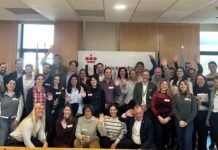
AIMPLAS, the Plastics Technology Centre, brought together more than 100 professionals from the plastics recycling sector at the third edition of its International Plastics Recycling Seminar, Plasrec. On 10 and 11 December, around 20 national and international speakers analyzed the legal, technological, and economic implications of the transition towards a more circular economy and the challenges faced by the plastics recycling industry.
In the first session, Nicolás Molina, from the Spanish Federation for Recovery and Recycling (FER), warned about the speed and depth of regulatory changes the sector will face: “Europe has turned plastics recycling into a geopolitical and strategic issue, driven by increasing regulatory pressure and measures such as the introduction of recycled material in vehicle manufacturing, expected in the coming months,” he stated.
Molina also highlighted that the progressive entry into force of the Industrial Decarbonization Acceleration Law and the new Circular Economy Law will mark a turning point that will require the industry to adapt to new requirements for traceability, classification, and quality of recycled material. “Europe has decided to retain, transform, and valorize its own waste. A change that will soon become tangible for the industry,” he said.
Regulatory tsunami
Óscar Hernández, from Anarpla, stressed that the sector faces a “regulatory tsunami” hindered by the lack of control over imports of cheap recycled materials and competition from virgin plastics. Although recycling capacity has reached 13 million tons, the 2030 targets are at risk due to stagnation and plant closures in the EU. To improve competitiveness, Hernández advocated for key measures such as restoring fair competition and reducing energy costs.
Next, Cristina Galán, from ANAIP, explained how the coming years will be crucial for transforming packaging ecodesign in Europe, as the entry into force of the European Packaging and Packaging Waste Regulation (PPWR) will make it mandatory for all packaging to be recyclable under a harmonized methodological framework that guarantees its safety, sustainability, and the quality of recycled material.
The European Commission plans to adopt implementing acts that will establish how to calculate and verify recycled content, as well as approve a harmonized label, also in digital format, and an official method based on marking technologies to identify the composition of packaging, including composites. From August 12, 2026, packaging intended for food contact may not be sold if it contains PFAS in concentrations exceeding certain limits set by the regulation. Galán also highlighted that 2028 will bring a new milestone, when all packaging subject to recycled content requirements must display its percentage of recycled or bio-based material according to official specifications. “Design for recycling will no longer be a recommendation: it will be a legal requirement,” she stated.
The complexity of the current situation for the industry was also reflected in the intervention of Irene Mora, from Plastics Europe, who offered a broad view of the sector’s declining competitiveness. Mora explained that European plastics production has fallen by 12.4% since 2018, that nearly 3,000 companies have closed since 2022, and that around 35,000 jobs have been lost during this period. This decline, combined with the rapid growth of regions such as China, places Europe at a critical point just as the new regulatory framework comes into force. Mora stressed that implementing the PPWR in 2026 will require greater availability of recycled material, a more efficient collection and sorting system, and reinforced traceability across all flows. “The industry needs legal certainty and fair conditions to compete. Without this, it will be difficult to meet the circularity targets for 2030 and 2050.”
The second session of the seminar focused on waste collection and sorting, a key phase of the recycling process whose role becomes even more relevant with the entry into force of design-for-recycling requirements in 2026. Roberto Paredes, from Solveria, explained how artificial intelligence is revolutionizing plastics recycling by automating waste classification and improving efficiency in recycling plants. However, he warned about the high costs and challenges related to the quality and integration of the data needed for widespread implementation.
For his part, Daniel Carrero, from Picvisa, presented an innovative system for shredding, separating, and classifying plastics from shoe soles using computer vision. This process makes it possible to obtain a recovered material called Ecoflake, demonstrating that technology can valorize traditionally complex and hard-to-recycle waste. “Computer vision allows us to recover materials that were previously systematically lost. It represents a leap in efficiency in pre-recycling classification,” he explained, emphasizing the decisive role that separation technologies will play in a context where European regulations will require higher quality levels in recycled materials.
Marc Puyuelo, from Coleo, addressed the challenge of synthetic fibers in the textile sector and their potential for circular recycling, highlighting how new technologies and processes can drive the reuse of materials that have traditionally been difficult to recycle. Meanwhile, Albert Sabala, from Hera Holding, analyzed how the sector is moving at three speeds: technology is advancing rapidly, regulation is trying to catch up, and the market, although responding to sustainability demands, still faces significant obstacles. Sabala stressed the importance of aligning these three aspects to achieve an effective transition towards a circular economy in the recycling industry.
The second session concluded with the intervention of Ettore Musacchi, from the European Tyre Recycling Association (ETRA), who discussed how tire recycling aligns with the European Green Deal and what the future holds for the industry in terms of competitiveness and new technologies.
A collapsed system
Next, Adrián Morales (AIMPLAS) explained the innovative technologies being developed to address the recycling of complex waste such as lithium-ion batteries and other electrical-electronic components, as well as multilayer packaging. Ángel Martínez (Acteco) spoke of a situation of “war” and a “collapsed system” due to plant closures but also opened a door of hope by discussing emerging technologies such as hydrothermal recycling, which promise very high-quality production.
Vincent Rerat (Bruggemann) presented Bruggolen R-8897 and R-8899 solutions, designed to improve the quality and performance of post-consumer PP/EPDM, and addressed the main technical challenges associated with its recovery, explaining how Bruggemann additives optimize compatibility and extend the useful life of recycled material, offering an innovative response to boost circularity in demanding applications. José Antonio Alarcón (Petcore) addressed the technical and regulatory challenges posed by recycling multilayer trays and the emerging solutions that improve recyclability without compromising packaging functionality, contributing to the sector’s sustainability goals.
The first day concluded with the audience voting for the winning team of the Hackathon, which had been held in parallel to the sessions and organized by the AIMPLAS-UV Chair.
On the second day, Santiago Llopis (AIMPLAS) offered a comprehensive overview of existing chemical recycling techniques, from the most established to the latest innovations, providing an essential reference framework for the session. Richard Aceituno (GSF) delved into pyrolysis techniques, with special emphasis on the use of catalysts to improve the quality of liquid products and to effectively remove critical contaminants such as halogens, metals, and heteroatoms.
Next, Irene Méndez (Entzimatiko) presented the innovative solutions offered by enzymatic depolymerization, highlighting the potential of biotechnology as a precise and sustainable pathway for advanced recycling of plastics and textiles. Hernán Calvo (Plastic Energy) advocated chemical recycling as the driving force to boost the circular economy of plastics, emphasizing market opportunities and the collaborative models needed for its scaling. The first panel closed with Jorge Ávila (Modus/Intecsa), who detailed Spain’s first industrial chemical recycling project (Foak) for polyester—a milestone marking the transition from technology to industrial reality.
Oliver Dietrich (Messer) showcased examples of its mechanical recycling technologies using liquid nitrogen in applications such as fiber-reinforced hoses, healthcare equipment, and metallized plastics. Meanwhile, Carlos Gómez (Promal) presented the advantages of the Bandera twin-screw system for recycling complex or contaminated materials and obtaining high-quality recycled plastics. Peter Kolbe (Kubota Brabender) addressed one of the critical points in the recycling process: heterogeneous materials, stressing the importance of identifying the right equipment for each type of waste. Bárbara Franch (UBE) presented some of the company’s success stories in recycling complex waste composed of polyamide and polyethylene, resulting in products with contents between 10% and 30% that maintain high performance such as mechanical strength, abrasion and impact resistance, and barrier function—demonstrating their recyclability.
Between the last two sessions, presentations were given on the Cíclicom and Free4lib projects in which AIMPLAS participates, led by Pablo Ferrero and Alicia Barbas.
The event concluded with a panel on meeting recycling targets in sectors such as textiles, electrical-electronic, automotive, and renewable energy. Jose David Allo (Texfor) presented, among others, the Cisutac project in which AIMPLAS is involved. Paula Quintanilla (Sostenplas) highlighted the high volume of WEEE waste generated in Spain (20 kilos per person per year) and presented her organization’s commitment to R&D&I, while also pointing out the growing increase in bureaucratic burden they face.
Juan Antonio Ruiz (Aantolin Ingenieria) presented some innovative projects to address the circularity that is expected to be required in the automotive sector and raised the issue of quality barriers, especially in such a technically demanding industry, explaining that amendments have already been submitted to reduce the recycled content target in automobiles to 20%. The seminar closed with Helena Abril (Aemac), who debunked the myth of the non-recyclability of composite materials and explained how the sector is currently dealing with a significant volume of waste from the dismantling of installations. Abril presented the solutions being developed in biocomposites and some R&D projects such as Rewind.