Enormous cost and competitive pressure, as well as the increasing difficulty of recruiting suitable personnel on the market, are driving the printing industry. An additional challenge is the fact that printing companies now have to generate a significant portion of their revenue, which they previously achieved with high-volume orders, through a large number of small orders.
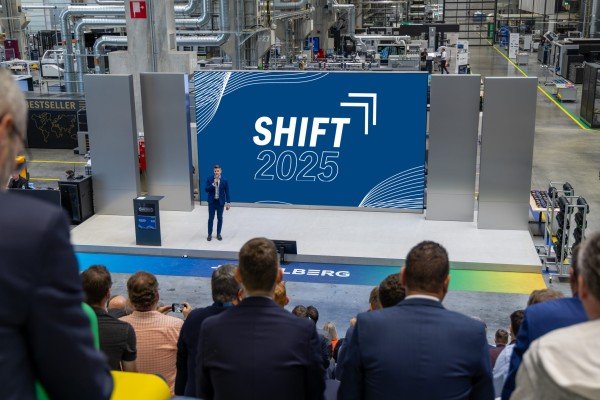
With conventional working methods, it is difficult to manage such an order structure economically. The solution is the consistent digitization and automation of as many processes as possible, as well as the increased use of robotics to reduce manual intervention to an absolute minimum. These topics were addressed at Shift 2025, a new two-day event format organized by Heidelberg, featuring external speakers on the one hand and interactive practical workshops on the other. More than 200 guests from all over Europe and overseas attended the summit.

Practical examples provide solutions
The first day focused on practical applications from various companies. One of the six speakers was Rob Cross, co-managing director of Micropress Printers, Reydon, England. He described how the company has accelerated its processes and alleviated the shortage of personnel thanks to automation, robotics, and AI. Micropress produces on a Speedmaster XL 106 with Plate to Unit and on several digital printing systems. All processes are controlled via Prinect. At the folding machines, robots, including a StackStar P from Heidelberg, place the packages on pallets. Autonomous Mobile Robots (AMR) move the pallets between the individual machines.
Bauer Packaging, Germany, specializes in label printing and packaging production. The company has largely digitized its production. Using a combination of Prinect Production from Heidelberg and Symphony from Ctrl-s, the numerous label orders are bundled, the impositions are automatically laid out, and the output is sent to several digital printing systems.
Compucut Auto-Control calculates the cutting programs fully automatically on Polar cutting technology. Around 700 orders are processed every day. Orders received by 7 p.m. are delivered on the same day from 9 pm. For the more than 600 million folding cartons produced annually, Bauer Packaging works with a new high-performance Mastermatrix 106 CSB die cutter, among other equipment.
Prinect Touch Free unlocks potential in digitalization
In the printing industry, the range of tasks that need to be digitized and automated is particularly wide. It extends from order entry, planning, production, and materials management to shipping, invoicing, and the evaluation of KPIs (key performance indicators). The second day of the event at the Home of Print in Wiesloch-Walldorf was dedicated to this broad topic. Heidelberg, together with its partners, presented itself as a solution provider and system integrator for end-to-end production in commercial and packaging printing—from the PDF file to the delivered product.
Special attention was paid to hybrid print production with Speedmaster technology on the one hand and digital printing with Jetfire 50 and Versafire systems on the other. The focus was on fully automated workflow control via the new Prinect Touch Free workflow. The AI-supported software guides an order independently and without human intervention through the entire manufacturing process, always taking into account the most cost-effective production route, available capacity, the current order backlog, and delivery dates. Prinect Touch Free is scheduled to be available from the end of 2025.
“With Shift, Heidelberg has created a unique platform where participants can network, discuss the topic of digital transformation and gain inspiration for solutions,” says Dr David Schmedding, chief technology and sales officer at Heidelberg. “We want to support our customers as partners with all our process expertise and experience in process digitalization.” Heidelberg will therefore continue the format due to the extremely positive feedback. The industry can already look forward to Shift 2026.