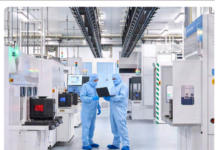
Toppan has constructed a new manufacturing line at its Niigata plant for flip chip-ball grid array (FC-BGA) substrates, a form of high-density semiconductor packaging. The new line will come online in January 2026. Toppan will also install a pilot line to conduct research and development of advanced semiconductor packaging at its Ishikawa plant in Japan acquired in 2023, aiming to commission the line in July 2026.
Regarding the Niigata plant, against a backdrop of rising demand for data centers and edge computing, demand for FC-BGA substrates is increasing. Toppan says it began mass production of FC-BGA substrates at the Niigata Plant in 2014 and has since increased capacity in phases, including the launch of mass production on an expanded line in 2022.

Recent years, however, have seen an acceleration in scaling of FC-BGA size, a rise in the number of layers, and increasingly advanced technical specifications, leading to continued growth in production capacity utilization.
The launch of the new manufacturing line will bolster Toppan’s capabilities for high-end FC-BGAs—large-scale, multilayer substrates delivering high-speed transmission needed for AI and data center semiconductors. FC-BGA production capacity at the Niigata Plant will reach double the fiscal 2022 first half level.
Features
Enhanced support for high-speed transmission: A process will be established to support new low-dielectric constant/low-dielectric dissipation factor materials. The line will employ copper wiring surface treatment that takes into account skin effects during high-speed signal transmission.
Supporting larger, multilayer substrates: There will be a further increase in transferable substrate thickness. The line is designed to support production of sizes that are too large even for JEDEC-standard-compliant trays. Inspection processes and measures against foreign particles will also be enhanced to increase yield rate.
Smart factory measures: Autonomous mobile robots will be adopted for transfer between certain processes.
Future Activities

Toppan aims to launch mass production on the new FC-BGA manufacturing line by the end of fiscal 2025. With the Singapore Plant currently under construction and due to launch operations in late 2026, a two-plant manufacturing system will enhance business continuity capabilities and facilitate global supply of FC-BGAs.
Advanced semiconductor packaging at Ishikawa
Organic redistribution layer (RDL) interposer development to be conducted on the pilot line at its Ishikawa plant has been selected for the research and development project of the enhanced infrastructures for post-5G information and communication systems / development of manufacturing technologies for advanced semiconductors (subsidy), for which the new energy and industrial technology development organization (NEDO) solicited applications.
In the area of advanced semiconductors used for applications such as generative AI and autonomous driving, packaging substrates are being scaled up and chiplet structures are being adopted to achieve higher densities. Chiplet structures require intermediate substrates called interposers to connect chips to packaging substrates. Silicon interposers are currently the predominant type, but due to challenges in scaling up, the industry is looking toward the establishment of interposer technology based on large glass substrates as an alternative to silicon.
Utilizing the new pilot line, Toppan will verify technologies for future mass production by pursuing R&D on components required for advanced semiconductor packaging, such as interposers using large glass substrates as well as glass cores and organic RDL interposers.
The project selected by NEDO aims to simultaneously achieve low power consumption and high-capacity data transfer by developing submicron interconnect fabrication technologies for organic RDL interposers. Toppan will advance the development of technologies and materials in collaboration with Osaka Metropolitan University, Toyama Prefectural University, Shinshu University, the Institute of Science Tokyo, and the National Institute of Advanced Industrial Science and Technology.