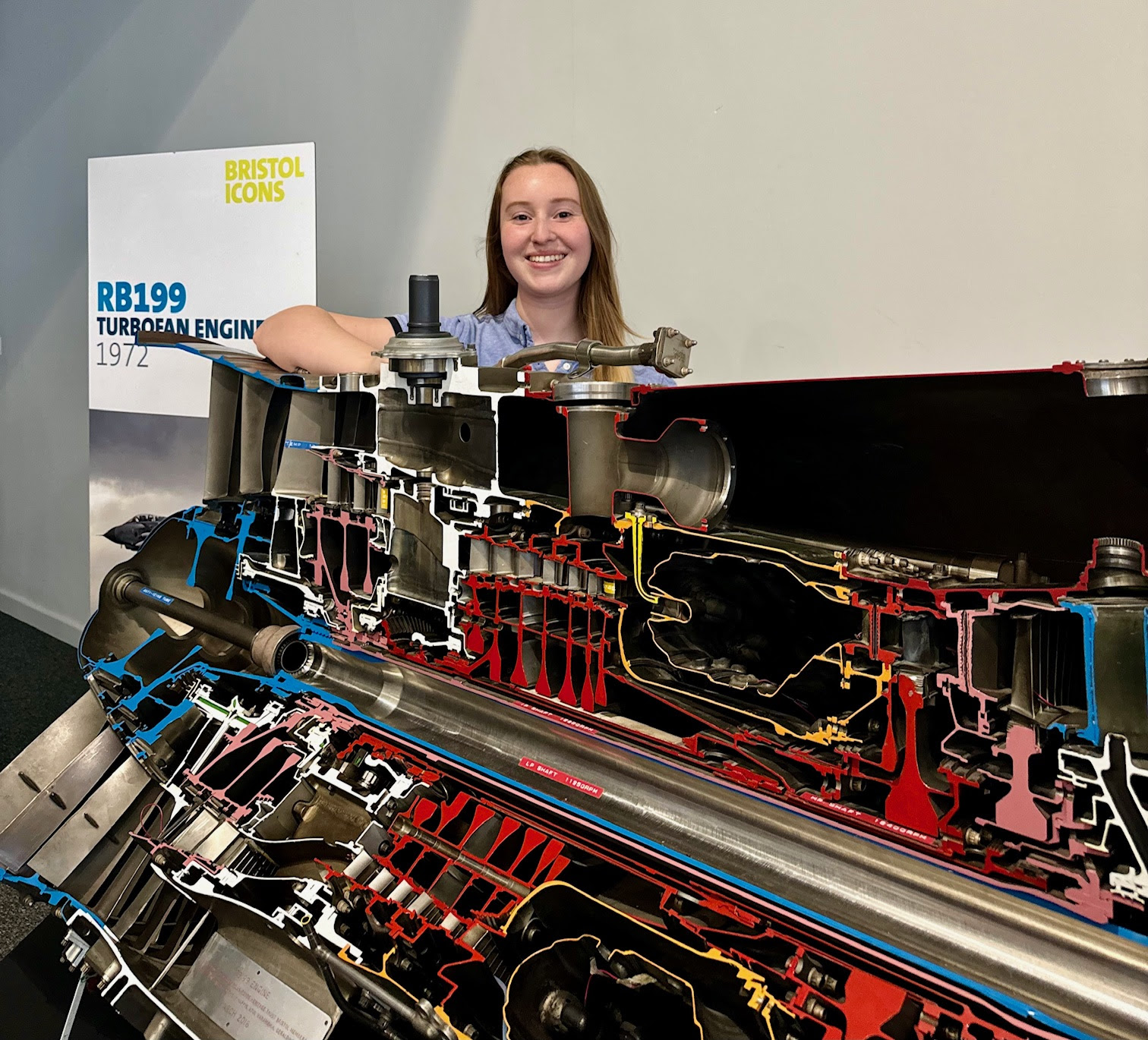
From aerospace to submarines, Alexia Williams’ career at manufacturing giant Rolls-Royce is defined by curiosity, adaptability, and a passion for engineering that lasts. Starting as an aerospace engineering apprentice in 2018, she discovered her calling in sustaining long-life assets already in service, work that now sees her as a Through Life Technical Lead in the Submarine Delivery Enterprise, tackling complex, multi-decade challenges in reliability, safety, and performance.
She’ll be speaking at Packaging Innovations & Empack 2026, sharing insight on how businesses can inspire the next generation of talent, and why packaging – a discipline that spans design, materials science, logistics, and engineering – needs to take STEM (science, technology, engineering, and math) engagement seriously.
“I always struggled with future design,” Alexia explains. “I need to be able to relate to the part, to see it and to interact with it. That’s what drew me to through-life engineering and sustainment. It’s real and it’s tangible – you get to make continuous improvements over time.”
That hands-on experience was possible because of the rotational structure of her degree apprenticeship. Starting at age 18, Alexia was thrown into a whirlwind of placements: from business sales to test and measurement, manufacturing to after-service repair. Not only did this help her zero-in on what made her tick, but it gave her a multi-dimensional view of how complex systems operate. This knowledge would later prove extremely valuable in the company’s submarine division.
“When I did a placement in future design, I hated it. I fell asleep at my desk! But the moment I got onto the shop floor, dealing with in-service issues, something clicked. That’s the benefit of the apprenticeship route, especially in a large business. You find out what fits.”
Breaking the stigma of apprenticeships
It’s this first-hand experience that fuels Alexia’s passion for advocacy. As someone who came through the system without much support from her school, she now works hard to make sure others have the opportunities she fought for. She sits on the Skills England Apprentice Panel, is a Trustee of Enginuity, and actively works to demystify routes into STEM for young people, parents, and employers alike.
“There’s still this archaic misconception that apprenticeships are just tea-making and manual labour grind,” she says. “But that couldn’t be further from the truth. There are degree-level, even masters-level apprenticeships across almost every sector now, and they’re a viable alternative to university.”
She credits an encounter at a country fair with setting her on her path. “I met a GKN graduate who told me his friend had done the same job via an apprenticeship and was two years ahead of him, with no debt. That stuck with me.”
Engineering is everywhere – including packaging
As Alexia points out, engineering doesn’t always mean building engines or utilitarian machines. It underpins sectors as diverse as food, fulfilment, and yes – packaging. That’s exactly why she believes packaging needs to get louder about its STEM credentials.
“When I speak to students, I say if you’re curious and if you like solving problems, there’s a place for you in engineering. It could be in submarines, or it could be in smart packaging. We need to show people that the skills are transferable, and the principles are the same.”
Her own career reflects that: moving from aerospace into submarines, she expected to have to start from scratch, but the opposite was true. “So many of the principles carried over. The idea that you can only work in one field is limiting. People working in packaging have just as much right to be proud engineers.”
Packaging might not always get the STEM spotlight, but it should. Perhaps it’s the small format that masks the complexity behind the scenes, or maybe the volumes produced. But scratch the surface and it’s clear that packaging is right at the intersection of science, technology, engineering and mathematics. And importantly, it’s as much a STEM field as aerospace or automotive; we just don’t always frame it that way.
Use your voice
“I’m passionate about closing the skills gap, but it can’t just be left to schools or government. Employers are absolutely vital and we need businesses to step up and engage,” Alexia says.
At Rolls-Royce, at least 200 apprentices are brought in every year, especially in the nuclear division. It’s not just about upskilling fresh talent, it’s also about the reverse. “Some of our apprentices go into teams and start teaching older staff newer principles and techniques they’ve learned at university or college. That diversity of thought is so valuable.”
From a technical standpoint, Alexia’s work on through-life sustainment echoes many of the same challenges facing packaging.
How do you make systems more sustainable, without compromising performance?
How do you future-proof materials in fast-moving sectors?
“We’re getting better at lifecycle thinking,” she says, “but composites are the next big challenge. They’re improving fast, but we don’t yet know how to repair or dispose of them sustainably. That’s going to be a big issue across sectors – packaging included.”
She also highlights the importance of data. “We gather tonnes of data from submarines when they return from service, but it’s useless if you don’t know how to then take that, interpret it, and apply it. Predictive maintenance, lifecycle optimisation – those principles apply just as much to a filling line as they do to an engine.”
Packaging as a platform for progress
Ultimately, Alexia sees packaging not just as an output, but as an enabler. “It’s a visible, accessible, consumer-facing example of engineering in action. If we want to engage more young people in STEM, packaging is an ideal platform to do that.”
And Alexia will be doing just that at Packaging Innovations & Empack 2026, where she joins a panel on how the industry can attract, retain and empower the next generation of engineering talent.
“There are huge challenges facing the UK, from sustainability to skills. But that also means there are huge opportunities. If we give people the tools and confidence, we can build something better.”
Packaging Innovations & Empack 2026 takes place on 11 & 12 February at Birmingham NEC. Register now for your free ticket and gain exclusive access to insights, innovations, and expert-led sessions that will shape the future of packaging.