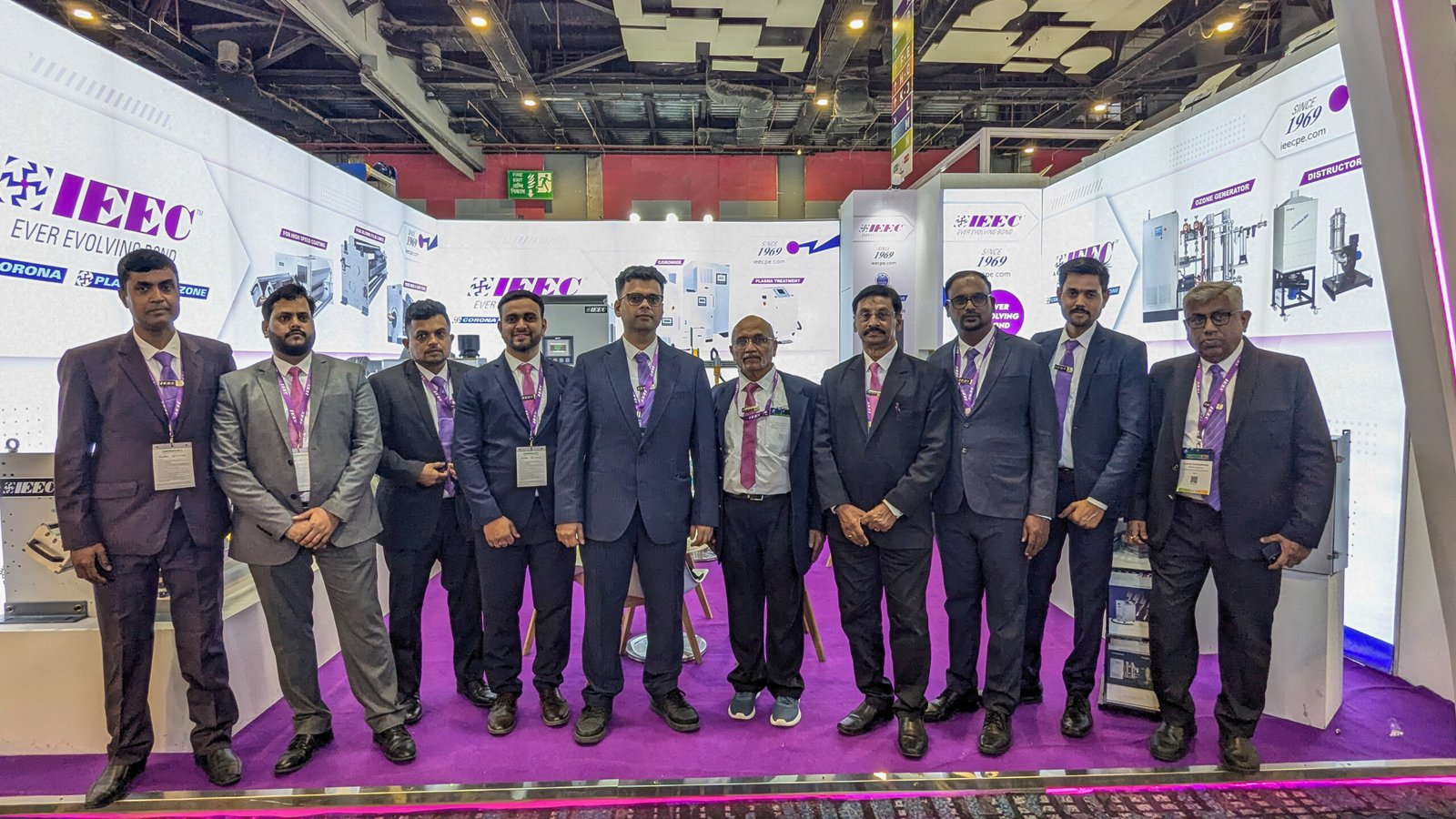
At PlastIndia 2026, IEEC showcased a number of products from its portfolio. Rohit Deshpande, the owner of IEEC Power Electronics, explained the company’s capabilities and strengths. “IEEC is a 58-year-old company with strong roots in surface treatment systems. The company’s expertise covers corona, plasma, and ozone technologies for both two-dimensional and three-dimensional applications.”
IEEC showcased a 2600-mm-wide, double-sided corona treatment system designed specifically for high-speed blown film extrusion lines. Equipped with a 20-kilowatt generator, the system is engineered to deliver stable treatment levels even at elevated production speeds.
Deshpande emphasized that the equipment has already been successfully installed across Indian, European, and Chinese extrusion lines. “The stability of treatment and the retention levels are fabulous with this system,” he noted, adding that the design prioritizes reliability and operator friendliness—two aspects the company considers non-negotiable.
Alongside the blown film solution, IEEC showcased a high-speed corona treater for converting applications, capable of handling line speeds up to 450 meters a minute. Designed for printing, lamination, extrusion, and slitting processes, the system can treat metallized films, non-metallized substrates, and aluminum foil. “We are geared up to treat all kinds of substrates,” Deshpande said.
Another highlight was IEEC’s inline ozone destructor system. Since ozone is an inevitable by-product of corona treatment and can be both corrosive and hazardous, IEEC’s solution employs a catalytic reduction process to convert ozone into oxygen. “No compromise in human safety and a clean environment for production needs,” Deshpande remarked, explaining that the system ensures safer working conditions while protecting critical machine components.
Responding to changing print trends, IEEC also introduced an offline sheet-fed corona treatment system designed for B2-sized plastic sheets used in offset printing. According to him, as non-tearable plastic substrates increasingly move beyond digital, flexo, and rotogravure into offset applications, the absence of inline corona systems in offset presses has created a gap. IEEC’s offline solution allows sheets to be treated and stacked before printing, enabling improved ink adhesion and print quality.
For three-dimensional applications, IEEC displayed its plasma treatment systems, developed to enhance surface energy on injection-moulded and blow-moulded parts, as well as pipes, wires, cables, and automotive components.
Having participated in PlastIndia since its inception, IEEC views the exhibition as a strategic platform. “It is a fantastic opportunity to interact with existing and potential customers.”
Reflecting on market trends, he pointed to rapidly increasing line speeds and higher extrusion outputs, now touching one ton an hour compared to 250 kilograms an hour a decade ago. “We have to gear up to their needs and expectations,” he said.
Looking ahead, IEEC is preparing to enter the waste-to-energy domain through a technology transfer tie-up with BARC for high-temperature DC thermal plasma torches. Operating at arc temperatures of around 8,000 degrees Kelvin, the system converts solid waste into hydrogen. “We are through with the technology development and are waiting to execute it in the market,” Deshpande concluded.