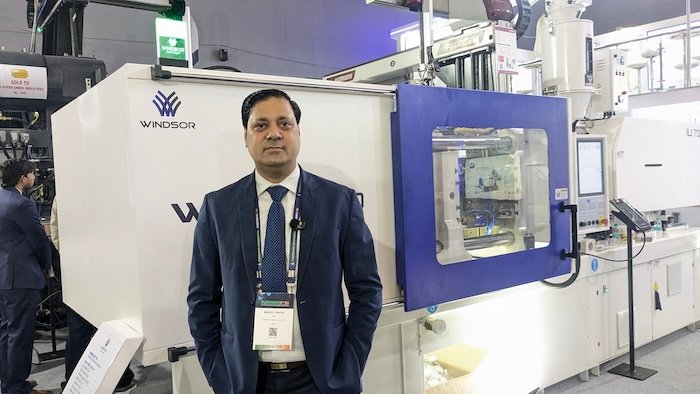
At PlastIndia 2026 in Delhi, Windsor Machines held live demonstrations of five injection molding machines, each tailored to highlight performance, efficiency, and application diversity. One blown film line also ran live at the exhibition. Complementing these showcases was an extrusion-based FFS (form-fill-seal) line.
A standout demonstration was a 1300-ton machine running a 22-inch cooler mold; an application typically requiring 1600 or even 1800-ton machines. According to Manoj Singh, general manager of sales and marketing, Windsor Machine, this reflects Windsor’s ability to optimize machine design and deliver higher output efficiency with comparatively lower tonnage.
The company showcased a 650-ton two-platen machine serving automotive applications. Singh said Windsor’s patented platen design enables a larger tie-bar distance, allowing the machine to accommodate bigger molds than competing systems in the same category. “This gives us a clear advantage in terms of flexibility and application range,” he explained.
A significant highlight of Windsor’s portfolio was its newly launched all-electric machines. Two such machines were demonstrated live—one producing pharma and medical components with a cycle time of five seconds, and the other manufacturing 300 ml thin-wall curd containers in a four-cavity setup with in-mold labelling (IML), achieving a six-second cycle time. The integration of side-entry robotics enhanced productivity and precision. In another application, Windsor displayed a system producing 1-litre IML paint pails.
Speaking about the company’s technological edge, Singh emphasized energy efficiency and machine stability as key differentiators. “Our hydraulic machines consume around 0.3 units per kg, which is among the lowest in the industry,” he said. He pointed to the vibration-free performance of the all-electric machines, demonstrated through a coin-balancing test on the LM guide. “Even during operation, the machine remains extremely stable, which is critical for high-precision applications,” he added.
Singh said the company sold three machines during the exhibition and secured orders worth approximately Rs 10 crore midway through the event. Among the confirmed deals, one cooler application machine was sold to Anmol Industries, while others were booked by customers in Bengaluru and Delhi. “Exhibitions such as these bring a large number of customers under one roof. It becomes easier to showcase our capabilities and close deals in a short span,” Singh remarked.
Looking ahead, Windsor is preparing for a significant scale-up in manufacturing capacity. Following its shift to a new facility in Rajkot, the company is investing in infrastructure aimed at producing up to 350 injection molding machines per month. Singh said this expansion could position Windsor among the largest manufacturing facilities in Asia in this segment.
The company is strengthening its extrusion business, with plans to introduce higher-capacity lines. These include a blown film line capable of 1100 kg output and an extrusion line with a capacity of 1.5 tons. Perhaps the most ambitious milestone on Windsor’s horizon is the development of a 4000-ton injection-molding machine. “Next year, we plan to showcase a 4000-ton machine, completely built in India by Indian engineers,” Singh said.