Packaging, and packaging trade fairs such as Metpack, are a bit of a dilemma for someone like myself because I mainly concentrate on printing. And while many people selling printing equipment do see packaging as their major focus, the packaging industry seems a bit more ambivalent, especially in the metal decorating sector.
Despite this, the metal decorators are facing the same challenge as other sectors within printing. The customers and brand owners really want the same level of image quality they’ve become accustomed to, but with lower order numbers – and for the same reasons as elsewhere – to save on logistics like warehousing and be able to respond faster to market conditions and to run more targeted campaigns. And the only way to do that is through digital – specifically UV-curable inkjet.

Fortunately, there are several inkjet presses for printing directly to metal sheets. I’ve already mentioned Koenig and Bauer’s MetJet series in the first part of this report, though these were only shown at MetPack as scale models. The Chinese manufacturer Hanglory used the show to launch its Nova 1200, which is a single-pass inkjet metal printer with a print width of 1.2m. It will print to aluminium, stainless steel, and tin-plated steel. The full line includes pretreatment, printing and varnishing, as well as a feeder and stacker.

The standard model prints CMYK plus varnish, but there’s an option to add two further colors, such as orange and green. The ink is UV with LED curing. The printheads are Kyocera, which gives it a maximum resolution of 1200 x 1200 dpi. The maximum speed is 50mpm, but many users would probably opt for printing at 600 x 1200 dpi at 30mpm. The print quality on the sheets shown from the press seemed very good. The price is around $3 million.
Now, Hanglory has successfully established itself as a major manufacturer of printing equipment. However, my experience of Chinese companies has been quite hit and miss, even though the engineering and technology are often on a par with anything that a Western vendor might offer. Some are willing and able to discuss their machines just as vendors from most other countries are. In this case, the Hanglory representative got bored and walked off halfway through the conversation, which might just be down to my winning personality. No matter – I’m not buying anything from them – but this kind of thing would worry me deeply if I were thinking of handing over large sums of money, as it suggests that servicing and support might not be everything that a customer would expect.
Sacmi, which is based in Italy, brought along its DMD 1412. It’s not a new printer, having first been announced back in 2019 and officially launched at the MetPack 2023 show. There are already two in Italy, including the beta site at Gruppo Asa in San Marino, as well as two in Australia, in Sydney and Melbourne. It’s a reasonably compact machine at around 25 metes long and highly automated so that it can be run by a single operator. It takes sheets up to 1.2 x 1 meters and can produce up to 2400 sheets per hour. It uses Dimatix Starfire SG600 printheads, which deliver 600 x 600 dpi resolution.
It will take up to 12 colors, with the basic configuration being CMYK plus a white undercoat and an over-varnish. The machine was shown with Sun Chemical UV-curable inks, but Simone Tardini, product manager for Sacmi’s industrial printing division, says, “We sell the machine but not the ink.” Instead, he says that Sacmi will work with other vendors to certify their inks and that inks from Fujifilm and INX should be available for it soon. He says that although this requires some R&D effort, it helps to open up the market and to ensure the ink suppliers compete in terms of price and quality.

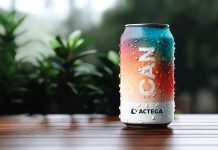
Actega has worked with HP’s Indigo division to develop its Innocan method of applying Indigo prints to metal cans. José Trigo, head of Actega’s Global Market Management for Cans, says, “The order numbers are becoming smaller and smaller. Something has to be done. When I talk to the customers about inkjet, they are investing because they have no other way, even though the quality is not as good as offset.”
So, for this solution, Actega has developed a base lacquer coating that protects the metal and promotes adhesion of the ink. Trigo explained to me, “The idea is that the printing is done on the reverse side of a flexible film and then this is laminated onto our coating.” This should produce a result close to that of offset printing, but with the short run and variable data capability of an Indigo press.
He added, “Metal is a very difficult substrate because of the surface tension. So we don’t print on the metal but on the film. So the process is different. But we don’t need an overcoat varnish because the ink is applied on the other side.” He continues, “We believe that inkjet printing will come, but that many customers will require quality that inkjet can never provide, so I believe this option will be there. We have a lot of companies looking at it.”

Otherwise, Actega showed a broad range of different inks and coatings. Thorsten Kroeller, president of Actega, explained, “For us, it’s more metal packaging than metal printing because we supply quite a broad range of different products. So we are the only ones with a PVC-free closure component. We supply solutions for food and beverage cans for two- and three-piece cans, and we supply coatings and ink primers.”
He added, “We do see ourselves as a solution provider to the metal packaging industry. What we see right now is a trend away from solvent-based coatings to more sustainability. That’s where we have our UV coatings.”
That includes ActNext, which is a UV and UV/LED coating for applications such as general line cans, aerosol cans, drums, closures, and the exterior surfaces of selected food cans. There were also Artistica water-based sealants for beverage cans. Actega also showed ACTstar PTFE-free special effect inks for indirect food contact with thermochromic, tactile, and fluorescent effects.

INX discussed its INXJet MDLM, which is a low-migration UV LED-curable inkjet ink for beverage cans. This is said to comply with all the usual standards, including Nestle, Swiss Ordinance, and EuPIA as well as withstanding pasteurisation. Ron Deegan, senior vice president of sales for INX North America, says that it’s currently available in CMYK and white as well as an over-lacquer, adding, “We have been asked about orange, violet and green, which is a little more difficult, particularly with violet, but that’s an R&D question.”
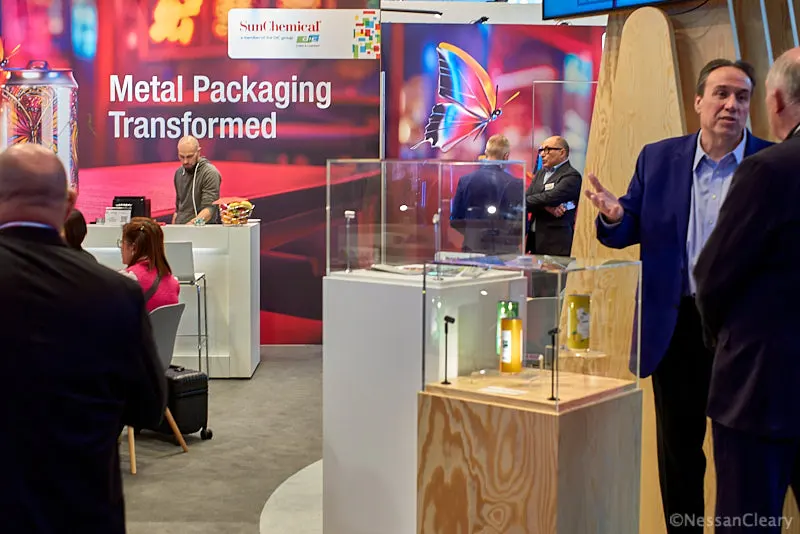
Sun Chemical showed off several of its product ranges, including its new SunDuo Mashu inks for two-piece beverage cans, which have been formulated without using formaldehyde in a bid to improve hygiene around the manufacturing process. Sun Chemical also showed its SunTrio UV inks for three-piece cans and SunAltec for aluminium tubes and monobloc aerosols.
I’ve only scratched the surface of all that was shown at MetPack. That’s partly because although I try to cover all aspects of printing, my main focus is on digital, and this only plays a small part in the metal dec world.
Overall, some 7000 people visited MetPack over the course of four days. According to Messe Essen, 81% of those visitors came from outside Germany, including Italy, the UK and the US, to see some 350 exhibitors from 32 countries. More than half of those exhibitors said that they expected to see additional sales as a result of the show, which is, after all, the purpose of a trade fair.
Despite this, MetPack remains a small show, which is part of its appeal. It’s easy to get around – and with a press office right next to the main entrance with coffee on tap – and yet it was also surprising to see that the metal dec sector is big enough to warrant its own event without in any way being overshadowed by the much larger Interpack fair in Düsseldorf.
And yet I left MetPack with a sense that this is an industry ripe for more digital innovation. It may be a conservative market, but it still faces the same market pressures as other packaging and printing sectors. Smaller order numbers are forcing customers to look into digital printing – or decorating – but those numbers are beyond the very small runs that wide format printing can handle. So it’s inevitable that we will see more single-pass and more direct-to-can inkjet, which should make the next outing to MetPack in 2029 quite interesting.
The first half of the report from MetPack 2026 is here.