The MetPack trade fair in Essen, Germany, which covers the metal decorating industry, proved to be an interesting introduction to a highly specialized niche within the wider packaging print market.
Like many visitors to Interpack, I looked at a day trip to Essen for MetPack as a light appetizer to enjoy the day before the main event kicked off in Düsseldorf, Germany. But it turned out to be much more substantial though not in the way that I had expected.
As with the rest of the print-for-packaging industry, there’s a lot of talk of digital printing. But unlike the rest of the industry, digital printing is nowhere near as widespread. Instead, everyone told me that metal dec is much more conservative. It’s unusual for sales people to tell a journalist that the thing they’re selling just isn’t as good as offset, and yet that’s the metal dec experience. Despite this, most of the digitally-printed samples that I saw were actually pretty good.
There appears to be a growing trend to Direct-to-Shape with two vendors – Koenig and Bauer plus Polytype discussing new prototypes of DtS metal can printers though neither had one at the show. In both cases these were adapted from existing DtS printers for other materials, with both companies trying to gauge the degree of likely interest in them.
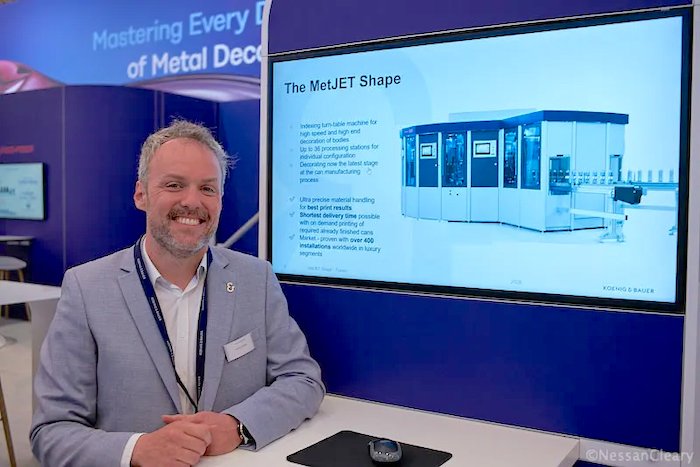
The Koenig and Bauer model is the MetJet Shape, which is the latest member of its MetJet digital metal printing presses. Damian Pollock, who leads the product management team for Koenig and Bauer Metalprint, says, “This is the first time we are talking about it as we want to gauge the interest from customers. Right now the feedback is good so we will most likely continue this product.”
He says that the main target market is three-piece can manufacturers who are looking for extremely short lead times, “and an extremely high digital quality.” It’s designed to print to blank containers and can handle rectangular cans as well as standard three-piece cans providing they have a base coating.
The MetJet Shape has been modified from an existing glass printer that’s used for luxury perfume and spirits bottles – where Koenig and Bauer already has 150 installations. The machine is built around a carousel design, so that the cans enter upright on a conveyer belt, before the grippers rotate them past the various stations. The standard machine has 18 stations, which includes four colors, plus other functions such as pretreatment, cameras for detecting welding marks, drying, embossing and coating, as well as a final camera for quality inspections.
Other stations can be added depending on customer requirements. Equally, the standard configuration is four colors but it can be fitted with up to seven colors. The ink is UV but Koenig and Bauer is working on an option for UV LED curing.
It uses Xaar printheads with a maximum resolution of 360dpi though the print quality from the samples at MetPack is much better than this might suggest. It’s also capable of producing tactile effects to emphasize graphic elements on the design of each can. The printheads are fixed but can be tilted to cope with curves. Thus it can print on the neck of a can, but this depends on the degree of curvature in the neck. Pollock notes, “There will come a point where you can see some lines or there is a dramatic drop.”
Pollock adds, “This solution has a big advantage in lead time. Usually it can take four to six weeks to have a can printed and converted but we can print on-demand.” The productivity obviously depends on the size and shape of the can but it’s likely to be around 100 pieces per minute.
Koenig and Bauer already has two inkjet metal printers, though these were only shown as two small models. The MetJet One is a multi-pass scanning printer jets capable of producing 400 sheets per hour. Koenig and Bauer has so far sold one of these, to a customer in the US.
Then there is the MetJet Pro, which is a single pass printer that can run at up to 2,500 sheets per hour. Again, there is only one installed so far, at a site in Italy. Between the two, customers have a choice between the higher print quality of the One and the faster speed of the Pro. These both use Ricoh printheads with a UV LED curable ink.
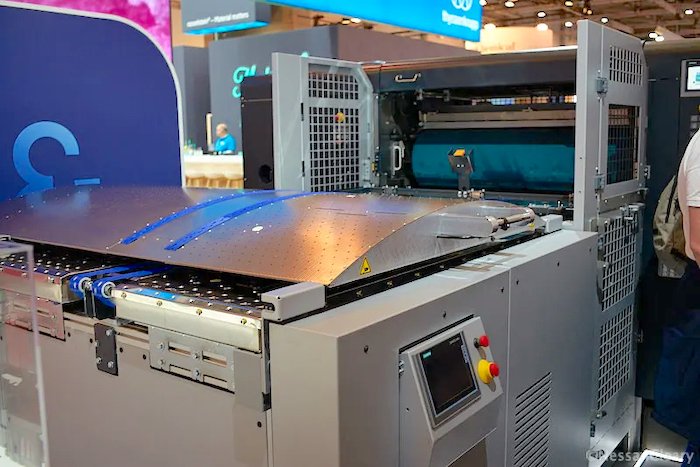
Otherwise Koenig and Bauer’s main news from MetPack was a new Metal Coater, the 484, which replaces the older 483. Product manager Olga Martin told me, “The 484 is the most automated coating machine. We have completely new functionality, including automated washing.”
She added, “We have made all our lines with completely new electrical components, new line controls and we have a job data management which can set everything to all the roller settings, all the feeder settings, and for the whole line, not just the coating machine.” Koenig and Bauer used the show to gain customer feedback on it, with availability in Europe planned for early 2027.
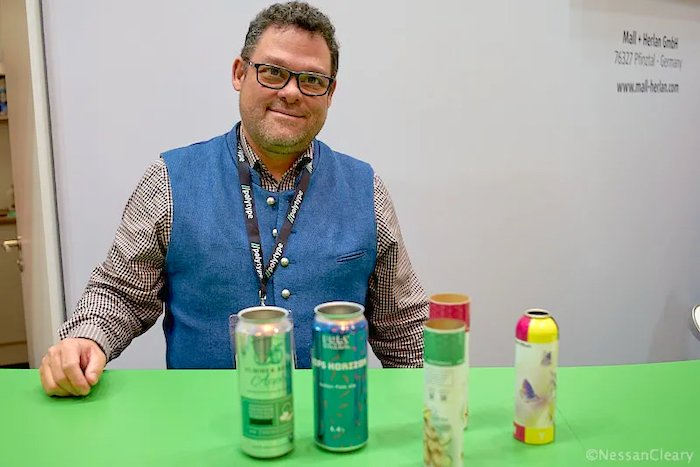
Polytype’s offering is the DigiCan, which has been adapted from the existing DigiTube that was developed to handle plastic tubes. The DigiCan is aimed at the beverage market and will take blank cans up to 66 mm wide and 180 mm high. It will print CMYK plus white, with the option to add orange, violet and green channels. There’s an extra channel to jet a varnish overprint. It can produce up to 120 cans per minute, depending on the size of the can and the configuration of the machine.
Polytype wouldn’t say which printhead it is using, only that it produces 600dpi resolution. The ink is UV LED curable though Polytype is working with several ink suppliers. It prints to the flat part of a can but can print to part of the neck, depending on the degree of curvature. The company is working to develop this further though it depends on the waveform for the printheads, and therefore the ink in use.
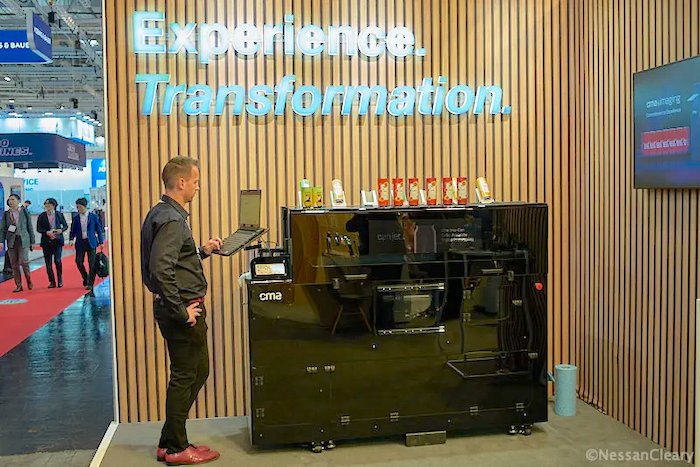
I came across two further DtS can printers. One of these, the CanJet, was sitting on the SunChemical stand. This was operated by CMA Imaging, which provides color management expertise to the metal decorating market. Naturally, it was running Sun Chemical UV inks. It’s fitted with Ricoh Gen6 printheads producing 960 x 1200 dpi resolution. It has ten channels in total, including white and a primer plus eight colors. Those colors are CMYK plus light cyan and light magenta as well as orange and blue. It’s a much smaller and slower machine than the others and is mainly meant for proofing and prototyping small sample runs rather than actual production.
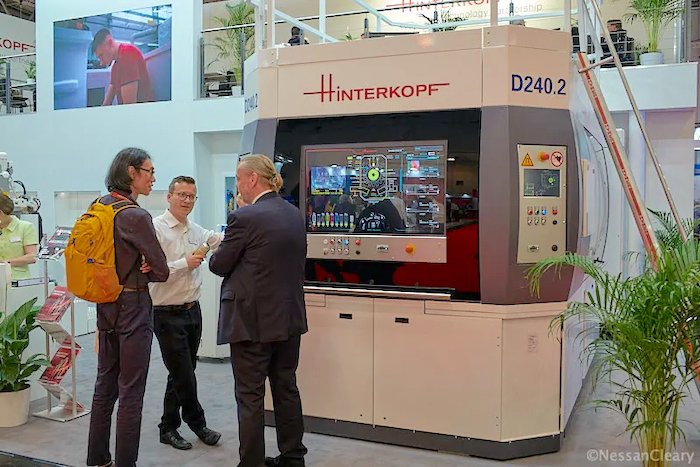
The other DtS printer was from Hinterkopf, which showed off its D240 mid-range model with one smaller and two larger variants also available. This can handle a range of different substrates, including plastic, glass and metal. The basic machine is around 12 years old but it has been updated to keep it current. Thus the D240 can print CMYK plus white, as well as a varnish and spot color. It features 32 mandrels and will take containers up to 74 mm in diameter and 240 mm in height. It will only print to the flat part of a can so that the neck has to be added after printing if needed. It can produce up to 240 cans per minute and mainly seems to be aimed at short–run general production.
There is more to the metal dec market so I’ll publish the second half of this story tomorrow, where I’ll cover printing to flat metal sheets as well as some of the inks and coatings that were shown at MetPack.
First published by Printing and Manufacturing Journal on 11 May 2026. Republished by permission.