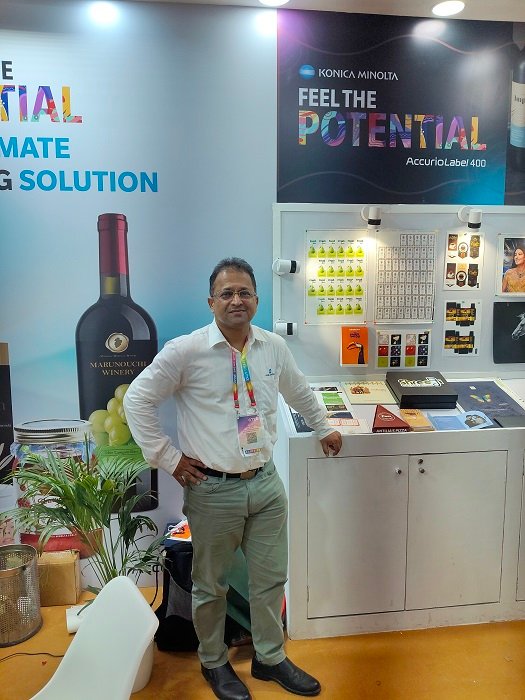
Growing demand for short-run packaging, digital embellishment and RFID-enabled labels is reshaping India’s label printing industry, according to Vijay Kamat of Konica Minolta, who spoke to Packaging South Asia at CMPL 2026 at the Jio World Convention Centre in Mumbai.
Kamat said this year’s CMPL exhibition has attracted a wider range of brand owners compared to previous editions, reflecting the rapid expansion of digital packaging applications across industries.

“Earlier, the show was dominated by cosmetics, pharma and herbal brands. This year, we are seeing participation from chemicals, nutraceuticals, food, beverages and many other verticals,” he said.
According to Kamat, the increasing diversity of visitors has helped create new business opportunities for digital print providers and converters using Konica Minolta technologies.
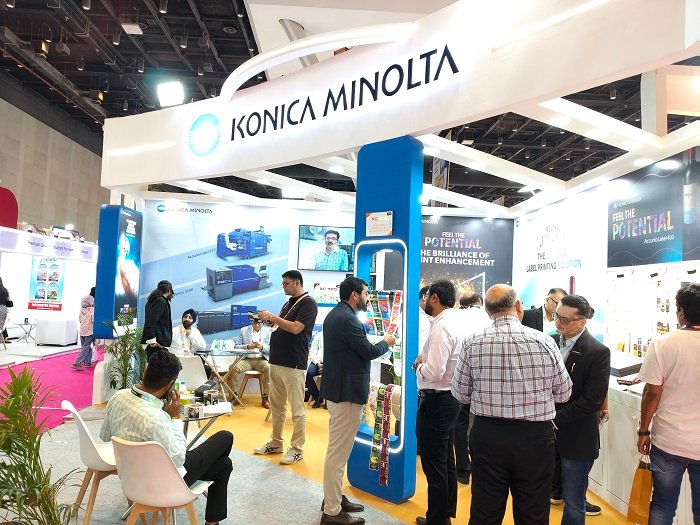
The company showcased applications produced by its customers using MGI digital embellishment systems, including UV and foil enhancements, as well as samples generated on the KM1 UV inkjet press platform. The displayed applications covered segments such as food packaging, cosmetics, pharmaceuticals, nutraceuticals and in-mold label (IML) production.
Kamat said one of the strongest market trends currently driving adoption of digital printing is the rise in short-run packaging and label production.
“Short-run quantities are increasing in the market, and that is benefiting both Konica Minolta and our customers because more print volumes are moving toward digital,” he said.
CMPL, he said, has become a platform that connects converters directly with brand owners, helping printers gain access to new business opportunities that were previously difficult to secure.
A notable shift highlighted by Kamat was the growing interest among brand owners in installing digital label presses for in-house production. Traditionally, digital label presses were purchased mainly by commercial print providers and converters.
“Now some brand owners are asking whether they can install the machines themselves,” he said. “This is a new trend we are witnessing.”
According to Kamat, export-oriented companies are increasingly considering in-house short-run printing because delays in outsourced label production can disrupt export shipments. He said some companies prefer to keep product development and trial packaging confidential during initial launches.
However, he clarified that most companies exploring in-house production are focusing only on short-run jobs, prototype packaging and trial runs rather than shifting their entire label operations internally.
Kamat said Konica Minolta sold 13 digital label presses in the past year, which he described as among the highest sales figures in the Indian market. He added that the company has remained a leading supplier in the segment over the last several years.
The executive also pointed to the growing role of digital labels in applications such as track-and-trace systems, augmented reality integrations, loyalty programs, barcode-enabled marketing and RFID technology. “RFID is booming,” he said.
Annual installations of digital label presses in India have continued to rise steadily over the last five years, signaling long-term growth potential for digital printing technologies in the packaging and labels sector, he said.