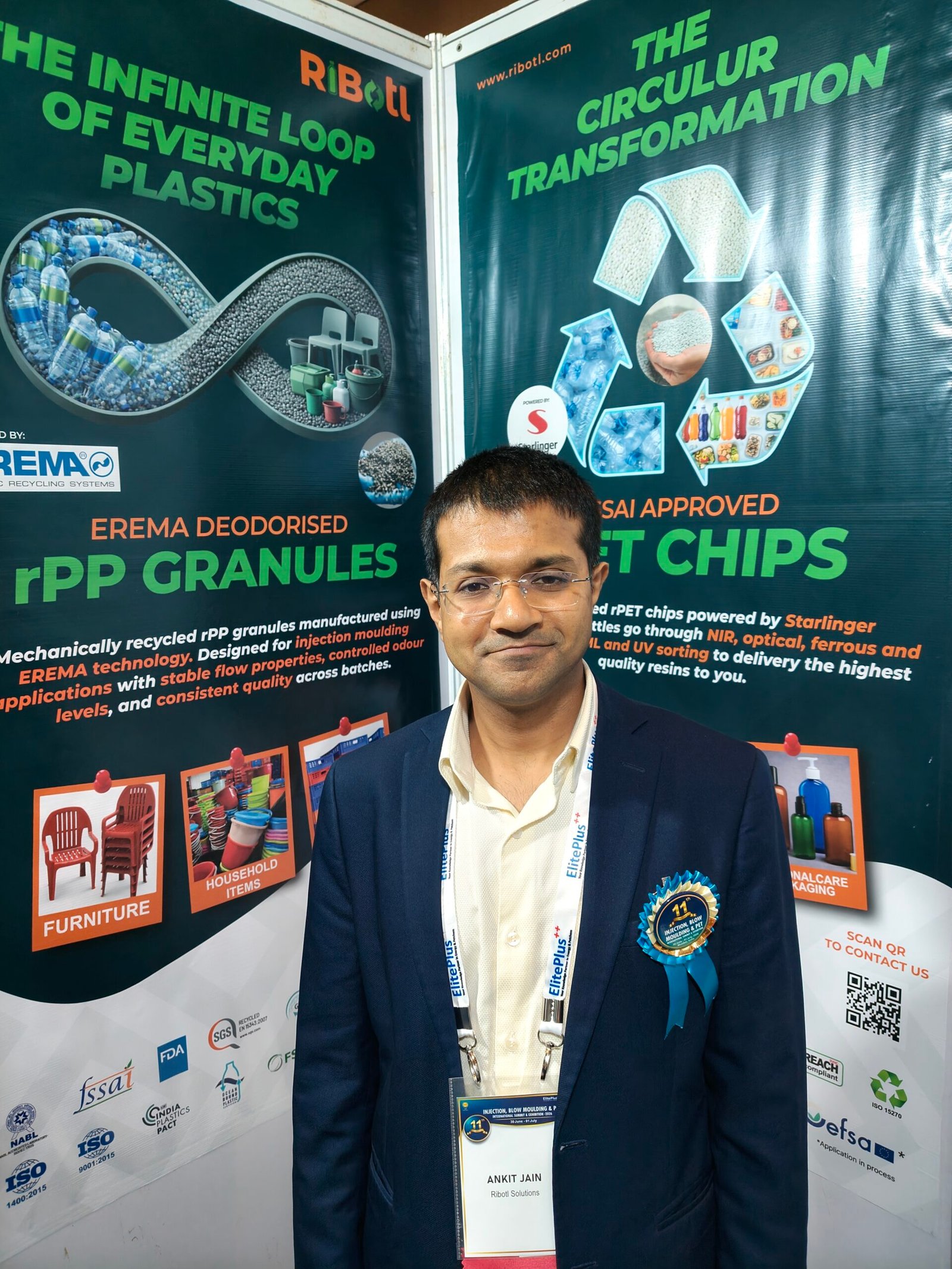
Plastic recycling company RiBotl is expanding beyond recycled PET to develop end-to-end recycling solutions for plastic bottles, as stronger government policies, rising brand-owner acceptance and favorable economics drive growth in India’s circular economy, according to director Ankit Jain.
Speaking to Packaging South Asia on the sidelines of the 11th ElitePlus International Injection, Blow Moulding, PET & Recycling International Business Summit & Exhibition 2025, Jain said the company, a third-generation recycler with more than three decades of experience, has steadily diversified its operations to meet the evolving needs of the packaging industry.
“We have been recycling plastics for the last 36 years. A few years ago, we saw a major opportunity after the government’s plastic waste management regulations encouraged the use of food-grade recycled PET. We invested early in dedicated facilities for food-grade rPET and have also expanded into food-grade HDPE recycling,” Jain said.
RiBotl currently recycles PET, HDPE and polypropylene (PP), to recover every component of a used plastic bottle.
“We aim to provide a complete bottle-to-bottle solution. That means recycling not just the PET bottle, but also the caps and labels, so that every component can be brought back into the value chain,” he said.
Jain believes India’s recycling industry has reached an important turning point, with brand owners becoming increasingly willing to incorporate recycled materials into packaging.
“The last couple of years have transformed the market. Government support, combined with supply chain disruptions and higher virgin polymer prices, made recycled materials far more competitive. That encouraged converters and brand owners to accelerate adoption of recycled PET,” he said.
According to Jain, the beverage industry has emerged as a major driver of food-grade rPET demand, with several leading brands already incorporating high levels of recycled content in their bottles.
He noted that PET has a structural advantage over other plastics because most beverage bottles are transparent, making collection, sorting, and high-quality recycling significantly easier.
“PET has developed a successful circular economy largely because the bottles are transparent. Polyolefins are much more complicated because every brand uses different colours and formulations, making sorting and producing consistent recycled material much more challenging,” he explained.
Jain also highlighted the absence of food-grade regulations for recycled HDPE as a constraint on wider adoption in sectors such as edible oil packaging.
On the raw material front, he said RiBotl benefits from an extensive supplier network built over decades. However, he expressed concern over imported plastic regrinds entering the Indian market through customs classifications, saying tighter enforcement would strengthen domestic recycling.
“Our PET supply chain is well established, but polyolefins face greater challenges because imported regrinds depress domestic prices and discourage the development of local feedstock,” he said.
PET chips remain RiBotl’s largest business segment, followed by PET sheet production, reflecting the company’s continued investment in food-grade recycled materials.
Commenting on the ElitePlus conference, Jain described the event as an important platform for engaging with brand owners, converters and technology suppliers.
“The conference brings together the entire value chain. It provides excellent opportunities to exchange knowledge, understand market trends and build partnerships, which is why we continue to participate,” he said.