The global petrochemicals industry is entering a period of structural transformation driven by geopolitical tensions, persistent overcapacity and the rapid adoption of artificial intelligence (AI), according to Divy Malik, partner at McKinsey & Company.
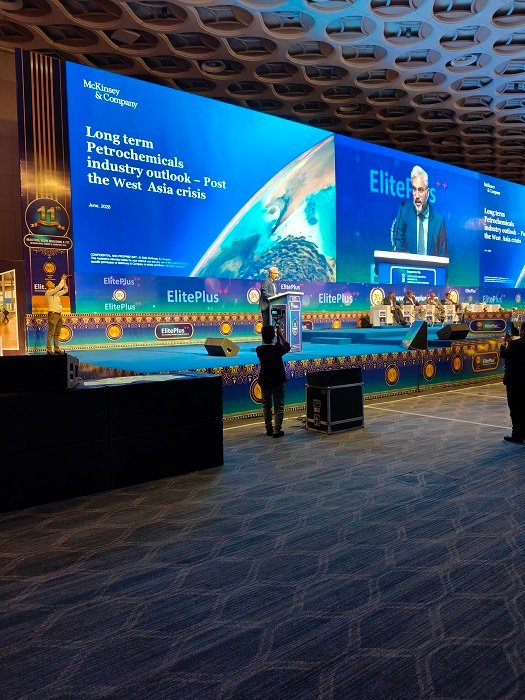
Speaking at the 11th Injection, Blow Moulding, PET International Business Summit & Exhibition, organized by ElitePlus in Mumbai, Malik said the recent conflict in West Asia underscored the vulnerability of global energy and petrochemical supply chains, forcing companies to rethink both their short- and long-term strategies.
“There are 10 global geopolitical drivers that we’re seeing evolving, ranging from trade agreements and currency controls to security conflicts and shifting alliances. Companies are now factoring these disruptions into their long-term planning,” Malik said.
He said the West Asia conflict had a cascading effect on energy markets, supply chains, business operations and investment decisions, making it one of the most disruptive geopolitical events for the petrochemical sector in recent years.
According to Malik, the crisis triggered sharp increases in the prices of several petrochemical feedstocks. Products such as butadiene and urea witnessed price jumps of as much as 75% due to low inventory levels, while methanol, polyethylene and polypropylene recorded increases of between 50% and 75%. PET polymers experienced relatively smaller disruptions, supported by additional production capacity in China.
“The crisis fundamentally shifted global cost curves. Higher energy costs reduced competitiveness, increased production costs and forced companies to reassess their supply chain exposure,” he said.
Although geopolitical tensions have eased following the ceasefire in the region, Malik cautioned that a full recovery will take time as production facilities gradually resume operations.
“We expect it will take between two and four months before supply chains begin returning to normal. Restarting large petrochemical and LNG facilities safely is a complex process,” he said.
Beyond the immediate disruption, Malik said the industry was already grappling with a severe downcycle caused by excess global production capacity and weakening demand.
“2025 was perhaps one of the toughest years for petrochemical producers. Even before the conflict, the industry was facing declining operating rates because of oversupply and slower demand growth,” he said.
He expects operating rates to remain below historical averages until the end of the decade, delaying a meaningful recovery for global producers. While this could keep resin prices subdued, it may benefit packaging manufacturers through lower raw material costs.
Malik said petrochemical companies worldwide are responding by rationalizing assets, pursuing mergers and acquisitions, cutting costs and accelerating investments in new technologies.
“The supplier landscape is changing rapidly. Companies are consolidating to improve competitiveness, and that will eventually influence pricing and commercial relationships across the packaging value chain,” he said.
Artificial intelligence is also emerging as a key strategic priority, moving beyond traditional automation and machine learning to improve manufacturing efficiency, optimize supply chains and identify new growth opportunities.
Looking ahead, Malik said Indian packaging companies could benefit from global supply chain diversification as multinational firms increasingly pursue a “China plus one” sourcing strategy.
“The China-plus-one opportunity is now more relevant than ever. Indian companies that strengthen supply chain resilience, invest in technology and continue advancing sustainability will be well positioned to expand their presence in Western markets,” he said.