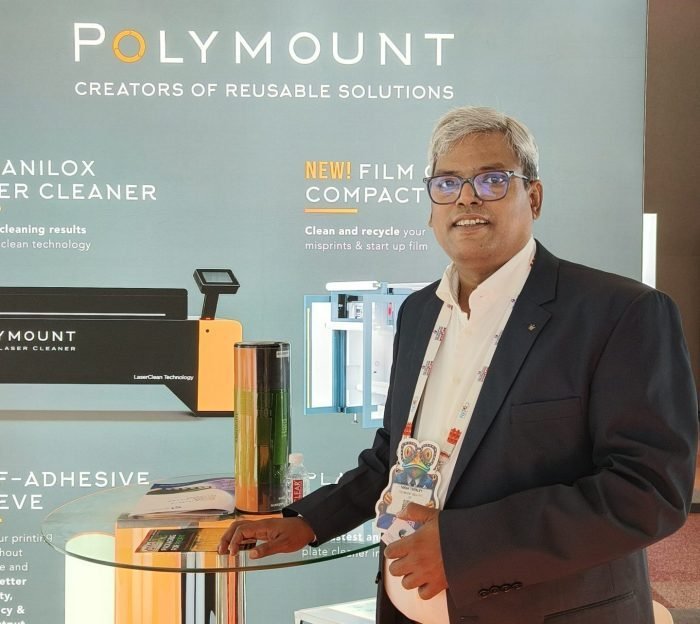
At the Flexo Summit Asia 2026 in Bengaluru, Polymount, an expert in sleeve technology, addressed the complex variables within flexographic printing and highlighted advanced solutions to enhance overall print quality.
Tarak Trifaley, sales director, Polymount India, emphasized the fifth Sigma of the six-part framework, with a heavy emphasis on operational improvement and process stabilization.

Trifaley reinforced their core philosophy that true quality control begins long before ink ever hits the substrate, urging commercial printers to prioritize repeatability, predictability, and profitability across every production run.
A major focus of the discussion was the inherent instability found in traditional mounting procedures, which rely heavily on operator skill and consumable mounting tapes.
Trifaley said conventional workflows frequently introduce hidden defects, such as tape thickness variation, trapped air bubbles, wrinkles, overlaps, and inconsistent cushioning. These manual variables lead to common printing defects such as inconsistent dot gain, halo effects, missing dots, dirty prints, uneven solids, poor color registration, and color inconsistency.
Because traditional mounting tapes are replaced and reapplied for every job, process variation is constantly reintroduced, often causing operators to lose valuable time re-mounting plates and cylinders on the press.
To eliminate these root causes, Polymount advocated for the adoption of self-adhesive sleeve technology as a standardized solution. Built directly into the sleeve, this multi-layer anatomical structure combines a specialized cushioning core, a permanent adhesive layer, and the photopolymer plate into a single, highly stable printing platform.
Available in soft, medium, and hard density options for specific applications like halftones, combination runs, or high-ink opacity, these sleeves streamline the mounting workflow into simple surface cleaning and plate positioning. By replacing variable tape applications with a permanent, engineered sticky coating rated to last up to 10 years, the system drastically reduces setup times, human error, and long-term costs.
He highlighted significant operational, financial, and environmental advantages. “By reducing process variation, converters achieve a faster return on investment, often within 25 to 35 runs, while increasing overall equipment effectiveness (OEE) through reduced press downtime, decreased startup waste, and extended plate lifespan. Furthermore, because the reusable sleeves eliminate single-use mounting tapes and lower solvent usage, they directly reduce landfill waste and carbon footprints, proving that meaningful industrial sustainability can coexist with direct financial savings,” he said.
Polymount announced significant domestic expansion plans. Having launched its Indian operations in 2023, the company inaugurated its new facility in Pune.
Trifaley said, “The plant features re-coating capabilities to quickly repair damaged sleeves locally, saving regional converters considerable freight costs and turnaround time compared to shipping units back to the Netherlands. Additionally, the new site houses a specialized demo room equipped with plate and anilox cleaners, allowing local clients to test cleaning performance directly and experience the operational benefits firsthand.”