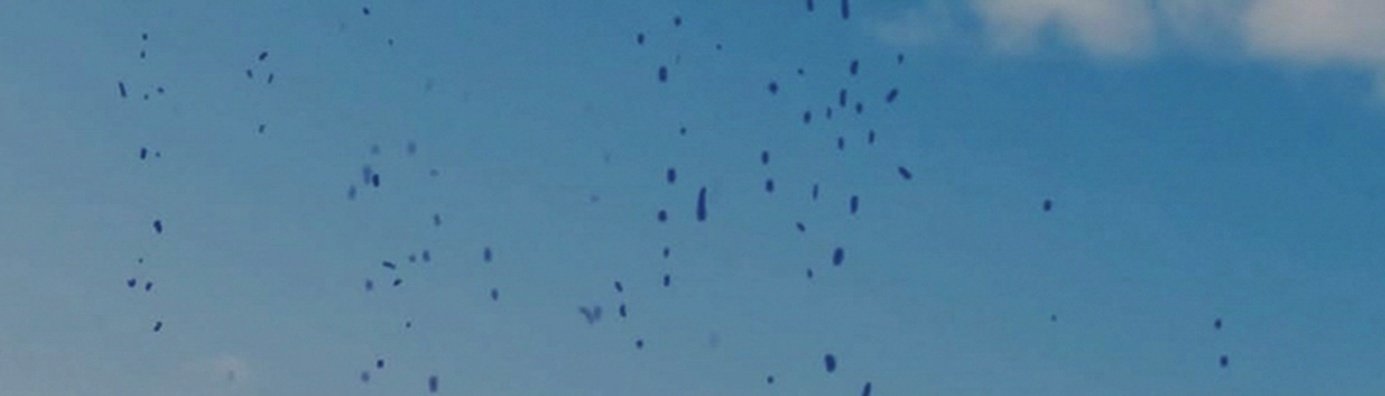
Regulatory requirements are intended to ensure the compliance of printing inks. However, they also affect print quality and process stability—for example, when foaming and spattering of UV label inks becomes an issue. Together with customers, Gallus investigated the root causes of these phenomena, leading to a design solution for chambered doctor blades and their specifications.
Phenomena such as ink foaming, ink spitting and blade jumping were long considered largely under control in label printing. However, they are increasingly occurring again — even on modern printing presses and with experienced printers.

“In my many years of experience as a printer, these defect patterns were virtually under control in practice, and the processes were correspondingly stable,” says Alexander Feit, customer success manager at Gallus.
Regulation changes the reality in the pressroom
One major factor is changing ink chemistry. The European REACH Regulation and its amendments have restricted or banned substances previously used in printing inks, including UV and LED formulations. Some ingredients with defoaming properties can no longer be used, making modern inks more susceptible to foaming.
What initially appears to be a purely ink-related problem therefore becomes a systemic challenge – new ink formulations interact with printing technologies that were originally developed for different material properties. The interaction between ink, ink chamber, doctor blade and anilox roller can become unbalanced.
When ink chamber geometry becomes a problem
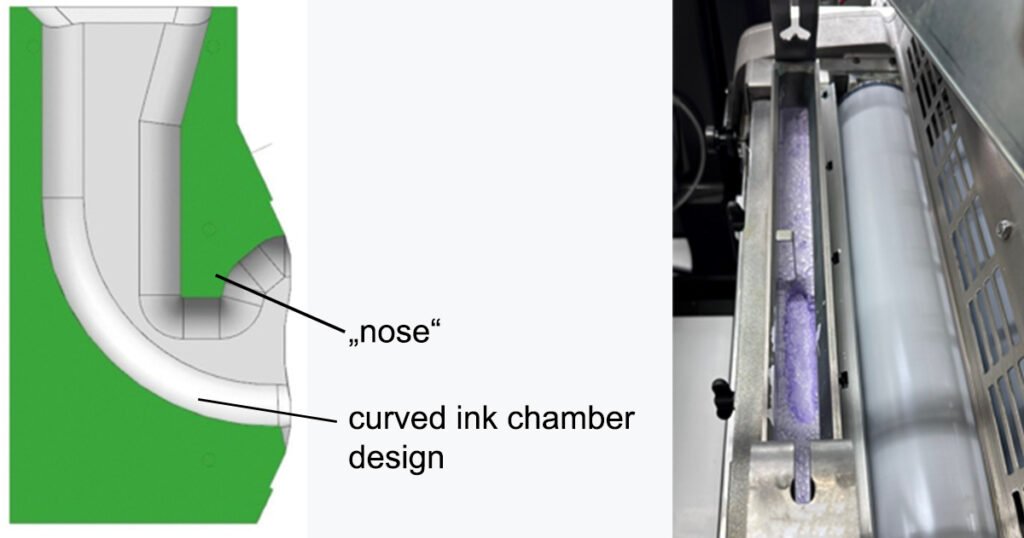
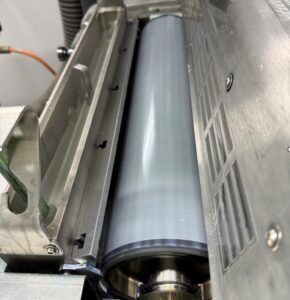
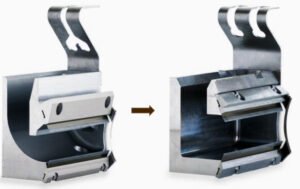
A key element in flexographic printing is the chambered doctor blade and its ink chamber. Its task is to transfer ink evenly onto the anilox roller. However, the geometry of previously used round-shaped ink chambers can generate greater ink movement.
In combination with inks that are more prone to foaming, this effect is amplified. Air drawn into the ink accumulates in the system, preventing the anilox roller from being wetted uniformly. The result can be uneven ink laydown, voids, and print quality losses.
The situation becomes particularly critical during production interruptions. When the press stops, air bubbles can migrate downward into the chamber and further exacerbate the problem, creating a self-reinforcing cycle.
Small change, big impact
Gallus addressed the problem by modifying the ink chamber geometry. Instead of the previous curved shape, an angular, flow-optimized version was developed. It reduces ink movement and air turbulence within the chamber.
“We only changed the geometry — the effect was enormous,” says Alexander Feit. “In field tests with around 15 customers, foaming was reduced by up to 80 percent.”
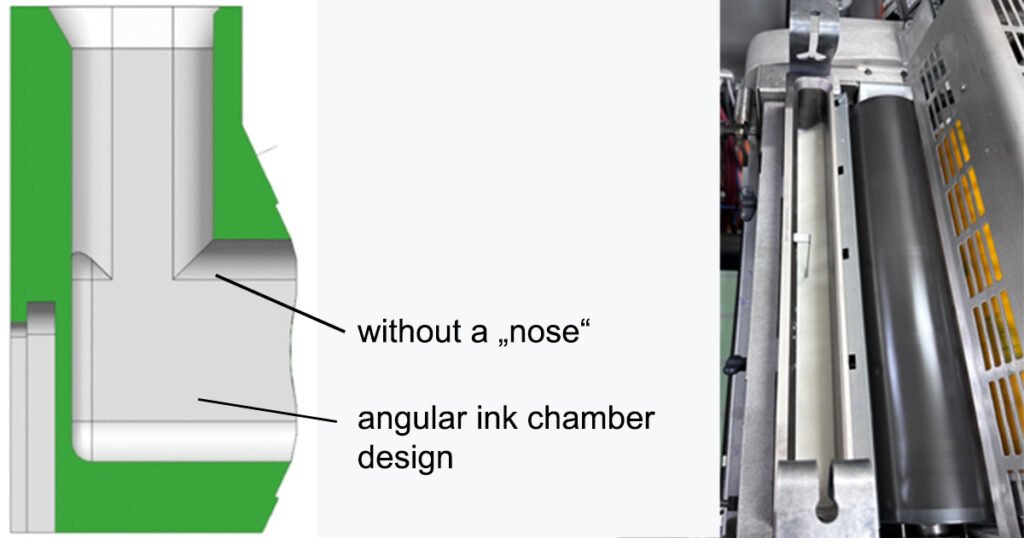
The results of field tests with around 15 customers were significant: foaming was reduced by up to 80%. At the same time, printing presses whose speed had previously been limited to around 20 to 30 meters a minute due to unstable processes were able to significantly increase their production performance.
The traditional curved geometry nevertheless continues to offer advantages. At higher printing speeds, it enables efficient ink transfer to the anilox roller and works reliably with many inks and varnishes. A change in geometry is therefore particularly relevant when foaming, ink spitting or blade jumping occurs.
An often underestimated factor: the doctor blade
In addition to the ink chamber, the doctor blade has a major impact on process stability. In practice, many users opt for inexpensive variants for cost reasons. However, blade quality and geometry can have a direct effect on ink spitting and blade jumping.
Specially alloyed blades promote a ‘lotus effect,’ helping excess ink run off. On uncoated blades, ink can accumulate on the open side, form droplets, and fall onto the anilox roller, which then flings it off. Unsuitable blade geometry or an incorrect angle can exacerbate the problem.
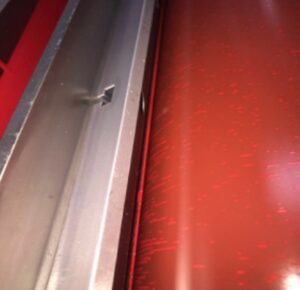
The cutting-edge design is also important. Lamellar edge geometries help control ink flow while reducing stress at the blade edge. Material thickness and stability matter too – micro-vibrations can contribute to spitting, whereas more stable blades help suppress these effects. Blade jumping also impairs doctoring and increases wear on both blade and anilox roller.
Gallus consequently revised its blade portfolio, introducing a material thickness of 0.25 mm to support smooth running and process reliability at competitive prices. Three product lines address different operating requirements:
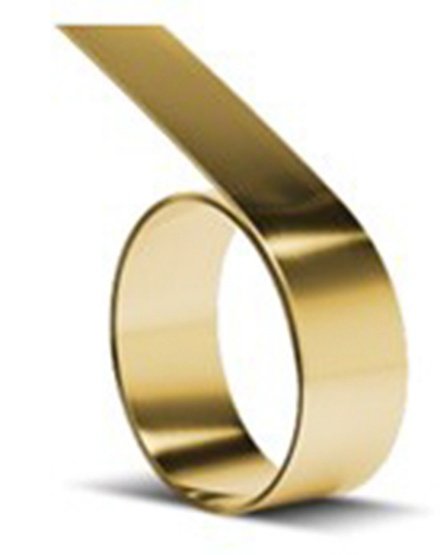
Soft Line uses a special coating to reduce ink adhesion, spitting, and streaking. Its soft composition protects the anilox roller against abrasion-related damage. It also suits sealing blade applications, particularly for short to medium runs.
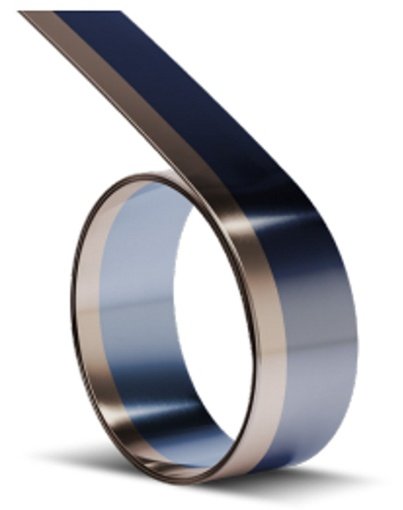
Classic Line provides a versatile standard, combining wear resistance, stable performance and economical service life for medium to high print runs.
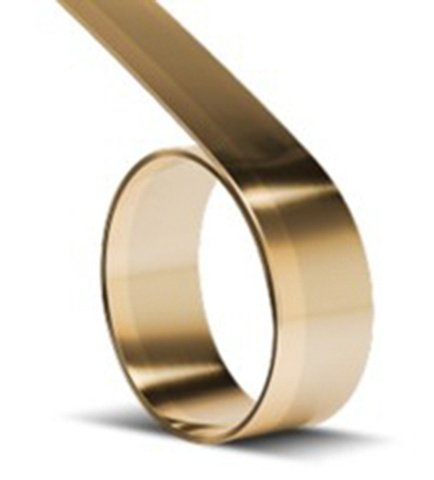
Top Line combines high-performance steel with a dual coating for demanding applications. It targets high speeds, UV and water-based ink systems, and highly abrasive inks and varnishes.
Cleaning – the often overlooked key
Another decisive factor in process stability is a consistently clean anilox Anilox cleanliness is another factor. Even small quantities of residue inside the cells can impair ink transfer; heavier contamination can contribute to spitting.
The roller must both accept ink and release it predictably. Deposits interfere with this balance, making cleaning integral to process control rather than simply a maintenance task. Alongside manual methods, dedicated cleaning systems and laser technology can remove stubborn residues, including contamination deep inside the cells.
A holistic approach rather than an isolated solution
Experience from numerous customer projects shows that isolated measures are not sufficient to address the complex interaction of ink transfer components. Process stability depends on the interaction of ink, chamber, doctor blade, anilox roller, and doctor blade pressure.
The key is therefore not a single component, but the way all components work together. When ink formulation, chamber geometry, blade design, anilox condition and pressure are properly matched, problems such as foaming, ink spitting and blade jumping can be significantly reduced. Ultimately, stable UV flexographic printing requires a system in which all components fit together and work in harmony.