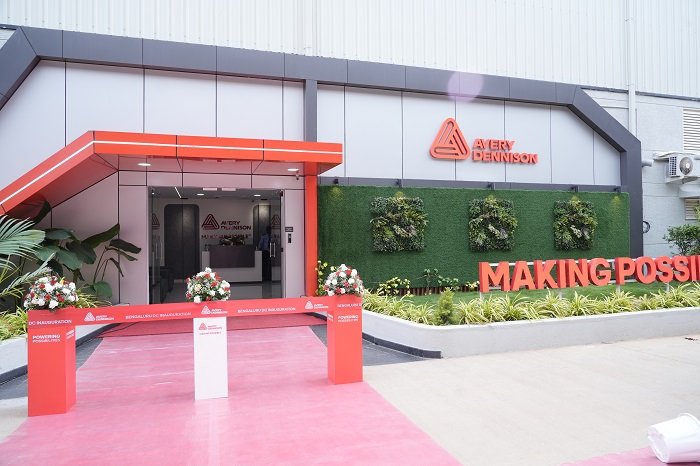
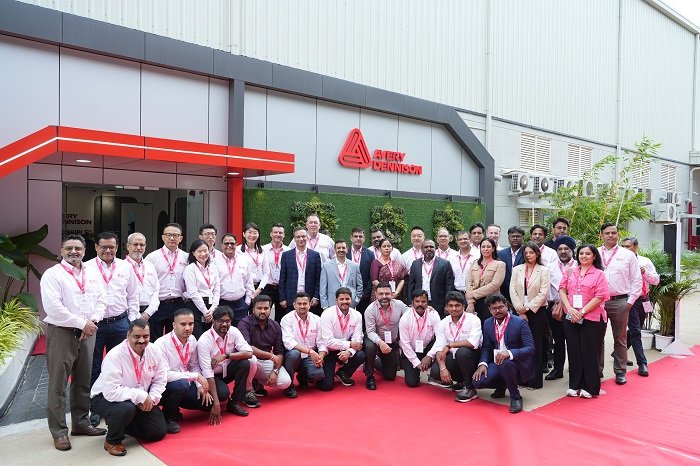
Avery Dennison South Asia, a leader in materials science and digital identification solutions, recently inaugurated its new distribution center in Bengaluru. Just ahead of the Loupe India show, Packaging South Asia spoke to Saurabh Agarwal, vice president and general manager, South Asia, Avery Dennison on the new distribution center and the response.
Agarwal said India is a strategically important market for Avery Dennison, and the company’s investments reflect a consistent approach of strengthening its capabilities close to customers while building the infrastructure needed to support their evolving requirements.

In 2022, Avery commissioned its Greater Noida manufacturing facility, which doubled its pressure-sensitive label production capacity. “We subsequently established our first RFID inlay and label manufacturing facility in India, in Pune, in 2025. Together, these investments strengthened our manufacturing capabilities and expanded our ability to serve customers with advanced labeling and identification solutions,” Agarwal said over an eMail interaction.
The Bengaluru center complements these investments by addressing another critical part of the value chain – product availability and speed of delivery. “With more than double the capacity of our previous facility, it strengthens our ability to serve customers across South India and support a diverse portfolio spanning pressure-sensitive labels, intelligent labels, tapes, graphics and reflective solutions,” he said.
As customer requirements evolve, reliable supply and timely access to products become just as important as product quality, he said ”Strengthening our distribution infrastructure enables us to respond more effectively to these expectations and build greater consistency into the customer experience.”
The new distribution center is more than an warehouse capacity expansion, Agarwal emphasized. “It is a strategic investment in the supply-chain capabilities required to support our customers’ growth, respond to changing market needs and strengthen our long-term presence in South India.”
Micro & macro indicators
The new facility highlights a strategy of “scaling infrastructure ahead of demand,” On the micro or macro market indicators in South India that Avery studied to scale up so significantly before the demand fully materialized, Agarwal said, “Our approach has always been to build capacity ahead of demand, ensuring we have the infrastructure in place to respond to evolving market needs.”
At the macro level, sustainability, evolving regulatory requirements and growing emphasis on product authentication and safety are reshaping the labeling industry, he said, adding these trends are creating demand for increasingly specialized materials and solutions, making supply-chain flexibility and product availability more important.
At the micro level, Avery looks at changing service expectations and the need for greater supply-chain responsiveness. Brand owners and converters, he said, increasingly expect consistent product availability, reliable service and faster turnaround times. “Meeting these expectations requires distribution infrastructure that can support a diverse product portfolio while enabling greater operational efficiency.”
According to Agarwal, South India is an important market, and Bengaluru provides a strategic base to strengthen Avery’s distribution capabilities in the region. Expanding the facility ahead of anticipated demand allows the company to build the capacity and flexibility needed to respond to emerging opportunities, improve delivery reliability and support the evolving requirements of industries.
The location advantage
Avery Dennison has heavily emphasized a ‘closer-to-customers’ approach with this launch. According to Agarwal, the change shows up in simple, everyday things for its customers. The new center is 2.3 times larger than its earlier warehouse.
“That allows us to hold more stock across labels, RFID, tapes, graphics and reflective solutions closer to customers. A printer or converter placing an order is now more likely to find the material ready, and less likely to wait on a replenishment cycle,” he explained.
Speed is the second change. The site has good access to Bengaluru’s peripheral road network and sits outside the city’s operational restrictions. This allows the company to offer a one-day delivery within Bengaluru and move material across the country more efficiently. “For customers working to tight production schedules, that gap matters.”
“Being closer to customers means fewer delays, fewer follow ups and more time spent solving problems together.”
Bengaluru’s location serves as a significant enabler. “In last-mile logistics, delivery timelines are influenced not just by distance, but also by urban congestion and vehicle access restrictions. Locating the facility outside Bengaluru’s city limits gives us greater flexibility in planning dispatches, allowing us to align our operations more closely with delivery requirements rather than being constrained by city-entry timings,” Agarwal said.
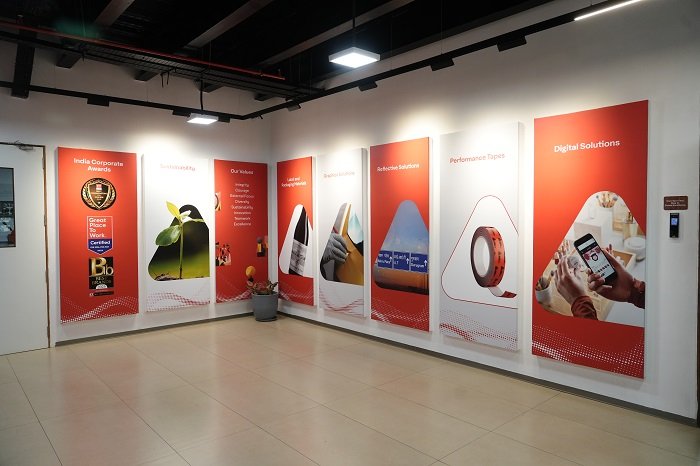
The third change, as per Agarwal, is access. The center has a customer experience center where brand owners and business partners can see Avery’s work in materials science, RFID, labeling and sustainable packaging applications for themselves.
Diverse range of technologies
“Every material we hold behaves differently, so the real challenge is making sure one roof does not mean one set of rules,” Agarwal said.
Pressure-sensitive labels and graphics films, he said, react to temperature and humidity, carry a defined shelf life, and need to be kept off the floor and in their original packaging until they are used.
Tapes have their own adhesive behavior and storage limits, while intelligent labels with RFID are a different kind of product altogether, since they carry electronic inlays that need careful handling and tight batch traceability. Reflective solutions bring another set of handling needs.
Together, this means the facility has to run different storage and handling practices for different businesses without letting them get mixed up, he explained.
The second challenge is inventory, he said, adding a wide mix means a large number of product codes, roll widths and lot numbers, and each one has to be picked, packed and dispatched accurately, on a first-in, first-out basis, so that nothing ages on the shelf. “Orders also rarely contain one product type. A customer may ask for labels and RFID together, and the center has to bring those into one dispatch.”
“The layout has been planned for growth, so that adding volume does not slow down service. That is why we see this facility as a supply chain capability and not as extra warehouse space. For the customer, the result should be simple. The right material, in the right condition, on time.”
Customer experience center
According to Agarwal, brand owners should be able to see, touch and evaluate a solution before making a decision. “Our distribution center is where our materials are physically present. An interactive experience into this setting creates a natural connection between exploring a solution and understanding how it can be applied.”
Avery established its distribution center in the city in 2010 and followed it in 2012 with a knowledge center, showcasing equipment and processes across the label converting and application chain. Located alongside Avery’s slitting and rewinding facility, it served as a space for training, prototyping, innovation and testing.
“That experience reinforced the value of bringing operational capabilities together with learning and collaboration, and we are building on that approach with the new center. The same thinking has informed our investments elsewhere in India, including our innovation and knowledge center in Pune.”
The Bengaluru customer experience center, he said, continues this approach, with a more direct focus on helping brand owners explore our capabilities and identify solutions suited to their requirements.
“The center allows businesses to experience our portfolio first-hand. They can compare materials, understand their potential applications and engage with our teams on what best aligns with their product requirements, market needs and sustainability priorities,” Agarwal concluded.