The Tokyo Pack packaging show comes around once every two years and gives an interesting idea of how the major Japanese vendors view the packaging industry, at least from a printing perspective. There was little in the way of printing equipment – which is not surprising for a packaging show – though quite a few press manufacturers did take stands, and there was also information on materials and inks.
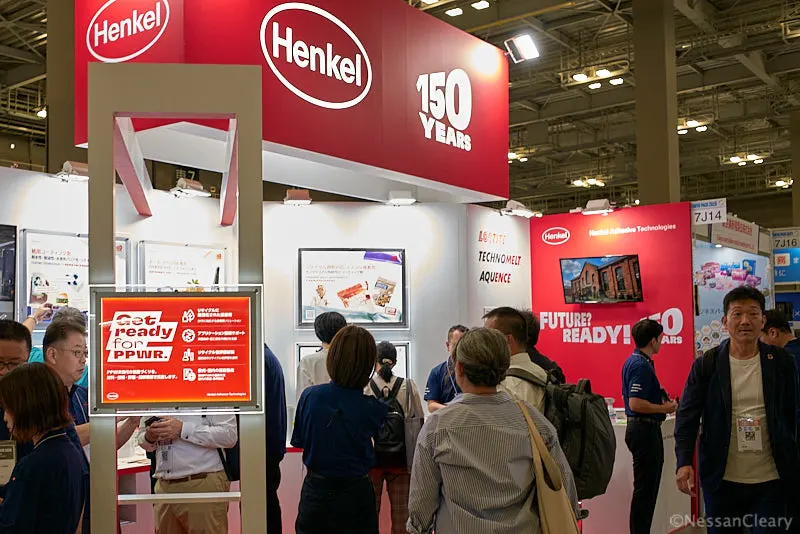
Several companies, such as Henkel, referenced the upcoming European PPWR Packaging and Packaging Waste Regulation. Japan is quite effective at separating waste into different streams and has been doing this for many years. But several vendors – who were pushing mono materials for packaging – suggested to me that the Japanese government was also considering its own regulation, essentially a copy of the European PPWR, and that this could be in force by 2035. Thus, Henkel showed off an OPP film that includes a laminated metallized layer for barrier performance.
DIC has also been thinking about PPWR, with Hiroyuki Fukui, manager of the printing material products division of DIC, telling me, “Many customers request us to be compliant with PPWR.” Thus, DIC is working on a water-based inkjet ink that is under development. DIC also showed Crystal, a UV ink available in two variants, as UDY for flexible materials and UDN for rigids. And DIC is working on Sunrise AQP, a water-based ink for publishing. DIC is hoping to sell it to a printer OEM but is still looking for one to take it on.
One of the things that always catches me by surprise in Japan is the level of interest in electron beam curing. For the most part, EB curing is prohibitively expensive despite the advantages it offers – namely no risk of contamination from the inks on the packaging to the products within, which is especially useful for food and healthcare packaging. And yet there is persistent interest in this technology within Japan despite little evidence of any widespread use or even working EB lamps produced within Japan. That said, four ink companies have invested considerable time and effort in developing suitable inks, including DIC, Sakata Inks, Artience (formerly Toyo) and T&K Toka. As far as I can tell, the most successful print solution comes from Comexi, which is distributed in Japan by Dainippon Screen, and uses DIC’s EB offset ink.
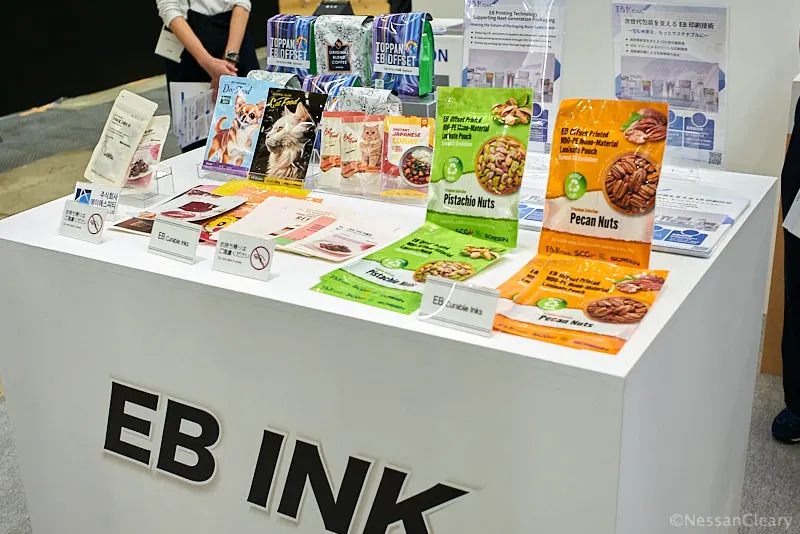
T&K Toka ink showed off samples printed with two different types of inks, including an EB flexo ink. Yuki Trinidad Shida, manager of the overseas ink sales group for T&K Toka, says, “We believe that EB has some potential.” He says this is mostly around food packaging but adds, “Also, we do see some movement from the European PPWR, and this might be one of the drivers for EB printing. So we are looking at the possibility of going for surface printing to eliminate the plastic waste. And also we are looking at mono materials.” T&K Toka already has customers in Thailand and Korea that are looking at EB curing, and he points out that Toppan is already running a Comexi EB press in Japan.
The main issue with EB inks is that the curing equipment is quite expensive, so to counter this, T&K Toka has developed a Zero UV ink, which is said to be a UV ink but without the photoinitiator, and which can be cured with a standard UV lamp. Shida explains, “Whenever we check the regulations, and especially from Europe, coming in two to three years those materials will be classed as toxic. We find materials, and then they are banned. So we would like to make an ink that aligns with sustainability but also complies with global regulations for a long period.”
However, this ink is still in development, and since T&K Toka has not yet patented it, he was unwilling to explain further how it works other than to say, “This new material also creates the reaction after UV radicalization, and then it polymerizes.” For now, T&K Toka is working with an unnamed converter to improve the print quality. The initial plan is to launch in Japan first, but Shida accepts that it is likely to be relatively expensive, limiting its appeal to niche applications, mainly around primary food packaging.
He says that the degree of interest amongst visitors at Tokyo Pack was split 50:50 between the two ink types. He adds that the EB is for wider web flexo competing against solvent gravure on film, while the zero UV is for paper-based flatbed inkjet printers but could also be used for narrow web presses.
Sakata & Miyakoshi ELM UV, EB offset, EAS & water-based developments
Elsewhere, Sakata inks showed off its broad portfolio, including its ELM Extreme Low Migration UV ink, which is based on a new but unspecified photoinitiator. It’s not yet available, still being under development for an unnamed printer manufacturer. For now, the inkset consists of a primer plus CMYK, but there is a white ink that is also in the pipeline. It’s designed to print to PE materials.
Hirokazu Kaneda, assistant manager in Sakata’s Digital and Speciality Products division, explains, “If we change the photoinitiator, then the ink viscosity becomes higher, which is how we can reduce the migration, but it does not affect the substrate compatibility.”
Sakata is also working on an EB offset ink under the DreamCure label, which is available in two versions. Thus, LA7 is for reverse printing for uses such as packaging for snacks, and includes CMYK plus orange, green, and violet as well as white. The other ink is EAS, which is for surface printing of labels and general-purpose packaging, and includes CMYK. I believe that Sakata is also working on an EB ink for inkjet use, but this was not shown.
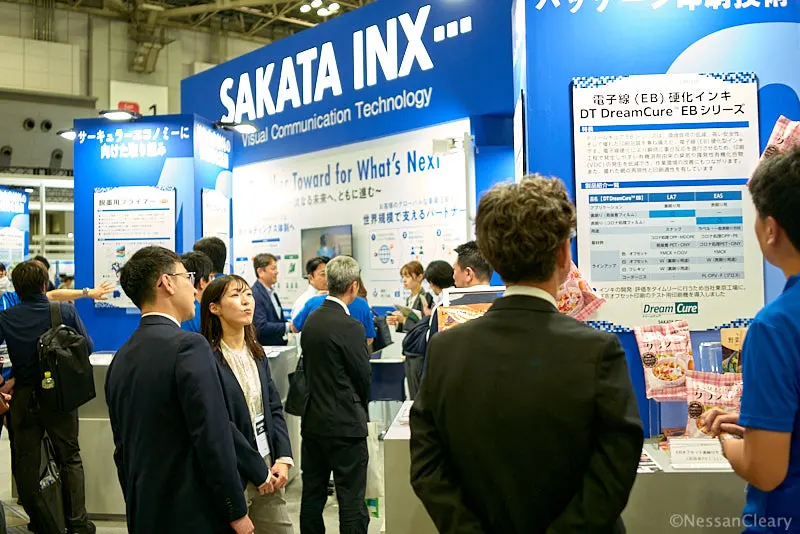
Sakata is working with Miyakoshi in developing its EB inks. Miyakoshi sees the packaging market as split into three parts based on run lengths and has three separate presses for addressing each of these segments. Marketing manager Tets Uchida says that new opportunities are opening up across the spectrum as brands look for alternatives to very long run rotogravure presses. That includes an inkjet press, the MJP Advanced, for short runs from 1000 to 4000 linear metres. There’s a choice of widths with the 30X at 790 mm, which is also rebadged by Fujifilm as its FP790, and the 45X at 1100 mm, with one of these in production at one of Japan’s largest flexible packaging companies, Osaka Sealing Printing. I’ve already written about this press here.
Then there is an EB offset press, the MHL EB, which is aimed at medium run lengths of 4,000 to 10,000 linear metres. This was commercially launched last year, and this year Miyakoshi added a 1000 mm-wide option. This runs with Sakata ink, and to date, the only installation is with Sakata as part of its R&D. The base configuration is for CMYK plus a single white channel, but it can take up to 10 colors, including a second white. There’s also a flexo option available for laying down a top coat or for reverse printing using white ink. It can run at a decent 200 meters per minute with CMYK + white with the flexo top-coating option. Uchida accepts that it’s an expensive machine but notes that Miyakoshi has also benefited from Comexi’s efforts to popularise this technology.
Miyakoshi’s third option is a wide web CI-flexo press, the MCI-W, which can cope with runs from 10,000 and upwards, and which uses water-based inks. Uchida says that gravure is still the dominant technology and that there is stiff competition from Western CI press manufacturers like Bobst or Windmöller & Hölsher, adding, “But we have an advantage in servicing and currency (because of the weakness of the Yen).” He accepts that the long-hoped-for shift from gravure to water-based flexo has not happened yet “so the market is still very limited.” But Uchida believes that there is an opportunity as converters will eventually have to replace their ageing gravure presses, and water-based flexo offers a more sustainable option.
It’s also worth remembering that Miyakoshi showed a prototype of a water-based inkjet press for the label market at last year’s European Labelexpo. This press, the MJP 14LXA, is still in development but with a good chance that it will appear commercially next year.
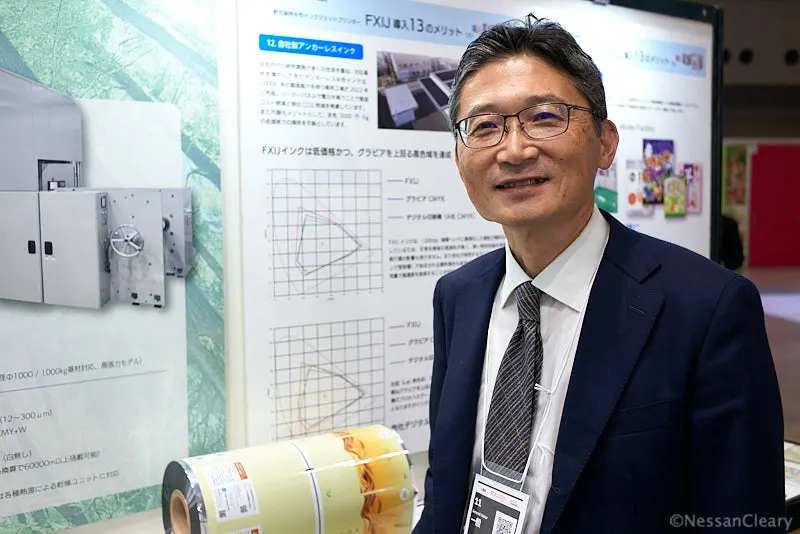
I also came across Think Laboratory, which is not as well known outside Japan as it should be. The company has developed a single-pass inkjet press for printing to flexible film, the FXIJ. There are currently four of these installed in Japan and a further two in Europe.
It prints to a wide range of media, including PET, OPP, PE, nylon and cellophane as well as shrink sleeve film. There’s a choice of two models, with the Type 540 printing up to 540 mm width on media up to 600 mm wide, while the Type 1080 has a print width of 1080mm on media up to 1100 mm. It uses a water-based ink, with president Kaku Shigeta saying that Think Lab has its own ink factory.
The FXIJ uses Dimatix Samba printheads at 1200 dpi for the CMYK colors, which can run from 40-70 meters per minute. It can also be configured with white ink, but the white channel uses 360 dpi Seiko heads because of the need for bigger drop sizes. The use of white ink slows the press down to 30-50 mpm.
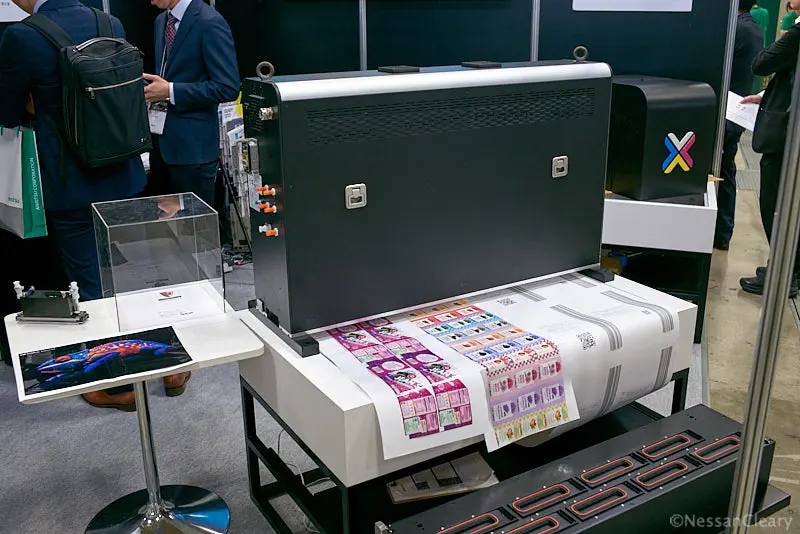
Kyocera Nixka showed off its Lenix 1200 printbar, which was developed at Nixka’s base in France and has been shown in Europe before. However, Kyocera is only just starting to sell this in Japan, so Tokyo Pack marked its debut.
The print bar has eight heads arranged in two rows of four, giving it a print width of 866mm. The heads themselves are Kyocera’s 1200 dpi KJ4B EX1200 for color printing to CMYK with water-based inks. But there’s also a 600dpi version for the white ink, although Kyocera also expects that some customers will simply use a flexo unit for white ink. Nixka has developed the ink system for it with Comexi and is assuming that Comexi will also launch its own version at some point.
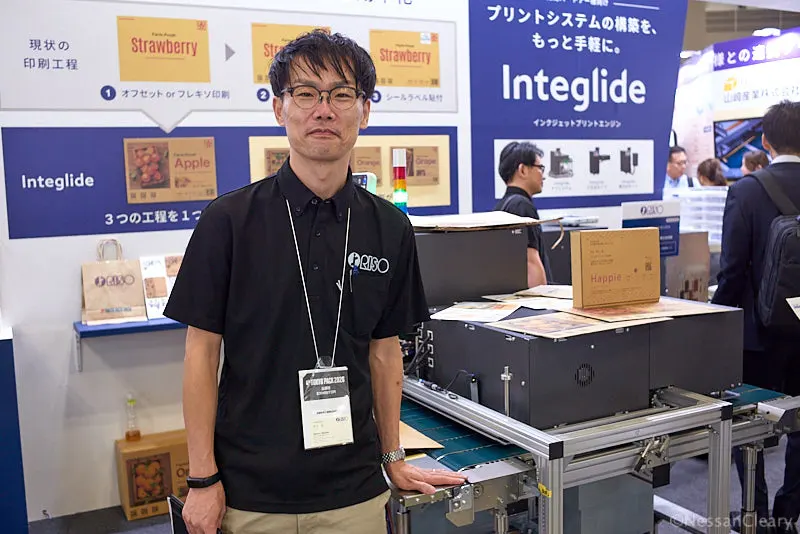
Riso showed off an updated version of its Integlide inkjet coding and marking printer. Riso previously provided its own printheads, ink, and control unit but now makes the print engine itself, including the maintenance unit, as well as the feeder and stacker. This uses an oil-based ink, so there’s no need for a drying system, as the ink is absorbed into paper-based substrates to be immediately touch-dry upon printing.
Finally, I came across Keyence, which makes a number of different products that are all aimed at factory automation. This includes a coding and marking printer for secondary packaging boxes that can print various items such as barcodes, QR codes, or lists of contents. It can even complete a job if the box stops halfway through for any reason.
Keyence also showed off a new laser printer that will work with most films. It does need an opaque area on the packaging as it works by changing the color of the plastic – meaning that there’s no ink or other consumable to run out and very little maintenance is required.
Inevitably this story has been more of a hurried snapshot rather than a detailed overview, partly because Tokyo Pack is spread over several halls, but mostly because it runs alongside Label Forum, which I’ve already written about, necessitating a certain amount of hurrying between the East and West sides of Tokyo Big Sight. Nonetheless, apart from keeping up my step count, the two shows taken together suggest that there is still plenty of innovation in Japan.
First published on 19 October 2026 by the Print and Manufacturing Journal www.nessancleary.co.uk