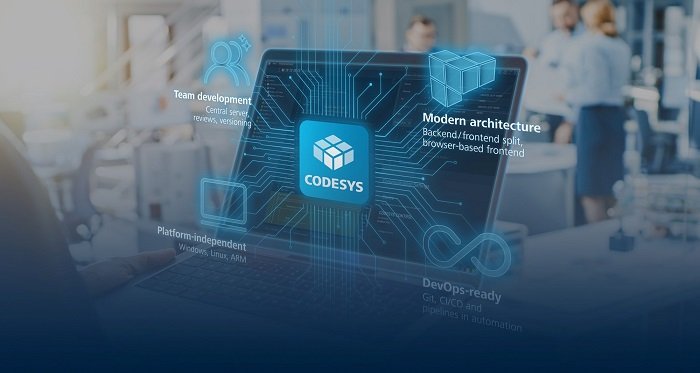
Codesys Group, a global name in hardware-independent industrial automation software, has announced the launch of Codesys 4, a web-based IEC 61131-3 development environment that brings cross-platform engineering, automated library builds and centralized team development to PLC programming. The initial release supports production use in library development and small device applications using Modbus TCP.
Codesys 4 runs natively on Windows x64, Linux x64 and Linux ARM64, eliminating the need for a virtual machine to operate the development environment on supported Linux platforms. Engineers can continue programming in Structured Text (ST) and Ladder Diagram (LD), using familiar IEC 61131-3 methods while incorporating modern version-control, code-review, and build-automation practices. Built on the same compiler, libraries and controller runtime foundation as Codesys 3, the new environment preserves established engineering investments while introducing more flexible development workflows.
The environment separates its web-based frontend from the backend responsible for compilation, project management, and controller communication. This architecture supports both interactive engineering and automated operation without a graphical interface. Windows users work in a self-contained application window, while Linux users access a local session through a browser. Fast project loading supports a responsive start to development work.
Native text-based project storage makes project contents accessible to standard development tools. Instead of a single proprietary binary project file, projects are stored as folders containing JSON, XML, and plain-text files. Teams can use external tools such as Git to track changes line by line, create branches, review code, and merge parallel contributions, making development changes easier to inspect and manage.
Command-line operation enables supported tasks to run through CI/CD pipelines without opening the user interface. Library developers can automate compiled-library builds while continuing to develop and test in Codesys 3, or develop directly in Codesys 4. This flexibility allows teams to introduce automated workflows without immediately changing their entire engineering process.
Dependency declarations, lock files with exact versions and checksums, and semantic versioning help maintain consistent library builds across developer workstations and automated pipelines. Compiled libraries can be delivered without accompanying source code and integrated into projects in either Codesys 3 or Codesys 4. Library projects stored using file-based storage can also be opened in both environments, supporting mixed-tool workflows and gradual adoption.
For team development, centralized Linux deployment reduces the need to maintain separate installations on individual workstations and allows users to work with a common software version. Each user session runs in a separate operating-system process, so a crash in one session does not affect the others. Server access can be managed through Linux account controls and integrated directory services.
For small machines, test benches, and other manageable device applications, the Modbus configurator allows engineers to create channels and map digital and analog inputs and outputs to program variables. Initial project-engineering support covers specified Codesys Control SL runtimes for Raspberry Pi, Windows soft PLC, Linux and virtual-controller platforms; devices from other manufacturers require validation of their device descriptions and libraries.
The Structured Text editor provides syntax highlighting, autocompletion and hover tooltips to assist programming and code review. Inline variable-value monitoring and a watchlist allow engineers to observe application values, while the initial Ladder Diagram editor provides basic offline graphical programming functions. German and English interfaces, light and dark themes, keyboard-accessible commands, sample projects and step-by-step guidance support everyday use and onboarding.
Codesys 4 can operate entirely within an organization’s own network without an Internet connection or cloud service, giving users control over where software runs and project files are stored. Architectural security controls include authentication, request rate limiting and cross-site request forgery protection in the frontend/backend channel.
By combining cross-platform development, text-based projects, automated library builds and centralized team workflows, Codesys 4 provides PLC developers greater flexibility in how they develop, manage and build automation software. Codesys 4 complements Codesys 3, with both environments continuing to be developed and maintained in parallel, allowing teams to adopt the new capabilities at their own pace while retaining established engineering tools. Codesys 4 can be used free of charge until the end of 2028 and will thereafter be included in the license bundle for the Codesys Professional Developer Edition.
Codesys Corporation is the North American division of the Codesys Group, a global leader in hardware-independent industrial automation software. Serving manufacturers, machine builders, OEMs and system integrators across the United States, Canada and Mexico, Codesys Corporation provides access to the industry-leading Codesys automation platform, along with dedicated sales, technical support, consulting and training services.