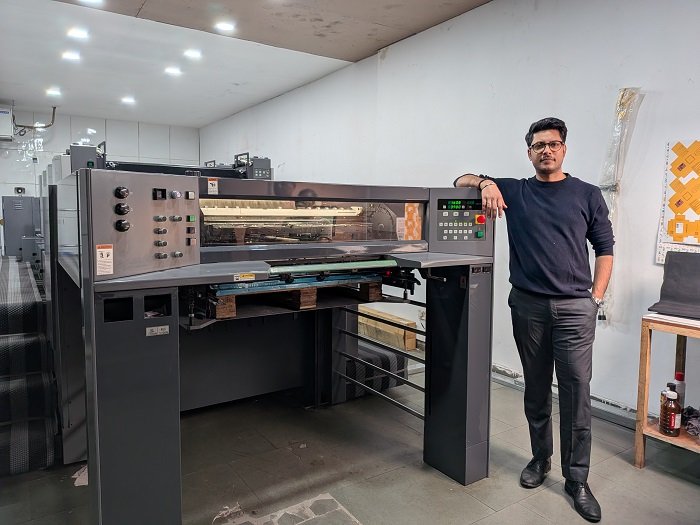
Commercial printer Universal Offsets was launched by Vikas Gupta in 1990 in Delhi’s Patparganj Industrial Area and shifted to Noida in 2015. A year later, Karan Gupta, the next generation, joined the family-owned and run commercial and book printing business.
The company, which recently added a new RMGT 920ST 4-color sheetfed offset press to expand its book printing capacity, has also diversified into rigid box manufacturing.
Universal currently has two plants in UP: one in Noida with 80,000 square feet on four floors and another on a one-acre plot in Pilkhuwa near Hapur (about 40 kilometers from Noida). We spoke to Karan Gupta during our mid-November visit to the Sector 67 Noida plant. Apart from the new RMGT, the Noida unit has six sheetfed offset machines – five 4-color and one 10-color offset press. The postpress department includes book binding machines from Bindwel, Muller Martini and Wohlenberg.
The Pilkhuwa plant has two coldset web offset machines from Ronald Web Offset and Orient TPH and two 8-color sheetfed offset presses from Komori and Akiyama. Universal Offsets mainly uses Toyo and Sakata inks.
Gupta, a master’s in finance graduate from the University of Strathclyde in Glasgow, said the company diversified into book printing in 1995, and while its current focus is on 4-color softcover books, it continues to produce a high volume of commercial print such as leaflets, calendars, and fliers. Having begun with a single-color Dominant sheetfed offset 36 years ago, the senior Gupta says much grit and hard work have gone into building the business to its current level.
Universal Offsets’ Noida plant specializes in 4-color book printing of soft cover books, paperbacks, children’s activity, board and sticker books for both domestic and global publishers. The Pilkhuwa plant mostly deals with government sector printing with tender-based work. While the company has case-making and casing-in machines for hardcover books, the focus is on softcover books. “Universal Offsets can produce 50,000-60,000 softcover books in a single day,” he said.
Except for certain states in South India, Universal produces softcover textbooks for publishers across the country. It has publishing contracts with the Punjab School Education Board, the Rajasthan State Textbook Board, the National Council of Educational Research and Training (NCERT), and the Jammu & Kashmir board. Gupta says besides point-of-sale materials for corporate brands in the Noida unit, it specializes in calendars. “We used to participate in government-based calendar tenders on a large scale. Before the Covid-19 pandemic, we used to print over 50 lakh calendars for both government and private clients. After the pandemic, the government spend on calendars has drastically reduced.”
Diversification into rigid box manufacturing
As recently as August 2026, Universal Offsets diversified into rigid box manufacturing. “The packaging industry is moving to rigid boxes, which offer a premium look and feel. Many D2C brands as well as confectionery and sweet shops are spending more on packaging products they can charge a premium for.”
He adds that, “Rigid box manufacturing is a lucrative but challenging business. It involves multiple stages – using lamination, foiling, UV drip-off textures for embellishment and embossing, making it much more difficult than simple monocartons and corrugated box manufacturing.”
For rigid boxes, there is a semi-automatic line from Ample Graphics, along with lamination and UV coating machines. “Depending on the size and type of box, we can produce 10,000 boxes in a day, on average.”
Challenges in the book printing market
According to Gupta, though the prices of paper, inks, and chemicals increased due to the most recent wars, end customers have not increased the prices of printed products. “Many printers are doing work at prices that shouldn’t be done. Although initially there was a 30-40% hike in prices due to the war, the prices of consumables have stabilized a bit now.”
Acknowledging a shortage of skilled manpower, he says print businesses can find good people if they pay the right wages. “The minimum wage protest in April across UP has had an impact on every business. Though the minimum wages have increased, we are fine with it.”
Book printing demand is holding. Though Noida has numerous printers specializing in book printing, there is tremendous demand for both private and government work. “If every printer works to give their best, there is enough business for everyone,” he concludes.