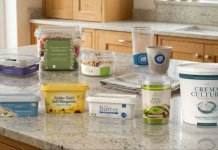
Multilayer packaging reliably ensures high quality and fresh food products. Thanks to its properties, it protects products and keeps them hygienic, thereby extending the shelf life of food. This is of particular importance in light of global food supply – one-third of all food produced worldwide is spoiled before it reaches consumers’ plates. Smart solutions with multilayer packaging can play a part in reducing this unnecessary waste.
Multilayer packaging is sustainable – it does not require much material and can now also be produced from chemically recycled material.

“Today’s high-tech film packaging solutions consist of multiple materials and layers with different properties, such as an oxygen barrier. And thanks to the optimized use of materials, we were able to reduce the packaging volume to a minimum,” said Johannes Remmele, managing director of Südpack.
Multilayer packaging consists of up to 11 individual, ultra-thin layers, making it considerably lighter and thinner than comparable packaging. In addition to reducing the amount of raw materials used, this also contributes to considerably lowering CO2 emissions during transport. All in all, multilayer packaging claims to be more resource efficient than its alternatives.
However, multilayer packaging could only be recycled to a limited extent, because mechanical recycling processes are not suitable for composite materials. “Within the ChemCycling project, BASF is working on advancing the chemical recycling of plastic waste, because this will make it possible to process and reuse previously non-recyclable plastics such as mixed plastics. In collaboration with our partners, we have now for the first time produced a prototype packaging made of chemically recycled polyamide and polyethylene. This goes to show that the recycling of multilayer packaging could soon come full circle,” explained Christoph Gahn, who is responsible for the polyamide business at BASF.
This pilot project was made possible because of the collaboration between the four partners BASF, Borealis, Südpack and Zott. BASF supplies chemically recycled polyamide, while Borealis provides sustainably produced polyethylene. Südpack, one of Europe’s leading producers of film packaging for food products, uses these materials to produce multilayer film for a specially sealed Mozzarella packaging for Zott Gourmet Dairy.
Zott enjoys numerous benefits thanks to this multilayer film. “In our dairy, we continuously review the entire value chain to determine where we can be even more sustainable and how we can sensibly extend our sustainability standards. Now more than ever, customers expect that the packaging of their high-quality and sustainably produced food is as resource-efficient as possible. This is why it was important to us to be part of this pilot project right from the start in order to share our experience as well as our high-level requirements on packaging and its barrier functions, and to contribute to the development of a solution with identical functionality and increased environmental performance. We are very optimistic and hope that this project will make it to series production,” explained Andreas Strunk, Head of Production, Technology & Supply Chain Management at Zott.
“What is special about this pilot project is that both components of the packaging – polyamide and polyethylene – are made from chemically recycled material,” emphasized Maurits van Tol, Borealis senior vice president – Innovation, Technology & Circular Economy Solutions. He added, “This innovative solution came about thanks to the selection of special polymers. In addition, the collaboration between the companies involved made it possible for the first time to consistently certify each step up from the raw material to the finished packaging.”
The raw materials for polyamide and polyethylene were produced in very small quantities as part of the ‘ChemCycling’ project. The pyrolysis oil derived from plastic waste was supplied by a partner and fed into BASFs Verbund production site in Ludwigshafen as feedstock. According to the certified mass balance method, both plastics have an allocated 100% share of recycled materials.