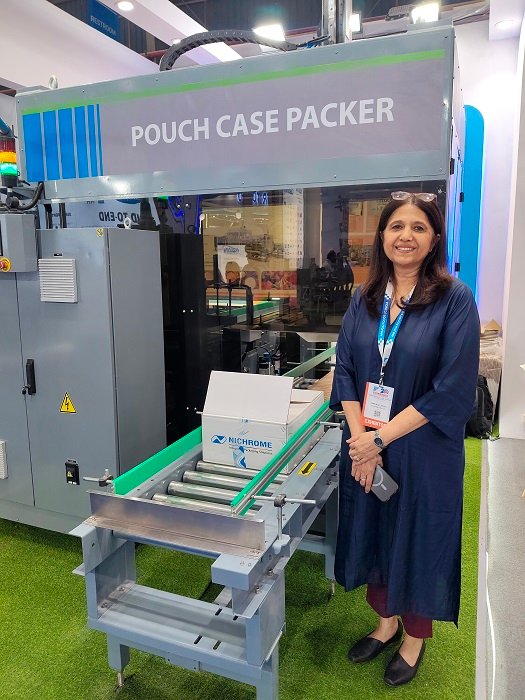
Nichrome India is expanding its focus on end-of-line packaging solutions as demand for automated food packaging equipment grows in India, according to CEO Mrunal Joshi.
Speaking at Anuga FoodTec 2026 in Mumbai, Joshi said the company, traditionally known for primary packaging machinery, spent the past five years developing solutions covering more of the packaging line.
Nichrome showcased an in-house-developed case packer designed to handle flexible pouches. The machine is initially aimed at 1kg and 5kg rice pouches, with the capability to handle packs of up to 10 kg and operate at up to 15 cycles per minute.
“Pouches are actually a challenge because they are flexible,” Joshi said, noting that the company had developed a range of pouch-handling solutions to address the requirements of the Indian market.
Nichrome has developed case packers for cartons, along with case erectors and robotic palletizing systems. The company has increasingly focused on automating secondary and end-of-line operations, including pouch collation, wrapping, case packing and palletizing.
Joshi said Nichrome recently completed a large integrated packaging line for a Middle East customer producing bread mixes. The line includes primary packaging equipment as well as secondary and end-of-line systems, including carton packing, shipper case packing and robotic palletizing.
The company’s end-of-line portfolio has evolved partly in response to the characteristics of the Indian market, where flexible pouches are widely used. Joshi said Nichrome had developed automated solutions for pouch configurations commonly found in retail and distribution, including multi-pouch formations and packing into nonwoven or gunny bags.
Japanese technology partnership
Nichrome has also entered into a new collaboration with Japanese packaging machinery manufacturer General Packer to offer high-speed pick-fill-seal equipment in India.
The partnership was finalized about a month before the exhibition after around six months of discussions. Under the agreement, Nichrome will handle sales, integration and after-sales service for the equipment in India.
The machines will initially be imported from Japan, with Nichrome integrating fillers in India according to individual product requirements. Joshi said this would allow the company to conduct product trials locally and provide service and support through its established Indian network.
The technology is aimed at applications including snacks, dry fruits and nuts, powdered mixes, ready-to-eat products, sauces, confectionery and pet food.
“Each and every product is different, so we have to understand the product and make the filler accordingly,” Joshi said.
She said General Packer has a strong position in its segment in Japan and exports its machinery to markets including North America, the Middle East and Africa.
Growing food packaging market
Joshi said the Indian food packaging machinery market was expanding across both mass-market and premium products.
“The economy sector is also increasing, as well as the premium sector. Both are growing markets,” she said.
Nichrome has also expanded its horizontal form-fill-seal offering, including wider pouch formats aimed at food, personal care and home care applications. Joshi said the wider formats would have applications in areas such as food products and liquid detergents.
She expects India’s large domestic consumption market to continue supporting machinery demand, while international opportunities could provide an additional growth avenue for Indian manufacturers.
However, geopolitical tensions have affected some of Nichrome’s export markets, particularly in the Middle East, where Joshi said customer decision-making had slowed but had not stopped.
Indian machinery moves toward global standards
Joshi said Indian packaging machinery manufacturers had made significant progress in terms of quality and technology over the past 15 years.
“The quality of Indian machinery has improved a lot,” she said, adding that the improvement extended across packaging segments including cartons and flexible packaging.
She attributed the progress partly to the wider packaging ecosystem, including machinery manufacturers, component suppliers and film producers, becoming more focused on international standards.
“The whole ecosystem is very quality conscious,” Joshi said. “The whole ecology is now maturing to reach global standards.”
Joshi said this development, combined with India’s manufacturing capabilities and growing export focus, could create further opportunities for Indian packaging machinery manufacturers in international markets.