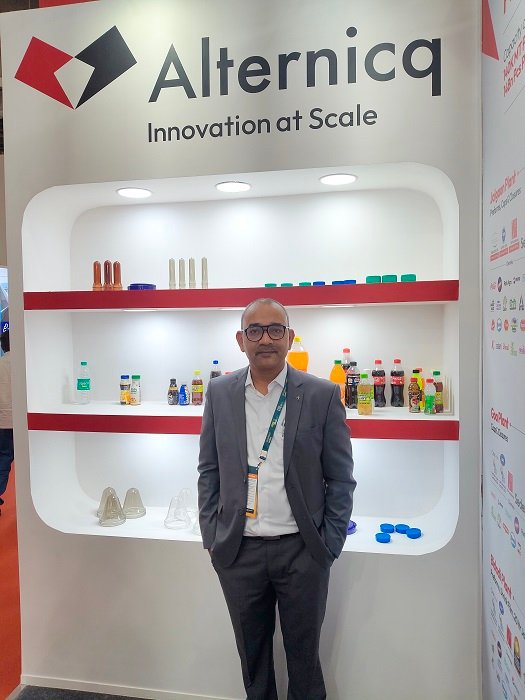
India’s beverage market could double in size by 2030 from its 2025 level, driven by rising per-capita consumption, greater market penetration and the entry of new players, according to Ashutosh Tripathi, business head – beverages packaging, at Alternicq (formerly Manjushree Technopack).
Speaking at Drinktec 2026 in Mumbai, Tripathi said the beverage industry returned to strong growth in 2026 after three years of largely stagnant consumption. Most major brands are now recording double-digit growth, providing fresh opportunities for packaging manufacturers.
He said the recovery was particularly encouraging because it reflected an increase in actual consumption rather than growth attributable solely to population expansion or price increases. A new large entrant in the Indian beverage market has also contributed to the momentum, with one new brand reportedly recording growth of 60-70%.
Tripathi expects the positive trend to continue over the next two to three years. The anticipated expansion covers bottled beverages across categories, including packaged water, juices and carbonated drinks.
Alternicq supplies packaging to major beverage manufacturers and is positioned to benefit from the recovery. Tripathi said the company had retained its market leadership since Advent International acquired Manjushree Technopack in 2018. Its revenue has increased approximately threefold since the acquisition, while it continues to lead across almost all its segments.
Continuous packaging innovation
Tripathi said innovation remained essential to maintaining the company’s market position in an industry where packaging specifications change frequently. Bottle designs, neck finishes and closures undergo regular modifications, often every four to five years, even when the changes are not immediately apparent to consumers.
He said the company continued to introduce new packaging solutions every year, focusing on product development, manufacturing efficiency and waste reduction. Innovation was no longer simply a means of differentiation but a requirement for remaining competitive in the beverage packaging business.
Although Alternicq did not announce any specific new product at Drinktec 2026, Tripathi said its development program remained continuous, reflecting changing customer requirements and the need to improve operational efficiency.
Supply-chain pressures and packaging costs
The improved market outlook comes amid persistent supply-chain disruptions and elevated raw material prices. Tripathi said India had sufficient domestic capacity for conventional plastics and standard resins, but certain speciality functional resins used in beverage closures, particularly for carbonated drinks, were still imported from the Middle East.
Geopolitical tensions have stretched the industry’s supply chain, which has yet to return to normal. Tripathi said Alternicq had been relatively insulated from direct supply disruptions because of its scale, established supplier relationships and supply contracts. However, renewed regional tensions have raised concerns about the availability and cost of imported materials ahead of the next beverage season.
He said the increase in commodity prices had placed considerable pressure on beverage manufacturers. Packaging costs for beverage companies are now estimated to be 50-60% higher than their normal levels a couple of years ago.
Passing on these increases to consumers is difficult because the Indian beverage market depends heavily on established retail price points. Products priced at Rs10, Rs20 and Rs30 serve distinct consumer segments, particularly in rural markets, where price sensitivity is high.
Tripathi said brands were reluctant to increase prices for fear of losing market share, particularly in a highly competitive market with several large players. Even a modest price increase could affect sales, leaving manufacturers to absorb much of the additional cost.
This has put pressure on packaging suppliers as well as beverage companies. However, Tripathi said Alternicq’s scale and long-term customer contracts helped it manage the challenges.
Despite these constraints, he remains optimistic about the industry’s prospects. With established brands returning to growth, new competitors expanding the market, and per-capita consumption increasing, Tripathi expects the beverage packaging business to sustain double-digit growth over the coming years.