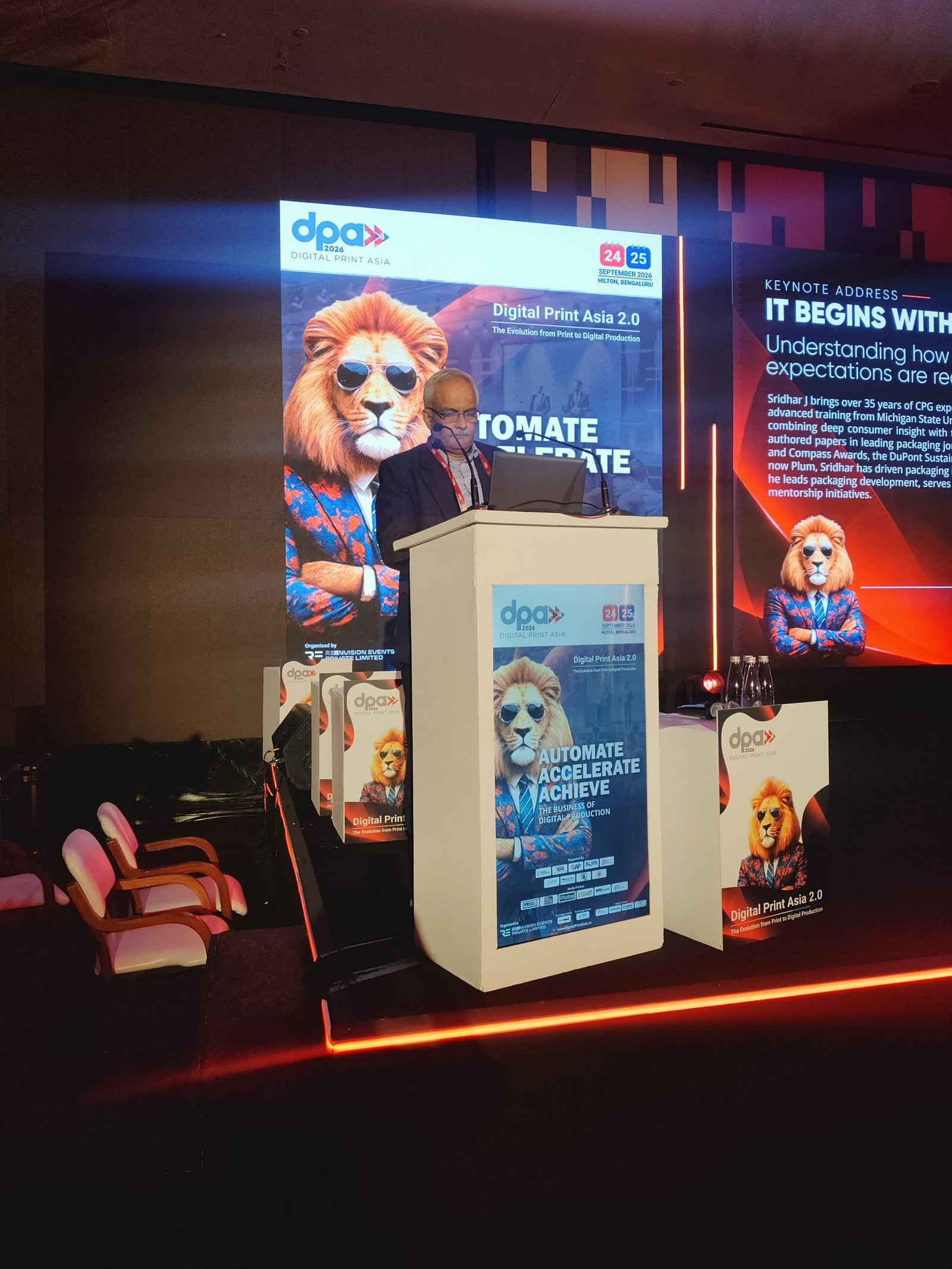
India’s rapidly expanding beauty and personal care market is creating significant opportunities for packaging companies. However, the packaging industry needs to move towards digital printing, personalization and faster product launches, according to Sridhar Janardhana, head of packaging at Pureplay Skin Sciences.
Speaking at Digital Print Asia 2026 in Bengaluru, Janardhana said changing consumer expectations, the growth of eCommerce and the rise of younger consumers were reshaping the relationship between brands and packaging.

“The consumer is changing in ways I think we have not seen before,” Janardhana said, noting that beauty consumers are increasingly influenced by digital media, packaging design and sustainability. Adding that packaging had moved beyond its traditional role as a container and had become an important part of the consumer experience, he said, “Packaging, as such, is not just a container. It blends psychology, design, and functionality.”
According to him, 78% of consumers are influenced by the packaging experience, while 70% either scroll past or move away from a product on the retail shelf before purchasing it. He said the first interaction with packaging comes during the unboxing experience, while continued product use can strengthen the emotional connection between consumers and brands.
“Packaging is no longer a finishing touch,” Janardhana said. “It’s a strategic action that shapes consumption, loyalty, and, of course, the long-term brand equity.”
He noted that India’s beauty and personal care market was expected to grow at a healthy pace, with rising incomes, digital and quick-commerce channels, growth in tier 2 and tier 3 cities, and a growing female workforce among the factors driving the market. Janardhana also highlighted what he described as a significant gap between India and global markets in packaging spend, arguing that the gap represented an opportunity for greater innovation and brand building.
India’s eCommerce and packaging markets are growing at double-digit rates, while the country’s digital printing ecosystem remains less developed than in major global markets, he said. This creates an opportunity for packaging companies to support brands seeking greater customization and agility. “The gap is not a constraint. I think it is headroom for innovation,” Janardhana said.
He argued that traditional packaging models based on long lead times and high minimum order quantities were increasingly out of step with the beauty industry, which is operating at the speed of digital commerce. According to Janardhana, packaging companies need to educate brands about the return on investment and speed-to-market benefits of digital printing rather than focusing primarily on volume manufacturing.
Shift from packaging vendor to value creator
He suggested that packaging suppliers should evolve into strategic partners capable of helping brands launch products faster, personalize their offerings and scale more efficiently. “The shift is from vendor to the value creator,” Janardhana said.
He identified digital print, personalization, sustainability and faster response times as key priorities for the packaging industry as beauty brands increasingly compete across eCommerce, quick-commerce and traditional retail channels. “The next generation of the beauty brand will demand speed, customization, sustainability, and seamless digital integration,” he said.
Janardhana said packaging companies that invest in digital printing and develop solutions tailored to emerging consumer and brand requirements would be better positioned to participate in the next phase of growth in India’s beauty packaging market. “Great products will get noticed, but great packaging will get chosen,” he said.