Bobst is placing automation, digital connectivity and data-driven production at the center of its flexographic printing strategy, arguing that converters can significantly improve efficiency, reduce waste and enhance sustainability by making better use of machine-generated data.
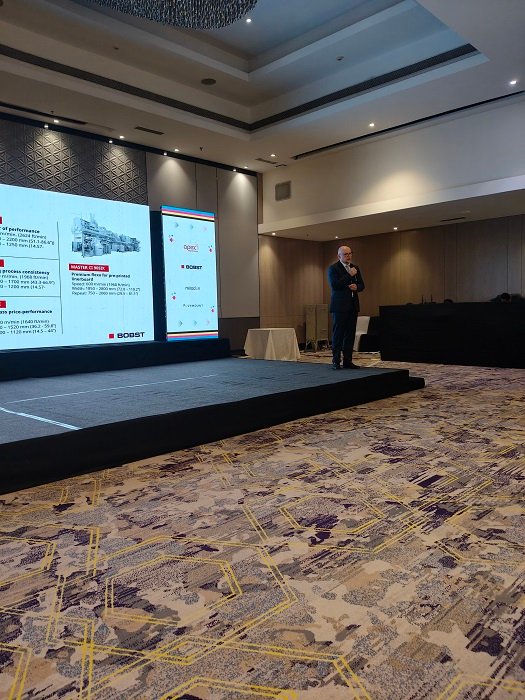
Speaking at the Flexo Forward Conference in Ahmedabad on June 5, jointly organized by Apex International, Miraclon, Bobst and Polymount, Rainer Rosenbusch, product management and business development at Bobst, outlined how the company is integrating digital technologies into its flexo press portfolio to improve overall equipment effectiveness (OEE).
Rosenbusch said modern printing and converting equipment generates vast amounts of operational data that can be used to optimize production. Through the Bobst Connect platform, customers can collect and analyze data from multiple machines, enabling real-time performance monitoring and more informed decision-making.
According to Rosenbusch, the platform is designed as an open ecosystem rather than a closed proprietary network. In addition to Bobst equipment, blown-film lines, cast-film lines and slitting machines from other manufacturers can be connected through standardized interfaces, allowing converters to monitor entire production operations from a single digital platform.
The company highlighted its three central impression (CI) flexo press platforms—Vision CI, Expert CI and Master CI—each targeting different production requirements. The Vision CI is aimed at standard flexible packaging applications, offering printing speeds of up to 400 meters per minute and supporting substrates ranging from laminates to paper. Production of the platform is being transferred from Europe to China as part of Bobst’s manufacturing strategy.
The Expert CI is manufactured in Germany and is designed as a highly customized platform capable of handling both flexible packaging and heavier paperboard applications. Rosenbusch described the machine as a tailor-made solution, with options including gravure, flexo, UV and electron-beam coating units.
At the top end of the portfolio is the Master CI range, designed for maximum productivity. The presses can operate at speeds of up to 800 meters per minute and support a wide variety of packaging and board applications. Bobst’s Master 96, developed for pre-print applications, features a printing width of up to 2.8 meters and is described by the company as the world’s largest CI flexo press.
Automation featured prominently throughout the presentation. Rosenbusch demonstrated Bobst’s SmartGPS technology, an automated impression and register-setting system that uses data generated during plate mounting to pre-configure the press before production begins. The system significantly reduces startup waste and shortens job changeover times.
According to Bobst, some customers perform as many as 30 job changes within 24 hours while maintaining minimal waste levels. The technology enables presses to achieve saleable production within approximately 10 meters of material following a changeover, reducing substrate losses and improving profitability.
The company talked about a digital inspection table that projects digital artwork files directly onto a physical inspection surface, allowing operators to compare printed output with approved designs before production begins. The objective is to identify design, text or plate errors early and prevent costly production mistakes.
Rosenbusch said the future of flexographic printing lies in combining automation, connectivity and quality control systems to create more efficient and sustainable manufacturing environments. To support customer adoption, Bobst operates competence centers in Germany, India, China and the United States, where converters can evaluate technologies, conduct trials and receive technical support.