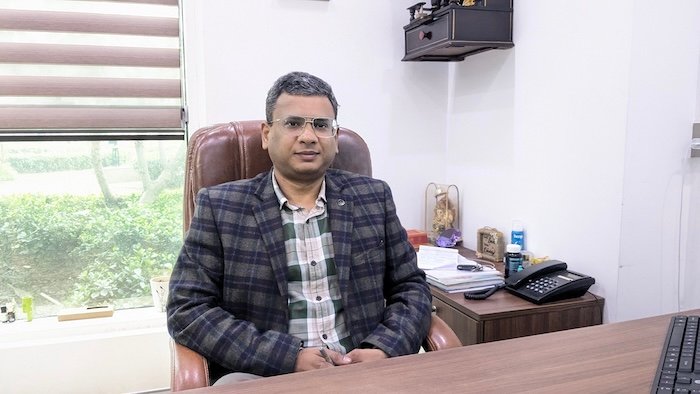
In a time when converters are under pressure to improve efficiency, traceability, and compliance, ERP-led automation is steadily moving from being a ‘good-to-have’ to a business necessity. In a meeting at the company’s office, Gaurav Bansal, director of Flexibiz, spoke about how structured digital systems are enabling packaging converters to scale without losing control over operations.
“We learned a lot from our early association with UFlex, and that’s how we developed our software. Today, it is an end-to-end ERP for mid-sized to large-scale converters looking for a complete solution that addresses all their business needs,” Bansal said.
Over the years, the company has modularized the solution to suit smaller converters as well. Instead of investing in a full-scale deployment, smaller businesses can begin with core modules such as stores, purchase, and production. According to Bansal, the key pain points for growing converters are material planning, inventory control, and compliance management.
“Our system digitizes all plant data, from non-conforming material records and corrective actions to shortage tracking. The algorithms in the system automatically define minimum levels and buffer stock. If inventory drops below that level, purchase requests are triggered automatically. That ensures there is no firefighting,” he explained.
Flexibiz currently operates in around nine countries with more than 100 clients. The company positions its ERP as a growth enabler rather than a basic accounting add-on.
According to Bansal, the printing and packaging industry is characterized by complex workflows, variable costing structures, and multiple space allocation challenges. And when asked how Flexibiz differentiates itself from other ERP vendors, Bansal emphasised its depth of functionality.
“Many players provide innovative solutions for job cards or material planning. But we go further, with algorithms, machine linkages, weighing scale integrations, and barcoding at every stage from gate-in to gate-out. For us, this is not an add-on. It is the starting level,” he said.
Unlike ERP providers that depend entirely on integrations with third-party accounting software, Flexibiz offers its own accounting module while also supporting linkages with external platforms. “We provide complete end-to-end coverage — materials, production, sales, and accounts. That is something others are not offering in totality,” Bansal added.
The company’s approach includes IoT-enabled machine data capture to minimize manual data entry and improve accuracy. According to Bansal, automation is no longer optional even in India, where labor was historically perceived as inexpensive. “Earlier, one could argue that labor was cheap in India. That is not true anymore. There is a manpower skill shortage. Speak to any plant owner they will tell you they are not finding the right talent to run machines properly,” he said. He further adds, “That is why IoT is picking up. The operator should focus on running the machine, not on filling registers.”
From ERP to plant-level automation
While ERP is the foundational layer, Flexibiz is also enabling higher levels of automation within plants. Bansal described conveyor-based dispatch systems integrated with barcode scanning and speaker-guided verification.
“If a wrong material is placed on the conveyor belt for dispatch, the system immediately identifies it. Speakers at the loading area alert the staff that the wrong material is being loaded. This prevents expensive dispatch errors,” he said.
Such systems help avoid costly returns, duplicate shipments, or reputational damage with brand owners. The ERP also enables complete traceability. Each reel is barcoded, allowing converters to trace a complaint back to the parent roll, machine, operator, substrate, and supplier details within seconds.
“If a brand owner faces an issue on their assembly line, they just need to specify the reel number. From there, the converter can pinpoint everything: the parent laminated roll, the printing machine used, the operator, the supplier, the GRN date, and QC checks performed. It’s all available at the click of a button,” Bansal explained.
Among its customers, Flexibiz counts integrated packaging groups such as Jupiter Group, which operates a 200-acre integrated facility in Sonipat with in-house ink, CPP film, cylinder, and packaging production.
“We are not just serving a packaging manufacturer. If a group has backward integration — inks, cylinders, film, or alu-alu foil — we can serve all divisions,” Bansal noted. The ERP supports rotogravure, labels, offset, ink manufacturing, and other related verticals, enabling seamless integration across business units.
Concluding the interaction, he notes that ERP is no longer an optional software upgrade. “It is as basic as having an accounting package. If you want to grow 3x, 5x, or 10x over the next few years, you need structured systems. Without that, scaling becomes chaos.”
Reflecting on the Plast India 2026, Bansal described the six days at the exhibition as ‘quite busy’ with a steady flow of visitors keen to understand how ERP-driven automation could support their expansion plans. The company booked two to three orders on the spot, and implementations have already begun.