In our first article about Heidelberg’s Prinect we explained that it is a connected, end-to-end production workflow ecosystem, this second article moves from concept to capability. While part one established Prinect as the digital backbone of a modern print shop, part 2 explores how this integration delivers real-world efficiency through simplified prepress workflows, advanced color management, and real-time production insights. It also highlights the growing adoption of Prinect in the Indian market, alongside Heidelberg’s shift towards a subscription-driven model.
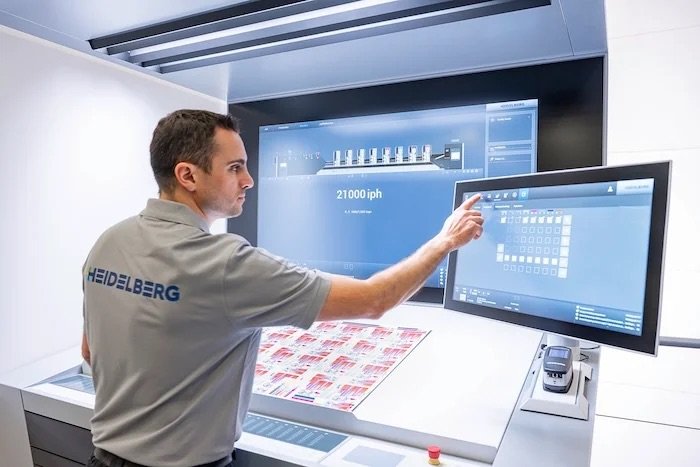
A key recent development is the launch of Prinect ‘Touch Free,’ which takes automation a step further. The system can automatically decide whether a job is better suited for digital or offset printing based on predefined parameters, volumes, and efficiencies. According to Indukalpa Saikia, senior sales manager and product specialist at Heidelberg India, in doing so, Prinect evolves from production software into what he describes as a decision-support system, capable of real-time job tracking, benchmarking, and Overall Equipment Effectiveness (OEE) analysis. “Many workflows stop at production—Prinect closes the loop with business insight,” he adds.

Saikia notes that Prinect defines automation through two philosophical stages—navigated printing and autonomous printing. In the navigated stage, intelligent assistance systems guide operators through the most efficient job-change sequence, ensuring minimal downtime.
In autonomous printing, presses process queued jobs automatically without operator intervention. Inline quality systems, such as Prinect Inpress Control 2, measure and adjust print quality in real time. “This is especially effective for standardized jobs with many changes,” Saikia explains, making it ideal for high-mix environments. This was presented at the Mumbai Heiconnect event in January, by Klaus Sauer, the managing director of Saxoprint in Germany.
Saxoprint’s plant video showed an almost extreme level of automation on each machine based on a rule-based workflow, and the very high level of standardization and workflow procedures was eye-opening. The insistence on running all presses 24/7 at the full rated speed demonstrated an efficiency that has so far remained well-beyond the aspirations of most Indian print and packaging companies.
“The complete integration of Prinect can bring 25% to 30% gains in productivity and efficiency,” Saikia states, adding that successful implementation plays a crucial role in how quickly these gains are realised.
Simplifying prepress and advancing color management
Prinect streamlines core prepress functions such as preflighting, imposition, and color management by standardizing decisions that were once operator-dependent. Incoming PDFs are automatically checked against job-specific rules, with critical errors stopping the workflow and minor issues corrected automatically.
Imposition templates are linked to press formats, substrates, and finishing processes, allowing instant recalculations when job parameters change. Color management is centralized through a shared database, enabling consistent output across devices.
For packaging printers, advanced color tools provide further advantages. Prinect supports CxF spectral data exchange and a Multicolor Toolset that enables up to seven-color printing (CMYK plus orange, green, and violet). This expanded color gamut allows printers to reproduce over 90% of Pantone spot colors with tight tolerances, reducing the need for custom ink mixing and simplifying ink duct cleanups and press setups.
Real-time insights and Indian market adoption
The Heidelberg customer portal, which is connected to Prinect Production Manger through the cloud, can provide real time production insights like remote live production monitoring, machine status, job currently running, estimated remaining time to finish, live OEE indicator, and more. The Heidelberg customer portal can also provide maintenance and service insights, like predictive maintenance alerts, and service history.
“India has a strong and growing base of Prinect subscribers across both commercial and packaging prepress, as well as production. With Prinect, many Indian customers are focusing on full integration between prepress and press to improve efficiency and consistency. Multi-site printers are also using Prinect to centrally monitor and track production across all locations,” said Saikia.
We have met printers keen to use Prinect not just for integrating prepress with their multicolor offset presses, but also for optimizing the postpress workflow. For instance Prinect can generate labels indicating the number of printed sheets on a pallette and the total number of sheets in the job, which is helpful for delivering full quantities.
Subscription model and the future plans
For Indian printers evaluating all costs, Prinect’s subscription-based model offers flexibility and predictable expenses. Unlike traditional workflows with high upfront CAPEX, Prinect Production Manager provides continuous updates, support, and future-ready features.
Looking ahead, Heidelberg is developing AI-driven enhancements, including automated scheduling, predictive process optimization, and smart error detection. “With Prinect offered as a subscription, existing users will automatically gain access to these new AI-powered capabilities as they are released,” Saikia concludes.