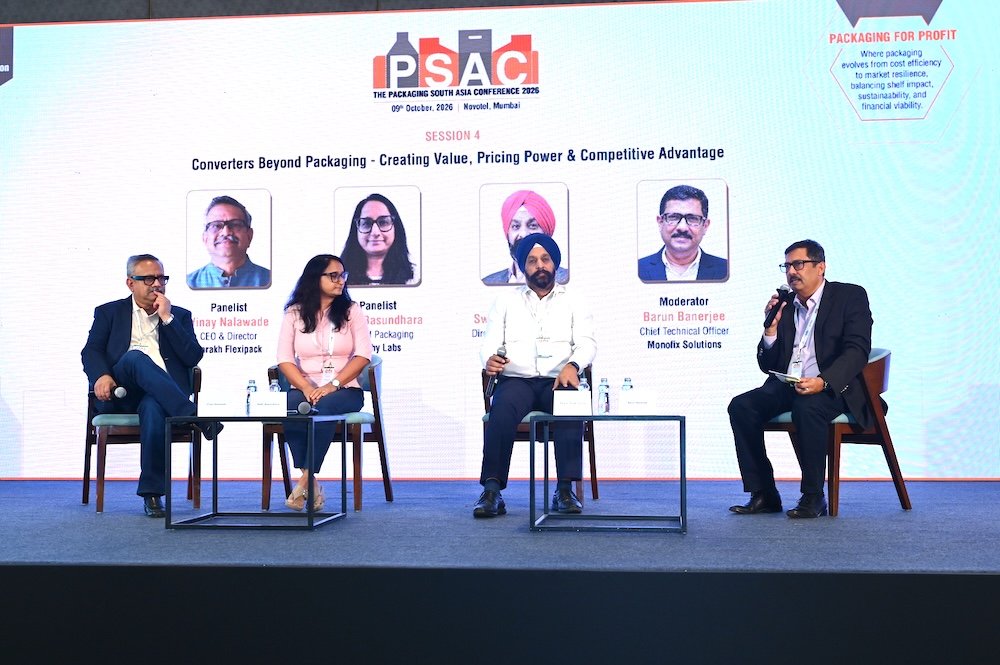
Increasingly recognized as a strategic business tool rather than merely a means of product protection and presentation, packaging can influence consumer preference, strengthen brand differentiation, support margin expansion and improve business resilience. At PSAC 2026, brand owners and converters agreed that achieving this requires collaboration so that converters do more than just supply packaging materials.
Leading consumer brands, packaging developers, and converters credibly revealed that innovation, process efficiency, and sustainability are central to creating value across the packaging supply chain. Barun Banerjee, CTO of Monofix Solutions, moderated the conversation between Vinay Nalawade of Parakh Flexipack, Nidhi Basundhara of Jyothy Labs, and Swarn Singh Grover of Mars Snacking India. They explored how closer collaboration, early supplier involvement, packaging innovation and sustainable material development can create value across the supply chain.
Opening the discussion, Banerjee highlighted the need to reposition packaging from a cost centre to a profit centre. While containment, safety, protection and shelf appeal remain its fundamental functions, he explained that packaging can contribute much more through differentiation, consumer loyalty, margin expansion and business resilience. “The industry must examine how value addition across flexible, rigid and other packaging formats can improve profitability for all stakeholders.”
Trilateral collab must begin at the design stage

Photo- PSA
Addressing geopolitical uncertainties, volatile polymer prices and increasing cost pressure, Basundhara stated that brands, packaging development teams and converters must work closer together. “From a perspective of working in isolation and just running around negotiating, the most important part is that all three, the brand, the packaging person and the converter, work as a trilateral function, where we work from design to the delivery framework, rather than just everyone working in silos,” she said.
Packaging development should begin with a thorough understanding of the product’s supply chain requirements. Lightweighting, for example, must not compromise the protection needed during transportation from manufacturing facilities to consumers. She highlighted the opportunity for converters to make suggestions that enhance the pack’s visual appeal, functionality, and shelf impact. “How can we help consumers perceive product quality and value and potentially pay a premium over competition.
“With Gen Z and Gen Alpha increasingly influencing consumption patterns, brands must consider how packaging connects with younger consumers. QR codes offering interactive 3D experiences and other digital features can help create more engaging interactions.”
Early supplier involvement & process excellence

Photo- PSA
Vinay Nalawade of Parakh Flexipack identified early supplier involvement (ESI) as one of the most important ways converters can contribute to packaging profitability. He emphasised that trust and transparency between suppliers, converters and brand owners are essential to achieving common business objectives. “Once that is on the table, we have to align the converter with his partners and the brand coming together to the final goal,” he said.
Packaging development must be aligned with the intended business outcome. “If the objective is profitability, the design must support it. If sustainability and profitability are both priorities, these considerations must be incorporated from the beginning.”
He added that converters must understand their machinery and establish strong process controls to ensure consistent product quality across different locations and production runs. Banerjee reinforced this point by highlighting the importance of first-time-right production and change management. He observed that raw material changes and inadequate process controls can create hidden costs for both converters and brand owners.
Sustainability requires commercially viable solutions
How can converters support brand owners to meet sustainability commitments, particularly by using post-consumer recycled (PCR) materials and recyclable packaging structures? Grover said that sustainability is an important part of his company’s philosophy and is measured through its Design for Circularity (D4C) framework. “Mars has already incorporated different levels of PCR content into its packaging, including applications using 100% recycled material. Over the last year, we have removed around 500 tons of virgin polymer by using PCR material, and I think next year also the numbers are going up for us.”
Converters have an important role in ensuring a consistent supply of recycled materials that meet the quality and safety requirements of food packaging, he added, highlighting the country’s potential, “For becoming a testing ground for sustainable packaging solutions that could be subsequently adopted in other markets by global brands.”
Innovation can create pricing power
An important theme throughout the discussion was the ability of packaging to help brands escape commodity-based competition. Grover pointed out that brands compete for limited shelf space, while the growing importance of eCommerce makes differentiation even more challenging. Converters, he suggested, can contribute through distinctive pack structures, tactile experiences, impressions, logos, and functional features.
“If you can show the value that is coming from packaging, we will be willing to pay for that,” he said, emphasizing that differentiation and functionality can justify additional packaging investment when the consumer benefit is evident. Nalawade also argued that packaging costs should be evaluated through the broader lens of total delivery cost rather than simply the price of packaging material.
He cited the Parakh Group’s experience in edible oil packaging and its backward integration strategy, which included an in-house packaging plant supporting its Gemini brand. “Converters must understand the economics of the brand owners they serve and develop solutions that balance packaging costs with sustainability, printing and recyclability requirements.”
A value-chain approach to profitability
In conclusion, Banerjee reiterated that packaging profitability cannot be achieved through procurement negotiations and cost reduction alone. It requires early involvement, jointly developed specifications, transparent relationships and collaboration across the value chain. He underscored the broader shift in the role of converters: “Rather than functioning solely as suppliers of packaging materials, they must increasingly participate in product development, consumer engagement, sustainability initiatives and operational improvements.”
Ultimately, packaging can command greater value when it delivers measurable benefits to brands and consumers. As the panel and audience questions and comments made clear, the transition from packaging as a cost center to becoming a contributor to business profitability leans on the possibility of making the entire value chain more transparent, collaborative, innovative, and commercially sustainable.