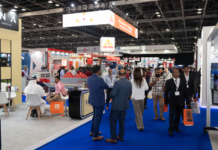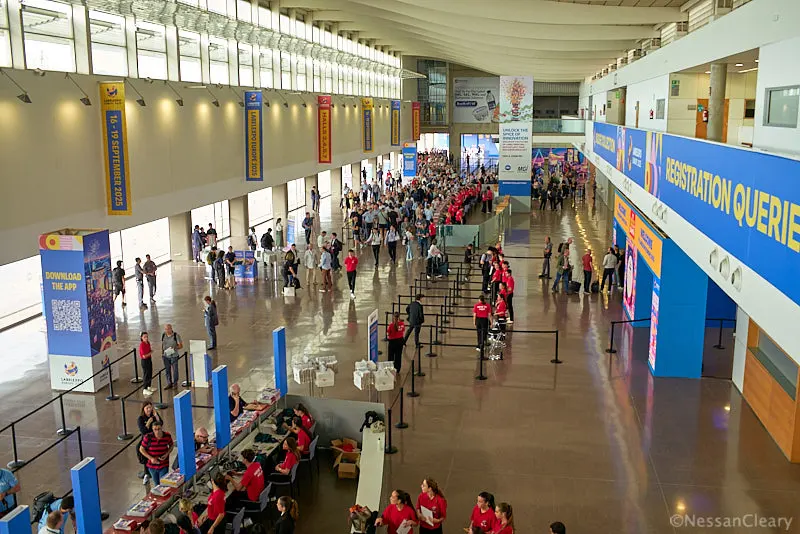
Perhaps it’s the non-stop English rain or the short dark winter days, but I find my thoughts at the end of the year returning to the long warm week I spent in Barcelona, Spain, earlier in 2025 for Labelexpo and the lessons learned there on the label sector.
For the last few years, Labelexpo has mostly charted the growth of digital — mainly meaning UV inkjet – in label printing, coupled with a general move towards wider presses to accommodate some short-run packaging, notably pouch making. But this year’s show revealed a much more complicated picture. Yes, there were a lot of digital presses, but there were also vendors that felt confident enough to just concentrate on flexo. Nilpeter, for example, declared that the future is flexo, and even Canon showed off a flexo press from its Edale subsidiary. To me, this suggests that production runs have recovered and that brands are looking to cut prices through longer run lengths, leaving less growth for short-run digital solutions.

This is in stark contrast to the situation two years earlier, with the 2023 show following directly after the Covid pandemic and the supply chain crisis that ensued. Then, it seemed clear that digital converters had been able to pivot quickly towards health and food production to cope with the rapid change of pace that accompanied the various lockdowns. That leads to more emphasis on hybrid solutions, mostly using digital print with conventional inline converting units.

Two years on, and some of the flexo press vendors have opted to leave the hybrids to their digital partners. Thus, Omet has left Durst to drive the development of their joint hybrid, which combines a Durst Tau inkjet press with Omet’s K-Jet flexo units. And Nilpeter seemed content to leave Screen to show off its Refine converting unit running inline with a Screen TruePress Label 350 UV SAI inkjet label press.
So, for me, the main takeaway from the Barcelona show is a reset in the balance between digital and flexo. For the last few years, there has been a rush towards faster digital presses, with 100 linear metres per minute seen as the threshold at which point digital could compete as an alternative to flexo. In theory, flexo presses are much faster, typically up to 240mpm, but converters rarely run their presses at such speeds, partly because of the difficulties in setting up the media tension properly to avoid breakages, but mainly because they just don’t need to.
But looking back at this year’s show, it seems to me that many converters still see digital as a short-run option to sit next to their flexo presses, but with the bulk of their work still running on flexo and no real need to invest in faster digital presses. The numbers haven’t really changed, with vendors such as Durst and Screen seeing about 20% of their customers looking for hybrid solutions. It’s just that more vendors are now concentrating their efforts on the 80% of the market that buys standalone digital presses. The technology is more stable than it was before the pandemic, so there is less variation in capability and, therefore, more emphasis on price. That led directly to a noticeable number of cheaper digital presses being launched at the show.

Of these, one of the best examples was Domino’s new N410i, which I believe is based on a Dilli press. It is a very compact device with a print width of 330mm. The standard speed is 30mpm although there is a 50mpm option, but this is only practical for low coverage jobs. It uses Kyocera printheads for 600dpi resolution and runs UV LED inks with CMYK plus white at 600dpi resolution. Warren Jarvis, the technical trainer for the N410i, says, “There’s a lot of automation that’s been taken out of it to achieve the lower price.” However, it does include corona pretreatment and an anti-static system for working with plastic substrates.
Gallus also showed off its new budget Alpha press, which I’ve already written about. Gallus remains one of the few traditional flexo press manufacturers to have really embraced inkjet printing. Two years ago, I described the Gallus One as a work in progress, but for this year’s show, Gallus has completed that work with its new flagship, the Gallus Five, which I’ve also covered in my earlier report.
Durst introduced the Tau G3 series of label presses, which are really an evolution of the existing Tau RSCi models. Martin Leitner, director of product management for Durst labels and flexible packaging, says that Durst is continuously developing these presses, noting, Some of the features of the G3 were in development for three years, but others for just one year.” As before, Durst has used the Fujifilm Dimatix Samba printheads with 1200 x 1200 dpi resolution. There’s a choice between UV and LED UV inksets, though the UV LED inks run at lower speeds. The G3 comes in two versions. The Core runs at 61mpm, while the Peak models reach 80mpm with the LED inks, but can hit 100mpm with UV inks. The standard configuration is CMYK, but both inksets can be extended with orange, green, and violet as well as white. Both are highly automated, including built-in quality inspection.
Aqueous, toner and packaging
For some years now, there has been a second story, on the growth of narrow- to mid-web packaging, hiding in plain sight behind labelling. This has brought with it an issue around the safety of the inks, particularly for food packaging, as well as for some pharmaceuticals and beauty products. This is because most inkjet labelling uses UV-curable inks, and there is a risk that some chemicals, typically from the photo-initiators used to kickstart the curing process, could migrate through the packaging to contaminate the products within. This is not a big issue for labelling, because the labels are on the outside and the packaging acts as a barrier. And UV inks cope very well with the wide range of substrates typically found in labelling, and with the handling and ambient conditions that labels have to endure.
However, this is a potential problem for anyone looking to use a narrow web press for packaging applications. Some vendors, such as Screen, have addressed this through low-migration UV inksets. But most people recognize that a better solution is to switch to water-based inks, which are proving harder to develop than expected. I’ve covered this in a separate story, but it’s worth noting here that Epson used the show to launch its Surepress L5034 press, and that both Screen and Miyakoshi showed prototypes with aqueous inksets.

I bumped into Toru Miyakoshi, the president and CEO of Miyakoshi, who told me that although he is happy to sell the bigger presses for commercial and packaging printing that his company makes as an OEM to other vendors, he prefers to keep the label presses for direct sales as Miyakoshi-branded products. Besides the digital prototype, Miyakoshi also showed its LPS13A intermittent LED-UV offset label press, which used AI to set the machine up for each job as well as for quality control, to reduce the level of operator intervention and skill required to run it.
The other alternative to aqueous inkjet remains toner, which can be used with a wide range of substrates and is generally safe to use with food and other products. Konica Minolta, for example, has had considerable success with its low-cost AccurioLabel series, which are based on the dry toner print engines from its production printers that were originally developed for commercial print. The company showed a prototype of a new version of the AccurioLabel 230, which uses the same print engine, meaning the speed remains at 23.4mpm but with improvements to the feeding and media transport. There’s also an optional module, based on Konica Minolta’s IQ601, that adds a spectrophotometer to improve the image quality. The idea was to gauge feedback as to what customers are looking for with a new updated model to come later next year.

Xeikon announced a 320mm wide label version of its Titon press, the TX300, following the introduction of the 500mm packaging model, the TX500, at the last European Labelexpo. The Titon technology combines dry toner with UV curing to produce a tougher finish while at the same time having the substrate flexibility and food-safety requirements associated with dry toner printing. The press has five channels, with Xeikon offering some spot colours, notably orange for the fifth channel.
Frank Jacobs, Xeikon’s senior product manager, says that Xeikon has had some success in France with labels for the wine industry. He explains, You don’t need to varnish and it’s still scratch resistant, so you save a complete step in the finishing. The only thing you need to do is die cut and the label is ready.” The labels can also be overprinted, allowing wine producers to add further information, such as the grape used for each bottle, at the last minute to the label using just a desktop printer. The Titon toner gives Xeikon a distinct advantage, and indeed Xeikon did sell both a TX500 and TX300 on the stand on the first day of the show.
HP announced a new press, the Indigo 6K+, which boasts a lot of automation, including a new SmartControlSystem that promises improved uptime for non-stop printing. The stand itself was dominated by the V12 press, which is the fastest available digital label press at 120mpm. HP has installed a number of these, with some customers, such as Nordvalls Etikett in Sweden, taking multiple presses. Noam Zilbershtain, vice president and general manager of HP Indigo, says, “The biggest challenge we have is how to feed them. We used to send 20% of the jobs to digital, but with the V12, it can be 80% because of the capacity.”

From next year, Labelexpo will be rebranded as Loupe, which apparently stands for Labels, OUter Packaging, and Embellishment in an effort to highlight the growing number of label solution vendors who also want to show folding carton and flexible film solutions. There was a mixed reaction to this news from the vendors, with some welcoming the change in emphasis, while others pointed out that they were already exhibiting packaging solutions.
In my view, there is a risk that the rebranding will blunt the identity of this event with its unique focus on the label sector. The event doesn’t really gain anything from this change in name since everybody involved in labelling already understands that there is some packaging involved, and the vendors are already showing packaging and embellishment solutions. Instead, it risks being lost among the more established packaging events, especially as other shows such as Fespa are also expanding into packaging. This won’t be helped by the change of location, since past visitors looking for the label show in Brussels will struggle to make the connection with Loupe in Barcelona.
Nonetheless, the event appeared to be very successful with some 40,000 registered visitors over the four days of the show. This was despite the failings of the air conditioning in the main area, hall 3, which led to some vendors calling for refunds since visitors were too uncomfortable to linger for long in their unbearable heat on their stands. That said, many vendors have since reported decent sales, and the label sector as a whole, both digital and flexo, appears to be very healthy.
For the coming year, the show will return to Chicago as Loupe USA, where it will be interesting to see if the US tariffs and visa restrictions have any impact. The next European Loupe will take place in October 2027.
You can find my other reports from the show by searching for the tag ‘Labelexpo2025’.
(First published in the Print and Manufacturing Journal. Republished with permission)