The rapid growth of commercial printing in India’s tier-2 and 3 cities is leading to a change in demand patterns, and HP India says it is witnessing strong growth and new installations in largely untapped areas just a few years ago.
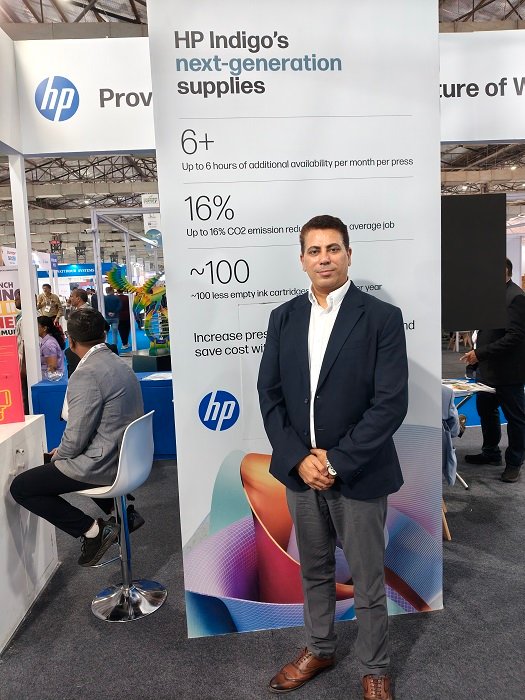
Speaking at Pamex 2026 in Mumbai, Pawan Chauhan, country business manager at HP industrial and inkjet business solutions, HP India, said commercial printing is rapidly moving beyond metropolitan centers. “Commercial printing in India is no longer metro-centric. We are witnessing robust growth, enquiries, and installations coming from tier-2 and tier-3 cities, and HP is growing along with these markets,” Chauhan said.
Chauhan cited examples of recent HP Indigo installations in Bihar and eastern Uttar Pradesh as evidence of this move. He said government policies encouraging decentralized industrial development are also supporting growth outside tier-1 cities.
Against this backdrop, HP is using Pamex as a key platform to engage with both new prospects and its existing customer base. Chauhan described commercial print as the backbone of India’s print industry and said the company remains firmly committed to the segment, where it has maintained leadership for several years.
Despite frequent concerns about slowing print volumes, Chauhan said the scale of the commercial print market continues to justify sustained investment.
Estimating India’s commercial print market as growing roughly 3% year on year, Chauhan noted that while labels and flexible packaging are growing at faster rates, commercial print remains critical due to its sheer size.
Chauhan said that HP Indigo 7K continues to serve entry-level 13-inch applications, while the Indigo 18K has been positioned as a versatile solution capable of handling substrates from 90 gsm to 600 microns, enabling applications ranging from commercial print and publications to mono cartons.
He highlighted the Indigo 120K, its latest-generation high-speed press designed to bridge short- and mid-run production. Chauhan said the press offers improved breakeven economics for runs in the 5,000–6,000 impression range, making the transition from analogue to digital easier for commercial printers.
According to Chauhan, HP has installed around 25 B2-format Indigo presses in India, with a growing proportion being placed in tier-2 and tier-3 markets. Customer profiles in this segment are increasingly mixed, with photo printers expanding into commercial applications such as rigid boxes, paper cups, and textile heat transfer.
Looking ahead, Chauhan said HP remains bullish on India over the next three to five years and aims to maintain leadership across commercial print, photo, labels, and flexible packaging. He said digital printing still accounts for only a small share of India’s overall print equipment market, underlining the long-term opportunity for growth and transition.