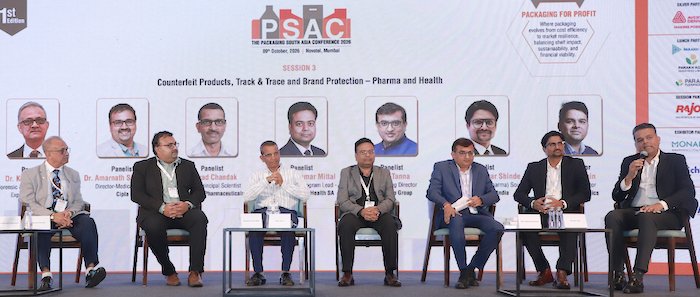
Counterfeit medicines pose a serious threat to patient safety and brand credibility, with vulnerabilities across raw materials, manufacturing, distribution and the wider pharmaceutical supply chain. As counterfeiters become increasingly sophisticated, packaging security, digital traceability and effective law enforcement are emerging as critical components of brand protection for high-value drugs.
These issues were at the centre of the session on Brand Protection in Pharma and Health for High Value Drugs at the recent Packaging South Asia Conference. Dr Keshav Kumar’s quick, pointed presentation brought a forensic perspective on investigation and law enforcement into counterfeit medicines and devices. Citing the natural attraction of counterfeiters to more expensive cancer and biologic drugs and high demand such as oncology with very high unit value, there is a need to trace counterfeit medicines to their manufacturing sources rather than focusing exclusively on smaller distributors. High-frequency travel and financial data also yield plenty of anomalies and clues for catching drug counterfeiters, he said.

He described an investigation involving medicines supplied to Agra and Delhi that led investigators to a manufacturing operation in Puducherry. Another example was of pharma labels produced in Turkiye for counterfeit medicines sold in the Indian market. Dr Kumar pointed out that regulations and laws exist, but for various reasons, enforcement is weak, and counterfeiting of high-value biologics is especially lucrative.
He then joined the panel moderated by Bhrigav Jain of Monarch Graphics, featuring Dr Amarnath Sugumaran of Cipla, Sharad Chandak of Glenmark Pharmaceuticals, Bhupesh Kumar Mittal of Bayer Consumer Health, Tejas Tanna of Printmann Group, and Ravi Vijaykumar Shinde of Avery Dennison India.
The panel emphasised that no single security feature can eliminate counterfeiting. Addressing the problem effectively requires a combination of packaging innovation, controlled material supply chains, consumer awareness, digital authentication, and stronger enforcement.
Distribution and enforcement remain critical challenges
While manufacturers may implement sophisticated controls, counterfeit products can enter legitimate channels through unauthorised distribution, relabelling and other forms of tampering. Sharat Chandak identified distribution as one of the weakest links and argued that limited consumer awareness, price sensitivity and inconsistent enforcement create opportunities for counterfeiters.
He noted that consumers often prioritize discounts without adequately examining the product’s authenticity, packaging or security features. “Unless, as users, patients, or buyers become more alert to what drugs they are purchasing, the challenges will remain.” The vulnerabilities will persist until we ourselves become aware, Chandak said.
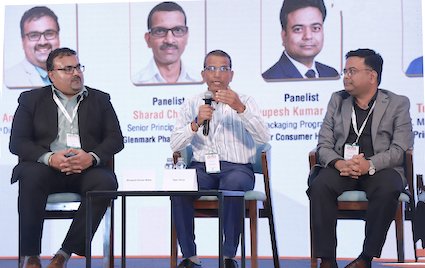
Dr Sugumaran highlighted the importance of electronic data capture and traceability across the product lifecycle. He advocated consideration of a unified system that could extend beyond private healthcare organizations to government facilities, enabling better access to data and helping investigators identify gaps in the supply chain. A unified digital system could function across the supply chain in ways similar to demat or dematerialized and digitally traceable company stocks in the share market, he suggested.
The discussion also underlined the importance of tracking products from raw-material procurement through manufacturing and distribution, particularly for complex pharmaceutical products such as biologics, biosimilars and peptides. As far as high-value biologics, it was stated that their complex production process is to some extent a form of protection, and thus other vulnerabilities in the supply chain are more likely to emerge from labels, packaging, and both physical and digital distribution networks. Dr Kumar pointed out that, as he had presented, there is a considerable vulnerability in both public and private hospitals supplying high-value biologics.
Making packaging security easier to recognize
A key theme was the need to make security features accessible to ordinary consumers. Although holograms, QR codes and other authentication technologies are available, their effectiveness depends partly on whether patients can recognize suspicious packaging and understand how to verify a product.
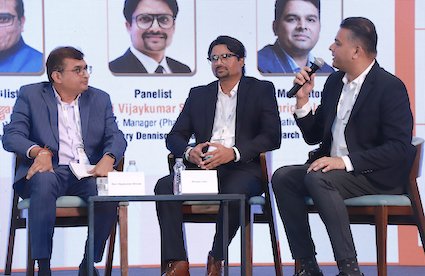
Tejas Tanna presented an example of a tamper-evident monocarton developed under license by his company Printmann, and used by Indian pharma for exports to Europe. The design leaves visible holes after the carton is opened, making it easy to identify whether the package has been opened, tampered with, or reclosed. Explaining the concept, Tanna said, “If the seal is broken, if there is a hole, there is something wrong with the product.” The concept is communicated through the phrase ‘hole hai to jhol hai ’, intended to give consumers a simple visual indicator.
The example illustrated how packaging design can incorporate practical security measures that consumers can understand within seconds, rather than relying exclusively on technologies requiring specialised equipment. Key to this licensed solution is that it uses a particular change part in the carton folder gluer supplied by the manufacturer only to authorized licensees of the technology, hence making it very difficult, if not impossible, to duplicate.
Secure labels and controlled material supply chains
Ravi Shinde emphasized that effective pharmaceutical authentication requires collaboration between material suppliers, trusted converters and brand owners. Security cannot depend on a single feature or on the raw material alone. “We have worked with the brands in the pharma industry, wherein we have added overt and covert authentication features as a combination. It’s not only one feature, but a combination of at least four features,” he said.
Visible, or overt features allow consumers to conduct basic checks, while covert features provide additional verification known to the brand or authorized parties. Shinde highlighted the importance of controlling the supply of specialized materials through agreements involving brands and their supply-chain partners.
The panel discussed digital product passports and invisible QR codes that could provide information about the origins of packaging materials, paper, as well as pharma product ingredients. However, they noted that the adoption and success of these systems depends or needs consumer incentives and effective implementation.
Regarding the low consumer interest in scanning QR codes, Bhupen Kumar Mittal suggested that QR codes should offer customer benefits beyond authentication. These could include directions for use in regional languages, instructional videos, manufacturing and expiry information, patient-support services and mechanisms for reporting incidents. He suggested, “Consumers would be more likely to use digital authentication if scanning a pack provided tangible value, alongside confirmation of whether a product was genuine.”
The primary label matters
When the panel considered whether a pharmaceutical company should prioritize a secure primary label or a secure monocarton when working with a limited budget, Chandak favoured the label. “The first thing customers throw out is the leaflet,” he said, describing how patients frequently discard packaging materials soon after purchasing medicines. “So what remains throughout the life of the product is the label.”
The primary label therefore offers a continuing opportunity to incorporate authentication features and communicate essential product information. This is especially important in India, where enforcement is acknowledged as weak, and not every patient has access to a smartphone, or is literate and can rely on digital verification. The discussion pointed towards a layered approach in which physical security features remain accessible to consumers, while digital technologies provide additional traceability and support where appropriate.
The panel concluded that packaging security, traceability, consumer education and law enforcement must operate together to prevent and catch pharmaceutical counterfeiting. Tamper-evident cartons, secure labels, controlled sourcing and digital authentication can make counterfeiting more difficult, but their effectiveness depends on implementation and law enforcement across the entire supply chain.
The discussion reinforced the need to develop security features that are difficult to replicate but simple to recognise, improve the control of specialised packaging materials and strengthen coordination between pharmaceutical companies and enforcement agencies.
Ultimately, the objective extends beyond protecting brands. A reliable system of authentication and traceability can help patients make informed decisions, enable investigators to identify counterfeit networks, and strengthen confidence in the medicines reaching the market. Apart from eroding the profitability of pharmaceutical companies, the health and lives of citizens are at stake.
Indeed, the reputation of the Indian pharma industry, which has a great opportunity to become a global pharmaceutical supplier not just of generics but of complex drugs, including biologics, is being compromised by inadequate enforcement of regulations and laws already in place. Nevertheless, refinements are needed, and Dr Kumar proposed a realignment of the Drugs and Cosmetics Act (DCA) and the Bharatiya Nagarik Suraksha Sanhita Act (BNSSA) from what he described as a “live-in relationship to a marriage of the DCA and the BNSSA.”
From the well-moderated and lively discussion at the PSA Conference, one senses that the Indian pharma industry and packaging and label industries are ready, firstly, to discuss the issues openly. And secondly, there is no shortage of either ideas or technologies. Unless the government enables and strengthens forensic tools and methods to enforce regulations and laws already on the books, both the health of our population and the dreams of ‘medical tourism’ and becoming the ‘pharmacy of the world’ will remain empty words or a mere pipe dream.