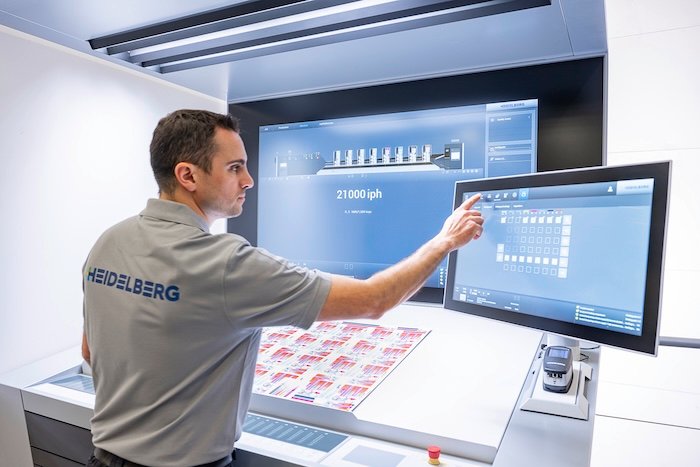
If you own a Heidelberg offset press, you are already a Prinect owner. Prinect Print Center is the interface for controlling and monitoring your press. Its features speed up the makeready for a new print job, such as feeder settings, including compressor and air settings, and the double-sheet detector. Its Intellistart feature reads the prepress data generated by your computer to plate (CtP) output device for quicker ink settings. A set of three washup programs can be utilized, keeping in mind the next job to be taken on press. There is also a device assistant that helps connect tools such as a spectrophotometer for color management and standardization.
Beyond the simplest Prinect console provided with each press, Heidelberg positions Prinect not merely as a press control software, but as a workflow software suite utilizing the digital backbone of a modern, hybrid print operation. According to Indukalpa Saikia, senior sales manager and product specialist, Heidelberg India, the philosophy behind Prinect is highlighted in its name. “Prinect derives from print and connect,” highlighting how the platform is designed to connect every stage of print production into one cohesive, data-driven ecosystem.

As a single, end-to-end platform, the Prinect suite of software tools integrates prepress, offset, and digital presses, postpress operations, quality and colour management, and even MIS or ERP systems. “Prinect is not only a standalone tool; it can be a single workflow platform that connects prepress, press, postpress, quality, colour management, and business systems,” Saikia notes.
Addressing the challenges in commercial and packaging printing
The pressures faced by commercial and packaging printers today are multifaceted. Shorter runs, frequent design changes, versioning, and an explosion of SKUs require high levels of efficiency. Manual intervention not only slows production but also increases the risk of errors. Because Prinect uses a single data source across departments, the need for re-keying information is eliminated, reducing delays and inconsistencies in the production workflow.
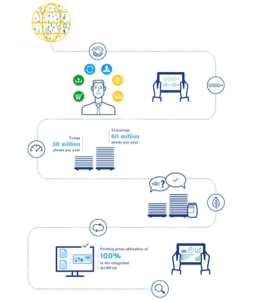 Prinect addresses these challenges by automating job setup and reducing human touchpoints. “With Prinect automation, it becomes much easier to handle frequent job changes in production,” Saikia explains. For brand-driven packaging, color management is critical. “Brand owners demand exact color consistency,” Saikia says. Prinect’s built-in color management capabilities allow printers to create device-independent profiles for offset presses, digital presses, and proofers without relying on third-party systems. This ensures repeatability and accuracy across substrates and technologies.
Disconnected systems can also hinder long-term growth. Prinect overcomes this by connecting presses and prepress systems for continuous data collection and performance analysis, providing actionable insights into where improvements are needed.
Enabling the Smart Print Shop
According to Saikia, Prinect practically enables the ‘Smart Print Shop’ concept on a day-to-day operational level by acting as a central, integrated workflow platform that automates and connects processes from customer interaction to production analytics. This integration significantly reduces manual touchpoints, increases automation, and provides data for continuous optimization.
Prinect integrates every process seamlessly from ERP to post-press. It helps in job automation, not only in pre-press but also in the press, from planning to scheduling. It supports hybrid printing in real terms as it can connect to CtP, inkjet proofer, toner-based digital press or an offset press. The Heidelberg Gallus flexo, digital, and hybrid label presses also use the Prinect workflow platform.
Customer interaction is also streamlined through web-based portals that enable online job submission, soft-proofing, approvals, and corrections. According to Saikia, the Prinect Customer Portal is “An all-in-one digital portal that provides easy access to production and workflow apps, analytics, service and maintenance, shopping, and administration tools from anywhere, anytime.” He adds that on the management side, performance monitoring and OEE benchmarking shift decision-making from intuition to data. “This shifts decision-making from intuition to facts.”