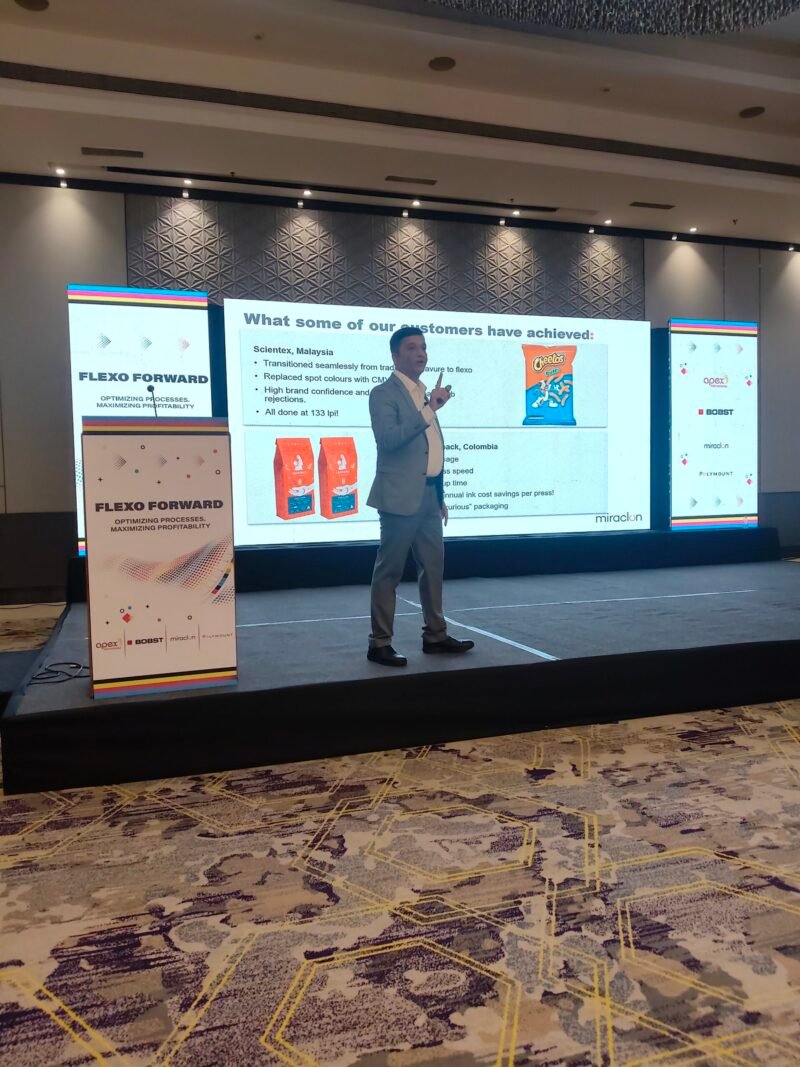
At the Flexo Forward Conference in Ahmedabad on 5 June, Miraclon outlined its vision for “modern flexo,” arguing that the future of flexographic printing lies not in adding complexity but in simplifying processes to achieve predictable, repeatable and sustainable results. The event was jointly organized by Apex International, Miraclon, Bobst and Polymount.
Presenting on behalf of Miraclon, Hrishikesh Kulkarni, regional sales manager for West and South India and Sri Lanka, said the flexographic printing industry continues to struggle with operational complexity despite significant advances in presses, inks, plates and mounting technologies. He noted that many converters still rely heavily on operator experience and on-the-spot troubleshooting rather than standardized production systems.

Kulkarni argued that excessive variables in ink systems, anilox configurations, tapes and plate combinations often create inconsistencies that lead to hidden costs, longer setup times and reduced profitability. According to him, even small press adjustments can create downstream variations that affect print quality and efficiency.
Miraclon’s strategy centers on simplifying the flexo workflow through standardization. The company advocates moving from operator-dependent production to data-driven processes where jobs are produced using defined parameters and predictable outcomes. Kulkarni described consistency and repeatability as the foundation of modern flexo, with sustainability and efficiency emerging as natural outcomes rather than standalone objectives.
A key part of the presentation focused on Miraclon’s Flexcel NX plate technology. The company highlighted its proprietary SquareSpot imaging technology, which it said enables higher imaging precision and more consistent plate production. Miraclon discussed its flat-top dot technology and customized surface patterning, designed to optimize ink transfer in accordance with anilox specifications and ink rheology. These developments are intended to reduce dot gain, improve contrast, enhance tonal reproduction, and minimize press-cleaning requirements.
The company emphasized that plate consistency is critical because plates are the only component that changes with every job. Standardizing plate performance allows converters to establish stable operating parameters and shorten the time required to achieve color on press.
Miraclon promoted expanded color gamut (ECG) printing as part of its broader modern flexo strategy, while stressing that successful ECG implementation depends first on establishing a stable and standardized CMYK process. The company said converters should focus on process control and predictable output before expanding into more advanced color management techniques.
To demonstrate the benefits of the approach, Miraclon showcased several case studies from its global ‘Wall of Champions’ program, featuring converters that have adopted modern flexo practices. Among the examples highlighted was an Indian project involving UFlex, where a packaging application was reportedly converted from gravure to water-based flexo printing on a recyclable film structure. According to the presentation, the project delivered sustainability benefits through lower ink and substrate consumption while maintaining production speeds comparable to gravure.
Another example cited was a Sri Lankan converter that has largely eliminated spot colors by using ECG workflows, reducing color complexity across hundreds of production jobs.
Kulkarni concluded that the industry’s next stage of development will be driven less by incremental hardware improvements and more by process simplification, standardization and the ability to predict print performance before a job reaches the press.