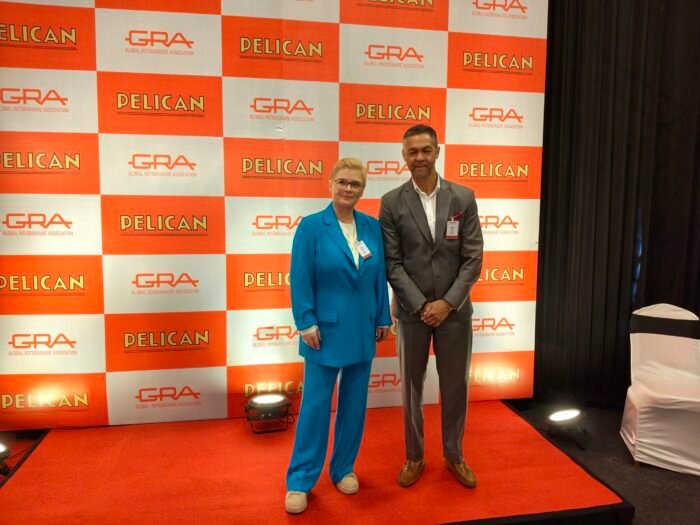
The Global Rotogravure Association (GRA) is looking to strengthen its engagement with emerging markets as part of its global expansion strategy, identifying India as one of the key regions for growth, GRA president Simon Sonn said during the GRA Talks Factory program held at Pelican Rotoflex’s facility in Rajkot in February 2026.
Sonn said the association’s recent transition from the European Rotogravure Association to a global body reflects its intent to work more closely with fast-growing packaging and printing markets.

“Since the transition from the European Rotogravure Association to the Global Rotogravure Association, the main objective has been to identify markets where we see the biggest impact and the biggest growth,” Sonn said. “Within those markets, we also look for companies that are forward-thinking in terms of expansion. Pelican was a perfect fit for us.”
The Rajkot event marked the first GRA Talks Factory held outside Europe, highlighting the association’s push to expand its presence in Asia, Africa, and other emerging regions.
Sonn said India’s rotogravure sector is expected to continue growing over the next decade, supported by the country’s expanding population and consumer markets.
“I think the gravure market will grow,” he said. “Whether it is going to grow by taking market share away from flexo is not really the key factor. The economy is expanding and the population is growing, so these are markets that will support both technologies.”
Rotogravure technology will continue to grow in India
According to Sonn, large consumer markets with younger populations often generate longer print runs, which favor rotogravure technology. As a result, he expects rotogravure to remain a strong segment in India even as central impression (CI) flexo continues to gain ground.
“I do see rotogravure continuing to grow in India over the next five to ten years, with space for both technologies to exist,” he said.
Sonn highlighted the advantages Indian companies would gain on joining the GRA, noting that membership offers access to global technical expertise, industry discussions, and networking opportunities.
“We are often asked about the membership benefits,” he said. “The best way to understand that is to attend one of our events. The Talks Factory at Pelican is almost the size of our annual conference, which gives participants a small taste of the kind of technical presentations and discussions we host.”
He said GRA events and membership platforms allow companies to engage with international experts on issues such as sustainability, press efficiency, cylinder life, cost reduction, and industry standardization.
“It is not only about what members get from us,” Sonn said. “It is also about what other markets can learn from India because we are seeing a lot of cutting-edge developments here.”
The Talks Factory format will be central to the association’s outreach efforts. Sonn said the initiative is designed to create smaller, more frequent technical gatherings around the world rather than relying only on an annual conference.
“The Talks Factory is a wonderful initiative,” he said. “It brings people together from different markets and allows us to exchange knowledge without waiting for the annual conference. The plan is to hold one every quarter and increasingly in locations outside Europe.”
The next Talks Factory is expected to take place in South Africa, reflecting the association’s interest in engaging with emerging regions such as Africa, where long-term population growth is expected to drive packaging demand.
During his visit to India, Sonn attended the PlastIndia exhibition in Delhi, which he described as an eye-opening experience in terms of the scale and energy of the country’s manufacturing sector.
“When I think of the Indian market, the word that comes to mind is scale,” he said. “Everything is big, there is a lot of activity, and the environment is very open and friendly.”
He said the collaborative spirit among exhibitors and visitors at the exhibition stood out.
“At PlastIndia, you could sit down and have a cup of tea with someone even if you might never do business with them,” Sonn said. “That kind of openness and interconnected community is good for everyone.”
Reflecting on his first visit to India, Sonn said the experience reinforced the importance of building stronger connections with the country’s printing and packaging industry.
“I have always heard about the growth in India, but spending a few days here has been invaluable,” he said. “The more we come to India, the more we will understand the market and the opportunities.”
Sonn confirmed that the GRA plans to organize another Talks Factory in India in the future as it continues to expand its global engagement.
“India is one of our key markets where we want to grow membership and participation,” he said. “We will definitely hold another Talks Factory here, whether it is in a year or two years’ time.”