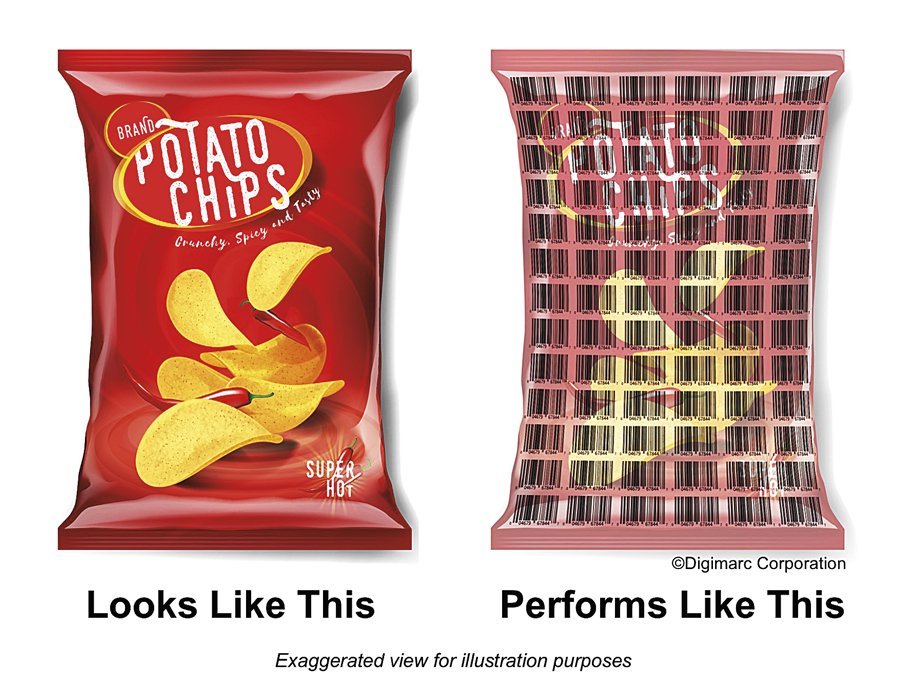
Mondelēz International, PepsiCo and pladis are taking part in a Belgium-wide trial to test whether invisible digital watermarks could help address one of the biggest practical barriers to circular food packaging: identifying and sorting flexible packaging accurately enough to support food-grade recycling.
The trial will assess how digital watermarking performs on wrappers, films and other plastic food packaging collected through Belgium’s household recycling system. By helping sorting systems recognize whether packaging once held food, the technology could support more targeted recycling streams and provide evidence on what would be needed to scale this approach.

The project brings together leading brands, technology providers, converters, sorting partners, recycling stakeholders and research institutes to test the technology in real-world conditions.
Liz Morrish, operations director of the Ceflex Leadership Team, said, “Food-contact recycled content is where the industry has some of the biggest challenges and the least time. This trial moves testing from evidence-gathering into commercial reality, which is exactly what bridging the gap between ambition and the 2030 targets requires.”
What is a digital watermark?
A digital watermark is an imperceptible code added across the surface of packaging in the printing process. For this trial, Digimarc watermarks are read by specialist sorting equipment, helping identify packaging characteristics such as material type and whether the pack was used for food. This is already paramount for food-grade recycling with mechanical processes.
The pilot is part of HolyGrail 2030 – Circular Packaging Consortium, facilitated by AIM – European Brands Association, which brings together around 79 local, European and global companies and organizations to explore intelligent sorting and new recycling technologies.
The Belgian sorting trials are led by Fost Plus, the organization that ensures the recycling and reuse of packaging waste in Belgium. Sorted bales of film are sent from Belgium to Hündgen Entsorgungs’ sorting centre in Germany, where high-resolution cameras supplied by machine vendor Pellenc ST read the digital watermarks. It is the first national-scale trial in Europe involving flexible post-consumer packaging collected through Belgium’s household recycling system.
Why this matters
Flexible food packaging remains challenging to recycle into high-quality, food-grade applications, which must meet strict quality and safety requirements. Accurate identification and sorting can be an important part of the process, alongside appropriate recycling and decontamination technologies.
The trial comes as the new European Packaging and Packaging Waste Regulation introduces recycled content requirements for certain categories of plastic food packaging beginning in 2030, including a 10% minimum recycled content requirement for some contact-sensitive packaging applications. This highlights the need for practical solutions that can work across real-world collection, sorting and recycling systems.
Dominika Maruszak-Dankbaar, senior Packaging Sustainability manager of Global Foods R&D at PepsiCo, said, “Flexible plastic packaging remains one of the more complex areas of packaging circularity, and progress will require collaboration across the entire value chain. Through HolyGrail 2030, PepsiCo is working alongside partners to explore how digital watermarking could support more effective sorting and help generate the real-world insights needed to evaluate pathways towards more circular packaging systems. Initiatives like this are important because no single company can drive this kind of system change alone.”
Richard Akkermans, European R&D Packaging Productivity and Sustainability manager at Mondelēz International, added, “HolyGrail 2030 is a pivotal, cross-industry initiative for better sorting and recycling of flexible packaging in the EU. Achieving circularity for food-contact flexible plastics isn’t just an ambition, it’s a necessity. In order to be ready for the ambitious recycled content targets in the upcoming EU Packaging and Packaging Waste Regulation, this market demonstration aims to provide the real-life technical learning that the value chain needs in order to increase the availability, compatibility and affordability of recycled plastic coming from new technologies.”