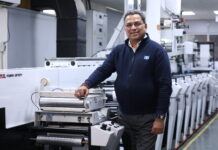
In mid-April, Delhi-headquartered Flexo Image Graphics announced the initial sale of five DCN ATN shrink sleeve converting machines to Zircon Technologies for its plant in Dehradun. Based just west of Paris, the 70-year-old DCN ATN appointed FIG in 2024 as its authorized distributor for India. During his recent visit to the country, the company’s Area Sales manager, Jason Elvery, stated, “It’s a big plus point for us to have the extremely customer-focused FIG organization as our distribution partner in India.”
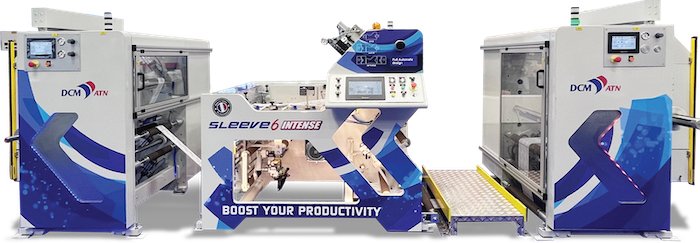
The five DCN ATN converting equipment installed by Zircon comprises a Sleeve 6 Intense, a fully automatic sleeve seamer, two Sleevecut units for perforation and cutting, a Babycat device for quality control of seaming strength and doctoring, and a Serval slitter rewinder for film, paper, and foil. Zircon’s director, Sanjeev Sondhi, says the DCM machines are robust, reliable, easy to use, precise, and guaranteed for three years. And the main differentiator is the high level of automation.”
Elvery explained that the DCM machines enhance automation, reduce waste, and improve throughput, especially in environments with a high number of SKUs and short runs. “Our fully-automated Sleeve 6 Intense ensures very low waste while setting up and zero waste during production due to its inline quality assurance. Although many customers assume that fully automated machines are not for short-run jobs, this is not the case, as the amount saved by the automated reduction of waste quickly justifies the ROI of the machines. Customers engaging only in short-run jobs choose our Sleeve 6 Evo with single unwinder and single rewinder, which is a modular machine that can be upgraded with a non-stop rewinder, and potentially even a non-stop unwinder, as the business grows.”
FIG’s managing director Gourav Roy says that while many customers tend to purchase low-cost seamers, these end up leading to huge waste in setup, together with numerous defects in quality, such as weak seam strength, inaccurate seam positioning, layflat width, and reel slipping. “DCM ATN’s flagship machines, like the Sleeve 6, are highly sophisticated and designed with full automations and permanent inline quality assurance, which in turn produce the highest-quality sleeves in the most economical manner, with no requirement for a highly skilled operator.”
Producing high-quality shrink sleeves requires highly controlled solvent application, for which the Sleeve 6 automatically applies a constant volume at ramping up and slowing down speeds from 10 meters a minute to 500 meters a minute, without operator intervention. The solvent flow is automatically and continuously measured.
For precise positioning, which is critical for consumer safety, the solvent must be applied less than 0.1 mm from the edge of the film. The machine has an automated positioning of the applicator with a micro-edge guide. The finished sleeve must match the size of the container, which the Sleeve 6 delivers with a lay-flat width within a tolerance of +/- 0.15 mm. Ultrasonic measurement permanently records the width of the sleeve, and if needed, it triggers automatic adjustment of the forming table, so that the lay-lat width is consistently within tolerance.
To avoid the risk of finished rewind reels slipping, the machine’s automatic oscillation system can be fully adjusted to include an automatic lateral offset that enables the finished rewind reels to be balanced without risk of slipping, even in cases where the seaming is very close to the fold. The DCM sleeve machines are compatible with diverse materials such as PET, PVC, OPS, PLA, and polyolefin. The film and inks used must be suitable for shrink sleeves. The inks can be solvent, water-based, or UV-curable for application across flexo, rotogravure, digital, and screen technologies.
The Sleeve 6 can run at 500 meters a minute, even for traditionally difficult work such as very thin and extra large sleeves. With speeds much higher than competitors’, the Sleeve 6 Intense installed by Zircon is highly configured with inline quality assurance and options including perforation, hot-melt, and pinhole microperforation, as well as non-stop unwinder and rewinders consuming just 20 meters of waste when switching from one sleeve to another.
As Elvery says, “Indian converters, as in other countries, do not all have the same profile. There are many producing very long-run jobs with rotogravure, while others print shorter-run work with digital and flexo machines. Important for those into short-run jobs is to have minimum waste, which the Sleeve 6 fully automatic machine ensures.”
He adds that DCM ATM customers who run both its Sleeve 6 and other equipment, apparently say, “Around 40,000-50,000 Euros in wastage is saved annually using the DCM machine.” Indian customers have visited the DCM ATN factory in France for test runs of the Sleeve 6. Customers are fully convinced on the basis of these visits to invest in DCM machines, according to Elvery.
Regarding the ROI which converters expect from the investments in DCM ATN machines, Elvery states, “Many of our customers across the globe who run both the SLEEVE 6 and other machines say around. While every DCM machine is designed to be extremely reliable and user-friendly, and we provide our customers full training and production support in the post-installation of all machines, it’s still important for customers to also have great local support. With FIG as our Indian partner, our customers get the best after-sales service unconditionally.”
In addition to DCM ATN, FIG is the Indian representative of Mark Andy, Rhyguan, Luster, IUV, Rotoflex, Kluge, KDS Quantum, and Presstek. With its head office in Delhi, FIG has branches in Mumbai and Chennai, with a centralized customer support department.
This is an edited article based on a press release from FIG.