India’s die-cutter and folder-gluer market is showing a clear shift toward automated, higher-capability finishing equipment, with converters investing not only to add capacity but also to handle more complex carton structures, reduce dependence on skilled labor and bring greater consistency to production. Space and energy are also a consideration, and converters prefer fewer but faster machines on the production floor.
Puneet Agarwal of DGM India said his company installed 45 machines, mainly folder gluers and diecutters, in the previous financial year, with bookings of around 50. It expects installations to cross the 50-mark in the current financial year. For DGM, this was part of a broader investment cycle, according to him.

The company has reported increasing demand for 4- and 6-corner cartons and specialized folder-gluer configurations. “More and more complicated cartons are coming into the market. People don’t want just a simple machine. They want a machine capable of doing everything,” Agarwal said.
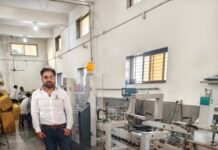
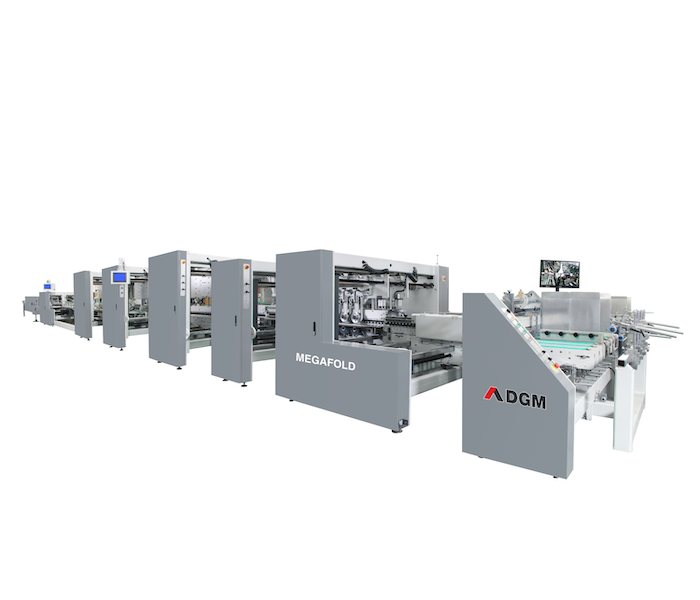
The demand for flexibility is visible in actual converter investments. Uttarakhand-based Meghdoot Packaging, which had already been using DGM’s TechnoFold series for four years, opted for the 1650-size MegaFold for 3- and 5-ply corrugated work. The machine is fully servo-driven, with independently operated units, and is designed for straight-line, lock-bottom and four- and six-corner cartons.
The investment is not confined to larger corrugated operations. Agra-based Shree Devi Packaging added a DGM Technocut 1050 automatic die-cutter to an existing fleet of manual die-cutters. According to proprietor Pramendra Sharma, the machine reduced production time to one-fourth. The company is now planning a 5-ply automatic die-cutter and has indicated plans to add a DGM folder-gluer.
At Perfect Packers, another Agra converter, a Technocut 1050S was added to an existing fleet of 11 manual die-cutters. The company produces around 1.25 lakh inner corrugated shoe boxes and 5,000 outer boxes a day. Its customers include footwear brands in India and overseas. Director Vikas Mahajan said the company was highly satisfied with the DGM machine and described it as a growth supplement. With around 300 employees, the company also sees automation as a response to the difficulty of finding trained manpower.
Folder-gluer investment, meanwhile, is increasingly being linked directly to the ability to accept more difficult work. At Mumbai-based converter Ashok Offset Printers, a DGM SmartFold 1100SL was installed in April 2023 specifically to address a finishing bottleneck. Corrugated outers account for around 60-70% of its output, and the machine produces approximately 30,000-40,000 cartons a day depending on flute and job complexity.
“For us, pasting was always the biggest struggle,” said director Nilesh Ahuja. “Printing can be outsourced, die cutting can be managed, but corrugated side-pasting, lock-bottoms, and large cartons were extremely difficult to get done reliably outside.”
The result has been more consistent output and lower rejection, while the company says the ability to handle larger and more complex jobs has supported its expansion. “Most printers don’t want to touch these jobs,” Ahuja said. “With SmartFold, this has become our strength.”
Excellent year for Bobst India
Bobst’s experience points to a similar demand pattern. The company reported its highest-ever folder-gluer sales in India in 2025, with folding carton having an “excellent year, especially for folder gluers,” according to Venugopal Menon. Bobst launched the SP 106 EVO die-cutter in India in January 2026 for new and mid-segment converters and reported that two machines had already been sold.
There is also evidence that the market is becoming more segmented. Bobst says its strategy is to offer three levels of technology, entry, medium-to-high and master, reflecting the diversity of Indian converters. Its Pune operations are simultaneously being expanded for manufacturing, engineering, software and services, as currency movements and higher interest costs make imported European equipment more difficult to justify in some cases.
That localization is being accompanied by a stronger service infrastructure. Bobst says it has more than 2,100 machines across its India Zone, including more than 1,350 folding-carton machines and 82 corrugated-board machines. Its field-service engineer strength has grown by 30% over the past one-and-a-half years. As machines become more automated, converters increasingly need reliable commissioning, process support, remote diagnostics and quick intervention to protect uptime.
For OEMs, the technology conversation is therefore moving beyond headline speeds. Koenig & Bauer’s CutPRO 2.1, for instance, is being developed around net output and the reduction of micro-stops, with a maximum sheet size of 1,300 x 2,100 mm and speeds of up to 7,000 sheets per hour. Its redesigned interface and AI-supported production-data functions also address the shortage of skilled operators.
Taken together, the installations point to a market where finishing is becoming a more deliberate part of capacity planning. Die-cutters are being bought for higher productivity, waste handling and complex shapes, while folder-gluers are increasingly expected to handle heavier boards, larger formats and more complicated carton constructions. The next phase of investment appears less about simply adding another machine and more about removing the bottleneck that limits the converter’s ability to take on the next level of work, profitably.