Kumar Labels merged its Spirited Labels plants in Goa and Indore, which were started in 2020 and 2022, with its main Greater Noida plant in 2025. A new four-floor building covers 55,000 square feet next to the older building in Greater Noida. The label converter brought in all the machinery and processes from the three units to its new building last year. From our discussions with founder Anuj Bhargav, he is generally grappling with how to scale label manufacture in India without eroding value and it seems that the latest internal restructuring or regrouping indicates, that for him, in the current situation, the sum is greater than the parts.
The company’s new ERP (Enterprise Resource Planning) software has been developed with a design unique to its requirements. “Our biggest concern was having better systems, controls on stores, dispatches and more automation. With all in one place, we were able to upgrade our ERP, and we now have much better control on our procurement systems, store systems, and warehousing. Similarly, on the dispatch side, we have much better control over our stock and finished goods. Also better tracking of materials and control on wastage.
“With consolidation, we have been able to build better systems,” Bhargava told Packaging South Asia, even as a new NBG adhesive coating line for its label stock production was being installed at the new building. The new label stock production line, designed by Bhargava, is 5 to 6 times faster than the company’s previous line. It is designed for higher-quality labelstocks while consuming less energy.
During our visit, solar panels were being placed on the roofs of both the old and new buildings. “With these, we should have about 38% of our consumption from solar energy. These improvements and benefits are a sort of launch pad that will allow us to scale further. We are now better equipped to run a remote facility than our earlier setup,” he added.
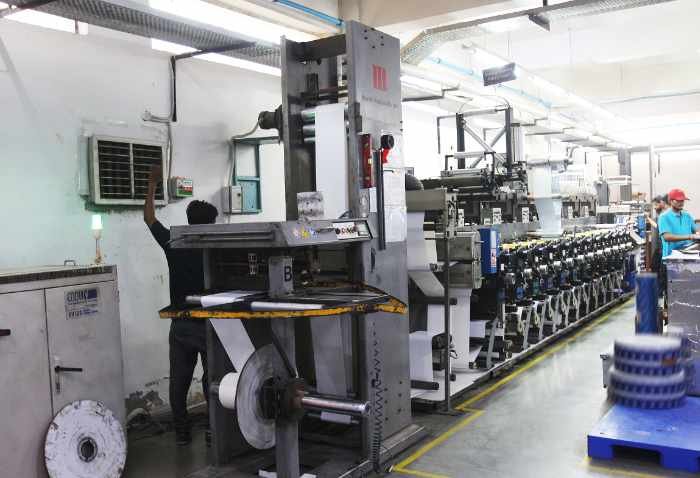
In the past year, Spirited Labels added three NBG flexo presses. The consolidated plant contains nine flexo presses, three letter presses, and seven screen lines. This year, the company is planning to enter digital printing and premium label categories with added innovations, to utilize the excess production capacity of 6 to 8 lakh square meters created by the streamlined production efficiencies. “Business development is obviously now a high priority for us,” says Bhargava.
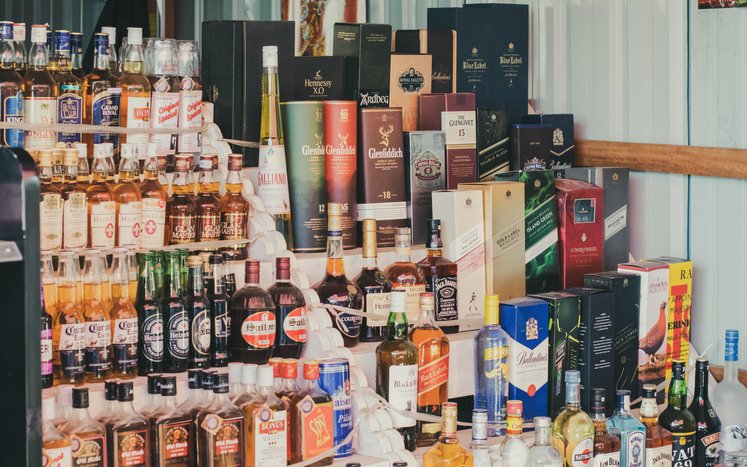
The company’s name was changed to Spirited Labels in 2020 as it produces all types of labels for the spirits industry. “We opted for specialization in the spirits industry because spirits and liquor cannot be advertised and cannot reach the market through other media. Hence, sales depend on how beautiful your label looks, how it stands out on the shelf. Brand owners are willing to accept new ideas from us, to work with newer, better embellishments, which we are equipped to execute with finesse.”
The company produces labels for all the leading Indian and global spirits companies. Its label exports account for roughly 8% of its revenue. Exports are expected to grow to 30% by the end of this financial year, Bhargava pointed out. At the same time, the company also wants to renew its focus on FMCG labels.
Lowering the carbon footprint of label manufacturing
According to Bhargava, Spirited Labels has five differentiators – “Our first differentiator very clearly is embellishment. We do some very premium embellishments. Our second differentiator is that we are backward integrated. We produce all label stocks in-house, which allows us to offer innovative materials and specially engineered materials at a very good price. Third, we have many sustainable ideas for labeling, such as a completely new technology, with the potential to disrupt how pressure-sensitive adhesive labels are produced today. Fourthly, with our equipment manufacturing experience, we are able to scale up at less cost and investment, which keeps our balance sheet healthy. Fifth, I think the most important thing is that we follow our values to the core, to the heart, to every action. Our values are integrity, reliability, resilience, results, and innovation. We call them two I’s and three R’s. It’s a clean, nice, absolutely clean business method.”
On the company’s multi-pronged and practical sustainability in operations, Bhargava explained, “We are the only Indian label printing company that is 100% using LED UV for curing. None of our printing lines uses conventional UVs. Hence, our power consumption is already at about 50% of most others. Our power consumption per square meter of label is the lowest in the country today. With our upcoming solar unit, it would further reduce by about 30% or so. We were the first ones in India and perhaps outside as well to use rPET as a liner. We also have a patented technology called SRTF, which uses 50% less liner, and the latest technology that we are working on now is disruptive and cost-effective. It can make labels highly sustainable in comparison to what they are today.”
Challenges to scale & the one country, one factory strategy
Bhargava says that, like every industry, the label industry has its own set of challenges. These include the availability of trained resources, the people costs, and hyper-competition in pricing. “Raw material prices went up because of the ongoing US-Israeli war on Iran, but I think customers have been very understanding in this situation. They have supported us with price rises,” he said.
“We are more ready now to set up a factory anywhere in the world,” Bhargava said, adding that our controls are better and we are not sure if we want another unit within the country. Probably one country, one factory is going to be our strategy for some more time.”
With a current production capacity of 24 million square meters annually of finished labels, Sprited employs 200 people, including both full-time and contractual employees. Speaking about the geographical and logistical advantages that Greater Noida provides, Bhargava says, “I think it’s a very well-connected place, a logistics hub, especially with the new Jewar Airport taking off. It is well connected to the Noida-Agra Expressway, which connects to the road to Lucknow, and further up to Gorakhpur, and still further to Nepal. The new Eastern Peripheral Expressway is excellent, with several new industrial areas coming up. Strategically located, this is a fantastic and well-connected place to operate from.”